Q.1.
A wire is cut into 4 pieces, which are put together side by side to obtain one conductor. If the original resistance of the wire was R, the resistance of the bundle will be
-
20%
a) R/4
-
0%
b) R/8
-
60%
c)R/16
-
20%
d)R/32
Q.2.
For ohmic conductor the drift velocity vd and the electric field applied across it are related as
-
0%
a) vd ∝ √E
-
60%
b) vd ∝ E
-
20%
c)vd ∝ E3/2
-
20%
d)vd ∝ E2
Q.3.
When piece of aluminum wire of finite length is drawn through a series of die to reduce its diameter to half its original value, its resistance will become
-
17%
a) two times
-
50%
b) four times
-
0%
c) eight times
-
33%
d) sixteen times
Q.4.
The unit of electrical conductivity is
-
20%
a)ohm/metre
-
20%
b) ohm × metre
-
20%
c)1/ (ohm × metre)
-
40%
d)mho×metre
Q.5.
The resistance of a wire at temperature t°C and 0°C are related as
-
40%
a) Rt=Ro [ 1+ αt]
-
0%
b) Rt=Ro [ 1 - αt]
-
60%
c)Rt=Ro2 [1 + αt]
-
0%
d)Rt=Ro2 [1 - αt]
Q.6.
The resistance of straight conductor does not depend upon its
-
67%
a) shape of cross-section
-
17%
b) temperature
-
0%
c)material
-
17%
d)length
Q.7.
the specific resistance of all metals is most affected by
-
67%
a) temperature
-
0%
b) pressure
-
0%
c) degree of illumination
-
33%
d) applied magnetic field
Q.8.
The belt of an electrostatic generator is 50 cm wide and travels at 30 m/sec. the belt carries charge into the sphere at a rate corresponding to 10-4 ampere. What is the surface density of charge on the belt?
-
20%
a)6.7×10⁻⁵ C/m2
-
40%
b) 6.7×10⁻⁶ C/m2
-
20%
c)6.7×10⁻⁷ C/m2
-
20%
d)6.7×10⁻⁸ C/m2
Q.9.
Through a metallic conductor an electric current is due to drift of
-
20%
a) free electrons
-
40%
b) positive and negative ions
-
0%
c)free electrons and holes
-
40%
d)protons
Q.10.
When there is an electric current through conducting wire along its length, then an electric field must exist
-
60%
a) outside the wire but normal to it
-
20%
b) outside the wire but parallel to it
-
20%
c)inside the wire but parallel to it
-
0%
d)inside the wire but normal to it
Q.11.
Which of the following characteristics of electrons determines the current in a conductor
-
20%
a) drift velocity alone
-
20%
b) thermal velocity alone
-
60%
c) both drift velocity and thermally velocity
-
0%
d) neither drift nor thermal velocity
Q.12.
through a semi-conductor, an electric current is due to drift of
-
80%
b) free electrons and holes
-
0%
c)positive and negative ions
-
0%
d)protons
-
20%
a)free electrons
Q.13.
Two copper wires have their masses in the ratio 8:They have their lengths in the ratio 3:Their resistance's are in the ratio of
-
20%
a) 4:9
-
40%
b) 16:9
-
40%
c)27:32
-
0%
d)27:128
Q.14.
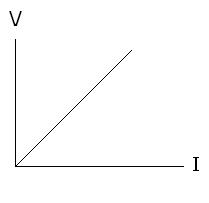
The current-voltage variation for a wire of copper of length L and area A is shown in the figure. The slope of the line will be
-
20%
a) less if the experiment is done at higher temperature
-
40%
b) more if a wire of silver of same dimensions is used
-
40%
c) will be doubled if the length of the wire is doubled
-
0%
d) will be halved if the length is doubled
Q.15.
The dimensions of a manganin ( ρ=4.4×10⁻⁷ ohm ×m) block are 1cm ×1 cm ×100 cm. The resistance between the opposite rectangular faces is
-
60%
a)4.4 ×10⁻⁷ ohm
-
0%
b) 4.4 ×10⁻³ ohm
-
0%
c)4.4 ×10⁻⁵ ohm
-
40%
d)4.4 ×10⁻¹ ohm
Q.16.
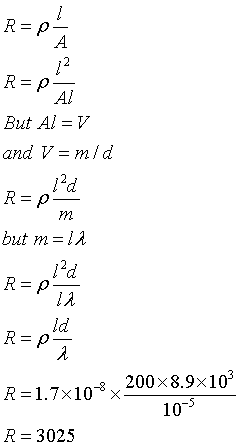
A copper wire ( specific resistance 1.7×10⁻⁸ Ωm) has a mass per unit length of 10-7 kg/cm. What is the resistance of a wire 200 m length? ( Density of copper=8.9×10³ kg/m3)
-
50%
a) 3 KΩ approx
-
50%
b) 0.3 mΩ approx
-
0%
c)30mΩ approx
-
0%
d)0.3Ω approx
Explanation
Q.17.
A steady current is passing through a linear conductor of non-uniform cross-section. The current density in the conductor is
-
25%
a) independent of area of cross section
-
0%
b) directly proportional to area of cross section
-
25%
c)inversely proportional to area of cross section
-
50%
d)inversely proportional to square root of area of cross section
Q.18.
If a copper wire is stretched to make its radius decrease by 0.1%, then the percentage in increase in resistance is approximately
-
50%
a) 0.1 %
-
17%
b) 0.2%
-
17%
c) 0.4%
-
17%
d) 0.8%
Q.19.
The resistance of wire of length L and diameter D is RΩ. The wire is stretched to reduce its diameter to one third. The resistance of the wire will now be
-
50%
a)R/9
-
0%
b) 9R
-
25%
c)R/81
-
25%
d)81R
Q.20.
Two wires of equal length and of material x and y have same resistance. The ratio of the radii of the two wire is 1:The ratio of the specific resistance of the two material is
-
50%
a) 1:1
-
0%
b) 1:2
-
25%
c)1:4
-
25%
d)4:1
Q.21.
Two wires of same material are given. The first wire is twice as long as the second and has twice the diameter of the second. The resistance of the first will be
-
0%
a) Twice of the second
-
50%
b) half of the second
-
50%
c)equal to the second
-
0%
d)four times of the second
Q.22.
A copper wire and aluminum wire of same length have same resistance. Specific resistance of aluminum is more than that of copper. Which of the following statement is correct
-
0%
a) Mass of copper and aluminum wire is same
-
0%
b) Mass of copper wire is more than that of aluminum wire
-
0%
c) Mass of copper wire is less than that of aluminum wire
-
100%
d) Nothing can be said about the relative mass of the two wires as information given is incomplete
Q.23.
A steady current is passing through linear conductor of non-uniform cross-section. The current in the conductor is
-
20%
a)independent of area of cross section
-
40%
b) directly proportional to length of conductor
-
20%
c)directly proportional to the area of cross-section
-
20%
d)inversely proportional to the length of the conductor
Q.24.
The quantity in electricity analogues to friction in linear mechanical motion is
-
75%
a) resistance
-
0%
b) potential
-
0%
c)charge
-
25%
d)induction
Q.25.
When current passes through a conductor a the heat produced due to
-
25%
a) fall of electrons from higher energy orbit to lower energy orbit
-
0%
b) Inter atomic collisions
-
0%
c)Inter electron collisions
-
75%
d)collision of electrons with atoms
Q.26.
The number of free electrons per unit volume in copper is n. the electrons, each of charge q are flowing systematically along the length of the wire with velocity v and constitute an electric current I. If the area of cross-section of the wire is A, the current density in the wire is
-
20%
a) nAq/v
-
20%
b) nq/v
-
20%
c) nAqv
-
40%
d) nqv
Q.27.
Two wires A and B are made of copper. Both wires are 1 metre long but wire A is 1mm thick and wire B is 2mm thick. The specific resistance is
-
17%
a)more for A
-
17%
b) more for B
-
50%
c)same for both A and B
-
17%
d)can not be compared
Q.28.
Through a wire of resistance 4Ω a charge of 12C is passing in 2 minutes. The potential difference across the wire is
-
25%
a) 0.4 V
-
25%
b) 1.5 V
-
25%
c)0.667V
-
25%
d)24 V
Q.29.
It is required to construct a coil having resistance of 35Ω from a wire 0.2mm diameter. If specific resistance of the material of wire is 1.10×10⁻⁶ ohm×metre, the length of the wire required is
-
25%
a) 2.2 m
-
25%
b) 1.0 m
-
50%
c) 49.0 m
-
0%
d) 3.5 m
Q.30.
The electric intensity E, Current density J and Specific resistance ρ are related to each other through the relation
-
25%
a) E = J ρ
-
25%
b) E = Jρ
-
25%
c) E = ρ/J
-
25%
d) ρ = JE