Q.1.
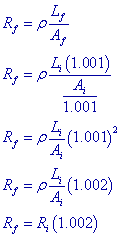
If copper wire is stretched to make it 0.1 % longer, the the percentage change in resistance is approximately
-
25%
a)0.1%
-
42%
b) 0.2%
-
33%
c)0.4%
-
0%
d)0.8%
Explanation
Q.2.
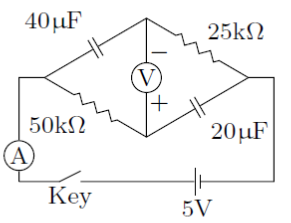
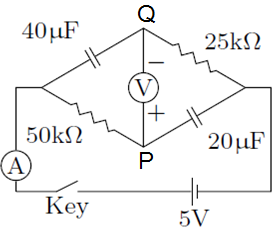
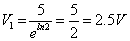
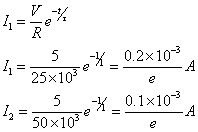
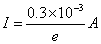
In the circuit shown below, the key is pressed at time t =Which of the following statement(s) is(are) true?
-
17%
a) The voltmeter displays - 5 V as soon as the key is pressed, and displays + 5 V after a long time
-
17%
b) The voltmeter will display 0 V at time t = ln 2 seconds
-
33%
c) The current in the ammeter becomes 1/e of the initial value after 1 second
-
33%
d) The current in the ammeter becomes zero after a long time
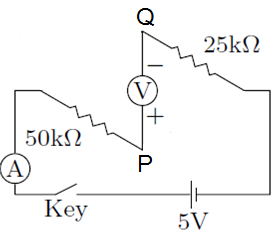
Explanation


Q.3.
When a potential difference V is applied across a conductor at temperature T, the drift velocity of electrons is proportional to
-
29%
a) √T
-
0%
b) V0
-
29%
c)√V
-
43%
d)V
Q.4.
You have three equal resistance's. How many different combinations can you have with these resistance's
-
0%
a) 2
-
29%
b) 3
-
29%
c) 4
-
43%
d) 6
Q.5.
All of the following statements are true, except:
-
29%
a)conductance is the reciprocal of resistance and is measured in sidemen
-
43%
b) Ohm's law is not applicable at very low and very high temperatures
-
29%
c)Ohm's law is applicable to semiconductors
-
0%
d)Ohm's law is not applicable to electron tubes, discharge tubes and electrolytes
Q.6.
The electric current in a discharge tube containing a gas is due to
-
29%
a) electrons only
-
0%
b) positive ions only
-
43%
c)negative ions and positive ions both
-
29%
d)electrons and positive ions both
Q.7.
The quantity in electricity analogous to temperature is
-
50%
a) resistance
-
38%
b) potential
-
12%
c)charge
-
0%
d)inductance
Q.8.
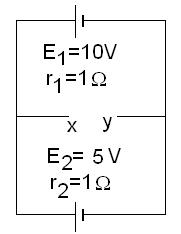
In figure potential difference between point x and y is
-
17%
a) 10 V
-
33%
b) 5 V
-
17%
c) 15 V
-
33%
d) 8.33 V
Q.9.
Two wire of same length and material have their cross-sections in the ratio of 1:The two wires are joined so that their ends fuse into one another without any other change. The ratio of the resistance of the fused wire and the wire of smaller cross-section is
-
17%
a) 1:3
-
50%
b) 1:4
-
17%
c) 1:2
-
17%
d) 4:1
Q.10.
(1) The product of a volt and coulomb is a Joule (2) The product of a volt and an ampere is Joule/sec (3) the product of volt and watt is horse power (4) watt-hour can be measured in terms of electron -volts
-
20%
a) all the four are correct
-
60%
b) (1) and (2) and (4) are correct
-
0%
c)(1) and (3) are correct
-
20%
d)(3( and (4) are correct
Q.11.
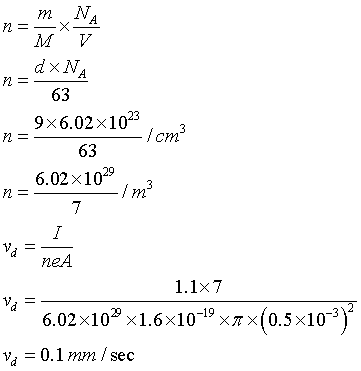
Assume that each atom of copper contributes one free electron. If the current flowing through a copper wire of 1mm diameter is 1.1 ampere, the drift velocity of electrons will be [ density of copper=9 gm/cm3 and atomic weight of copper=63]
-
0%
a) 0.3 mm/sec
-
50%
b) 0.1 mm/sec
-
50%
c) 0.5 mm/sec
-
0%
d) 0.2 mm/sec
Explanation
Q.12.
A beam of 16MeV deuterons ( charge=1.6×10⁻¹⁹ C) from a cyclotron falls on a copper block. The beam is equivalent to current of 15µA. At what rate do the deuterons strike the block?
-
60%
a)9.4 × 10¹³
-
0%
b) 9.4 × 10¹¹
-
40%
c)9.4 × 10⁹
-
0%
d)9.4 × 10⁷
Q.13.
Overloading of an electric circuit implies
-
0%
a) drawing of large current
-
0%
b) connecting high resistance device
-
75%
c)connecting a number of electric devices in series with the power supply
-
25%
d)none of the above
Q.14.
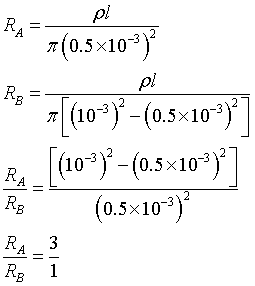
Two conductor are made of the same material and have same length. Conductor A is solid wire of diameter 1mm. Conductor B is hollow tube of outer diameter 2 mm and inner diameter 1mm. The ratio of resistance RA to RB
-
50%
a) 3:1
-
25%
b) 1:3
-
25%
c)1:1
-
0%
d)2:1
Explanation
Q.15.
The temperature of metal wire rises when an electric current passes through it because
-
25%
a) collision of conduction electrons with each other releases heat energy
-
75%
b) collision of conduction electrons with atoms of the metal gives them energy which appears as heat
-
0%
c) when the conduction electrons fall from higher energy level to a lower energy level, heat energy is released
-
0%
d) heat energy is released when the conduction electrons are separated from their parent atoms
Q.16.
Which of the following can be used to express energy? Symbols have usual meaning for the units of physical quantities (1) kWh (2) VC (3) VAs2 (4) A2Ωs2
-
25%
a)All of above
-
25%
b) (1), (2), (3)
-
25%
c)(3), (4)
-
25%
d)(1), (2)
Q.17.
A current I flows in a wire of circular cross-section with the free electrons travelling with a drift velocity v. What is the drift velocity of electrons when a current 2I flows in another wire of twice the radius and of the same material
-
25%
a) v / 4
-
25%
b) v / 2
-
50%
c)v
-
0%
d)2v
Q.18.
Two wires of same material have same length. Their resistance's are proportional to
-
20%
a) 1 / masses of the wires
-
60%
b) square of masses of the wires
-
0%
c)masses of the wires
-
20%
d)cube of masses of the wires
Q.19.
A steady current i passes through a linear conductor of uniform cross-section. Any given segment of the conductor has
-
25%
a) A net negative charge
-
0%
b) a net positive charge
-
75%
c) a zero net charge of any kind
-
0%
d) a net charge proportional to the volume of the segment
Q.20.
Increase in which property of free electrons causes increase in the resistance of a conductor with rise in temperature?
-
25%
a)number density
-
75%
b) relaxation times
-
0%
c)mass
-
0%
d)none of above
Q.21.
A steady current is set up in a metallic wire of non-uniform cross-section. How is the rate flow of electrons (R) related to the area of cross-section A?
-
25%
a) R is independent of A
-
0%
b) R ∝ A-1
-
75%
c)R ∝ A
-
0%
d)R ∝ A2
Q.22.
Two unequal resistor are connected in series with a cell. Which of the following statement is true?
-
20%
a) Potential drop across either resistor is same
-
20%
b) Potential drop across smaller resistor is more
-
60%
c)Potential drop across larger resistor is more
-
0%
d)Any one of the above can be true depends on the emf of the cell
Q.23.
A potential difference of 10V is applied across a conductance 4 S. The current in the conductor is
-
25%
a) 40 A
-
25%
b) 2.5 A
-
25%
c) 2.4 A
-
25%
d) none of the above
Q.24.
The resistivity of a material is inversely proportional to
-
75%
a)number density of electrons as well as relaxation time
-
0%
b) number density of electrons and directly proportional to relaxation time
-
25%
c)relaxation time and directly proportional to the number density of electrons
-
0%
d)neither relaxation time nor number density of electrons
Q.25.
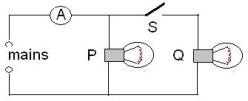
How will the reading in ammeter A affected if another identical bulb Q is connected in parallel to P as shown in figure . The voltage of the mains is maintained at a constant value
-
80%
a) the reading will be reduced to one half
-
0%
b) the reading will not affected
-
20%
c)the reading will be double of previous one
-
0%
d)the reading will be increased to four fold
Q.26.
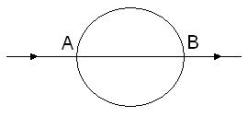
Wire of resistance 0.5 Ω/m is bent into a circle of radius 1 m. The same wire is connected across a diameter AB as shown in figure. The equivalent resistance is
-
0%
a)π ohm
-
50%
b)π/ (π+2) ohm
-
25%
c)π/ (π+ 4) ohm
-
25%
d)(π+1) ohm
Q.27.
A galvanometer together with an unknown resistance in series is connected across two identical cells each of 1.5V. When the batteries are connected in series, the galvanometer records a current of 1A and when the batteries are connected in parallel, the current is 0.6A. The internal resistance of the battery is
-
50%
a) 0.33 Ω
-
0%
b) 1 Ω
-
25%
c) 0.66Ω
-
25%
d) 0.5Ω
Q.28.
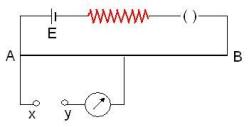
In figure point x and y represent the terminals of an unknown emf. On moving jockey J from A towards B it is observed that deflection of galvanometer remains in the same direction but increases. Which one of the following conclusions is correct
-
33%
a)the emf E is less than the unknown emf
-
0%
b) the emf E is more than the unknown emf
-
33%
c)the potential drop of potential across potentiometer wire is less than the unknown emf
-
33%
d)the unknown emf is wrongly connected
Q.29.
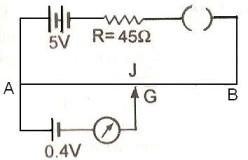
In figure the potentiometer wire AB has a resistance of 5Ω and length 10 m. The balancing length AJ for the emf of 0.4V is
-
0%
a) 8 m
-
100%
b) 0.8 m
-
0%
c)4 m
-
0%
d)0.4 m
Q.30.
Circuit whose resistance is R is connected to n similar cells. If the current in the circuit is the same whether the cells are connected in series or in parallel, then the internal resistance r of each cell is given by
-
0%
a) r=R/n
-
33%
b) r=nR
-
67%
c)r=R
-
0%
d)r=1/R