Q.1.
ion Q12) Match the following and choose the correct combination from the options given:
| Column I | Column II |
| a. Ptyalin | Lipids |
| b. Pepsin | Starch |
| c. Steapsin | DNA |
| d. Nucleases | Proteins |
-
0%
a) a →1 b→3, c→2, d→4
-
25%
b) a →1 b→4, c→3, d→2
-
75%
c) a →2 b→4, c→1, d→3
-
0%
d) a →2 b→3, c→1, d→4
Q.2.
ion Q13) Which one of the following statements about glycogen is correct:
-
67%
a) It is a disaccharide stored in liver and takes part in the formation of bile, lipase, besides being a source of energy.
-
33%
b) It is a monosaccharide synthesised in the liver and takes part in the formation of bile and lipases, besides being a source of energy
-
0%
c) It is a polysaccharide which is synthesised and stored in liver cells
-
0%
d) It is synthesised in blood and stored in liver cells and gastric glands to provide glucose in times of need.
Q.3.
ion Q14) The enzymes which are responsible for the digestion of starch in food of man is present in:
-
0%
a) The salivary and gastric secretions
-
50%
b) The salivary and pancreatic secretions.
-
50%
c) The gastric and pancreatic secretions.
-
0%
d) The gastric and duodenal secretions.
Q.4.
ion Q15) Read carefully the following statements: (i) Human liver is bilobed and weighs about 1.2 to 1.5kg. (ii) pH of gastric juice is 6.8 while the pH of saliva is 1. (iii) Saliva contains amylase, lysozyme and electrolytes. (iv) Each lobule of liver is guarded by sphincter of Oddi. (v) Digestion is initiated by ptyalin and it hydrolyses about 30% starch in oral cavity.
-
50%
a) Statements (ii) and (iv) are wrong
-
0%
b) Only statement (v) is wrong
-
50%
c) Statements (iii) and (v) are wrong
-
0%
d) Statements (ii) and (iii) are wrong.
Q.5.
ion Q16) Which of the following statement is incorrect:
-
0%
a) Parotid glands is the largest salivary gland which are situated near the ears
-
50%
b) Liver contains Kupffer cells which are phagocytic in nature
-
50%
c) Humans have three pairs of salivary glands – parotid, submaxillary and infraorital
-
0%
d) Bulk of the tooth in mammals is made up of dentine
Q.6.
ionMore than one correct answerr Q17) Which one of the following is true regarding the digestion and absorption of food in humans?
-
0%
a) Glucose and amino acids are absorbed through intestinal mucosa with the help of carrier ions like Na+
-
50%
b) Chylomicrons are small lipoprotein particles that are transported from intestine into lymph vessels.
-
0%
c) About 60% of the starch is hydrolysed by salivary amylase in mouth.
-
50%
d) Oxyntic cells in our stomach secrete the proenzyme pepsinogen.
Q.7.
ion Q18) Identify the correct matching of items given in the three columns:
| Column I | Column II | Column III |
| Chymotripsin | a. Trypsinogen | (i) Small peptides |
| Carboxypeptidase | b. Nucleoside | (ii) DNA + RNA |
| Nucleosidase | c. Nucleotide | (iii) Large peptides |
| Nucleotidase | d. Proteins | (iv) Amino acids |
| Enterokinase | e. Large peptides | (v) Sugar + base |
| - - - - | f. Starch | (vi) Trypsin |
| - - - - | - - - - | (vii) Nucleoside + Phosphates. |
-
0%
a) 1-d-(iii), 2-c-(vii), 3-b-(ii), 4-e-(vi), 5-a-(iv).
-
0%
b) 1-c-(iv), 2-f-(i), 3-a-(v), 4-(d)-(ii), 5-b-(vi).
-
100%
c) 1-d-(iii), 2-e-(i), 3-b-(v), 4-c-(vii), 5-a-(vi)
-
0%
d) 1-d-(iii), 2-e-(i), 3-f-(v), 4-c-(vii), 5-a-(vi).
Q.8.
ion Q19) Read the following sentences and choose the correct option: (i) The wall of alimentary canal from oesophagus to rectum has four layers namely Serosa, muscularis, sub-mucosa and mucosa. (ii) Serosa is the outermost layer and is made up of thin mesothelium with some connective tissue. (iii) Muscularis is formed by smooth muscles usually arranged into an inner circular muscle and an outer longitudinal muscle. (iv) The sub-mucosal layer is formed of dense connective tissue containing nerves, blood and lymph vessels. (v) In duodenum the glands are present in the sub mucosa. (vi) The innermost layer lining the lumen of alimentary canal is mucosa.
-
100%
a) All statements are true
-
0%
b) (ii) and (iii) are false.
-
0%
c) (iii), (iv) and (v) are false.
-
0%
d) (ii), (iv) and (v) are false.
Q.9.
ion Q20) Read the following statements regarding the digestive system and select the correct statement: Explanation is provided please clcik on
-
0%
a) Oesophagus passes through neck, thorax and diaphragm and opens into stomach.
-
0%
b) Stomach is located in the upper right portion of the abdominal cavity.
-
100%
c) Stomach, a J shaped organ is the longest organ of the alimentary canal
-
0%
d) Caecum, a small blind sac is a part of large intestine and host symbiotic bacteria
Q.10.
ion Q21) During the intake of food, what prevents the entry of food into the glottis?
-
0%
a) Glottis itself prevents the entry of food into the food pipe.
-
0%
b) Food entry is prevented by the air in the windpipe
-
0%
c) Food entry is prevented by the annular rings of the pharynx
-
100%
d) Food entry is prevented by epiglottis into the glottis
Q.11.
ion Q22) The sphincter that regulates the opening of oesophagus into the stomach;
-
0%
a) Pyloric sphincter
-
0%
b) Gastro-duodenal sphincter
-
0%
c) Cardiac sphincter.
-
100%
d) Sphincter of Oddi.
Q.12.
ion Q24) Which part of stomach contains the main gastric glands which secrete enzyme, HCl and mucous.
-
0%
a) Cardiac portion
-
0%
b) Fundus portion
-
100%
c) Pylorus portion
-
0%
d) Abomassum portion
Q.13.
ion Q25) How does autonomic nervous system affect the secretion of digestive juices:
-
0%
a) Both Parasympathetic and Sympathetic nervous system increases the secretion of digestive juices.
-
0%
b) Both Parasympathetic and Sympathetic nervous system decreases the secretion of digestive juices
-
100%
c) Sympathetic nervous system decreases the secretion of digestive juices while parasympathetic nervous system increases the secretion of digestive juices
-
0%
d) Parasympathetic nervous system decreases the secretion of digestive juices while Sympathetic nervous system increases the secretion of digestive juices
Q.14.
ion Q26) The enzyme called universal enzyme which is present in all organisms starting from Protozoans to mammals is:
-
0%
a) Trypsin
-
0%
b) Steapsin
-
0%
c) Rennin
-
100%
d) Pepsin
Q.15.
ion Q27) Choose the wrong statement:
-
0%
a) A Stenson’s duct arises from the parotid gland opening it into upper jaw and cheeks.
-
0%
b) A Wharton’s duct arises from Submaxillary gland opening it into lower jaw.
-
100%
c) A Duct of Rivinus/Bartholin’s duct arises from the sublingual gland and opens below tongue on the floor of buccopharyngeal cavity.
-
0%
d) Bacterial infection of parotid gland causes mumps.
Q.16.
ion Q28) The process of digestion proceeds in this order:
-
0%
a) Digestion → Ingestion → Sorption → Absorption → Egestion
-
0%
b) Ingestion → Digestion → Absorption → Assimilation → Egestion.
-
0%
c) Ingestion → Solution → Absorption → Assimilation → Egestion.
-
100%
d) Ingestion → Digestion → Assimilation → Absorption → Egestion.
Q.17.
ion Q29) Column I contains the name of the sphincter muscles of the alimentary canal and column II contains their locations. Match them properly and choose the correct answer:
| Column I | Column II |
| a. Sphincter of ani internus | Opening of hepatopancreatic duct into duodenum |
| b. Cardiac sphincter | Between duodenum and posterior stomach |
| c. Sphincter of Oddi. | Guarding the terminal part of alimentary canal. |
| d. Illeocaecal sphincter | Between oesophagus and anterior stomach |
| e. Pyloric sphincter | Between small intestine and large intestine |
-
0%
a) a →3 ,b →2 ,c →4 ,d →1 ,e →5
-
100%
b) a →2 ,b →5 ,c →1 ,d →4 ,e →3
-
0%
c) a →3 ,b →4 ,c →1 ,d →5 ,e →2
-
0%
d) a →4 ,b →3 ,c →1 ,d →2 ,e →5
Q.18.
ion Q33) Consider the following statements: (i) The longest part of the gastrointestinal tract is duodenum. (ii) Heart burn is due to regurgitation of acidic contents into oesophagus. (iii) Vermiform appendix is attached to the Caecum. (iv) Epiglottis prevents the entry of food into the trachea. (v) Trypsin catalyses the conversion of chymotripsinogen into Chymotripsin.
-
0%
a) All are correct.
-
100%
b) Only (iv) is true.
-
0%
c) Only (i) is incorrect.
-
0%
d) Only (iv) and (v) are true.
Q.19.
ion Q34) Find out the wrong statement:
-
0%
a) The exocrine part of pancreas secretes an alkaline pancreatic juice.
-
0%
b) Hepato-pancreatic duct is guarded by Sphincter of Oddi.
-
0%
c) Liver is situated in the abdominal cavity, just below the diaphragm and has three (3) lobes.
-
100%
d) The duct of gall bladder along with the hepatic duct from the liver forms the common bile duct
Q.20.
ion Q35) Vermiform appendix, a vestigial part of the alimentary canal is situated:
-
0%
a) at the end of fundic region of stomach.
-
0%
b) between the oesophagus and cardiac region of stomach.
-
0%
c) at the end of ileum, an outgrowth from Caecum.
-
100%
d) as an outgrowth from descending colon.
Q.21.
ion Q36) Study the statements given: (i) Human dentition is thecodont, diphyodont and heterodont. (ii) Enamel is produced by ameloblast while dentine is produced by odontoblast. (iii) Frenulum connects tongue to the buccal cavity. (iv) The liver is bilobed and weighs 1.2 to 1.5kg. (v) Pancreas is both exocrine and endocrine.
-
0%
a) Statement (i) and (iv) are false
-
0%
b) Only statement (v) is true
-
100%
c) Statement (iii) is false.
-
0%
d) All statements are true.
Q.22.
ion Q37) Cholecystokinin is a secretion of:
-
0%
a) Stomach which stimulates the pancreas to release pancreatic juice.
-
0%
b) Liver synthesised from cholesterol and controls secondary sexual characters.
-
0%
c) Duodenum and makes gall bladder to contract and release bile.
-
100%
d) Goblet cells of ileum and stimulates the secretion of succus entericus
Q.23.
ion Q38) Partial removal of liver is not harmful because:
-
0%
a) Liver being a large organ can suffice the functions even if part is removed.
-
0%
b) Liver is not a very essential organ of our body.
-
100%
c) Liver has regenerative capacity and will grow after partial hepatectomy.
-
0%
d) The function of liver can be taken over by kidneys.
Q.24.
ion Q40) Consider the following statements: (i) Sympathetic nervous system can decrease salivation. (ii) Oxyntic glands located in the fundus of stomach and it contributes 80% of stomach. (iii) Most parts of the gastrointestinal tract is lined with unicellular mucous glands. (iv) Defecation is a voluntary process only. (v) In addition to nervous signals gastrin, CCK, insulin and serotonin also affect peristalsis.
-
0%
a) (i), (ii), (v) are correct but (iii) and (iv) are incorrect.
-
100%
b) (i), (iii), (iv) are correct but (ii) and (v) are incorrect.
-
0%
c) All are correct.
-
0%
d) Only (iv) is false.
Q.25.
ion Q41) Liver, the largest gland is associated with several functions. Which one of the following is stated incorrectly:
-
0%
a) Stores glucose as glycogen.
-
0%
b) Manufactures bile, converts amino group to urea.
-
0%
c) Makes all the cholesterol the human body needs.
-
100%
d) Secretes a hormone called gastrin.
Q.26.
ion Q43) Aggregates of lymphoid tissue present in the distal portion of small intestine are known as:
-
0%
a) Villi
-
100%
b) Payer’s patches.
-
0%
c) Rugae
-
0%
d) Choroid plexus
Q.27.
ion Q44) Surgical removal of gall bladder in human beings lead to:
-
0%
a) Jaundice.
-
0%
b) Increases acidity of intestine.
-
0%
c) Impairment of the digestion of fat
-
100%
d) None of these.
Q.28.
ion Q45) When breast feeding is replaced by less nutritive food low in proteins and calories, the infants below the age of one year are likely to suffer from:
-
100%
a) Pellagra
-
0%
b) Marasmus
-
0%
c) Rickets
-
0%
d) Kwashiorkor
Q.29.
ion Q46) Continuous consumption of a diet rich food in butter, red meat and eggs for a long period may lead to:
-
0%
a) Urine laden with ketone bodies
-
0%
b) Kidney stones.
-
100%
c) Hypercholesterolemia.
-
0%
d) Vitamin A toxicity
Q.30.
ion Q47) Which of the following statements is not correct:
-
0%
a) Acini are present in the pancreas and secrete procarboxypeptidase.
-
0%
b) Brunner’s glands are present in the submucosa of stomach and secrete pepsinogen.
-
0%
c) Goblet cells are present in the mucosa of intestine and secrete mucous.
-
100%
d) Oxyntic cells are present in the mucosa of stomach and secrete HCl.
Q.31.
ion Q48) A person has decreased secretion of lactase enzyme. What would happen if he consumes more milk?
-
0%
a) He becomes lactose intolerant and digestion of milk would be easier.
-
100%
b) He becomes lactose tolerant and digestion of milk is difficult.
-
0%
c) The milk reaches the intestine and undergoes fermentation by bacteria producing gases and acids.
-
0%
d) The milk is regurgitated as soon as it reaches the stomach.
Q.32.
ion Q49) What will happen if all the bacteria of intestine died?
-
0%
a) Total reabsorption of nutrient takes place in the body.
-
0%
b) Digestive system works very fast.
-
0%
c) Synthesis of vitamin B and K stop.
-
100%
d) Irregular behaviour of man.
Q.33.
ion Q50) If we take food rich in lime juice, then:
-
0%
a) Action of ptyalin is enhanced.
-
0%
b) Action of ptyalin is reduced.
-
0%
c) Action of ptyalin is unaffected.
-
100%
d) Action of ptyalin stops.
Q.34.
ion Q51) Which of the following statements are correct regarding secretion of Oxyntic cells? (i) It denatures proteins and softens fibrous connective tissue in blood. (ii) It activates rennin. (iii) It had a role in the maturation of RBCs. (iv) It activates trypsin.
-
0%
a) (i) and (iv)
-
0%
b) (ii), (iii) and (iv)
-
100%
c) (i), (ii) and (iii)
-
0%
d) (i), (ii) and (iv)
Q.35.
ion Q52) A person takes a large quantity of antacid. As a result, the activity of which of the following enzymes would be affected:
-
0%
a) Pepsin
-
0%
b) Maltase
-
0%
c) Lipase
-
100%
d) Chymotripsin.
Q.36.
ion Q53) The enterochromaffin cells contain small granules which produce secretin hormone whose function is:
-
0%
a) It helps in the stimulation of gastric gland.
-
100%
b) It play important role in the regulation of vitamin synthesis.
-
0%
c) It helps in the digestion of cellulose.
-
0%
d) It helps in the absorption of food.
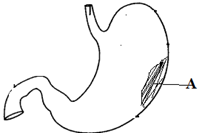
Q.37.
ion Q54) What will be the consequence if the portion marked as ‘A’ in the following diagram has been removed:
-
0%
a) Anaemia
-
0%
b) Jaundice
-
100%
c) Hepatitis
-
0%
d) Glaucoma
Q.38.
ion Q55) The length of alimentary canal is more in herbivorous animals than the carnivorous animals because:
-
0%
a) Herbivorous diet contains more fat which takes more time to digest.
-
0%
b) Herbivorous diet contains more carbohydrates particularly cellulose.
-
100%
c) Herbivorous diet contains more proteins to digest.
-
0%
d) Herbivorous diet contains more vitamins to digest.
Q.39.
ion Q56) Which one of the following is a fat soluble vitamin and its related deficiency disease:
-
0%
a) Calciferol – Pellagra.
-
0%
b) Ascorbic acid – Scurvy.
-
0%
c) Retinol – Xerophthalmia
-
100%
d) Cobalamine – Beriberi.
Q.40.
ion Q57) In the gastro-intestinal tract, the Meissner’s plexus and the Auerbach’s plexus occur respectively in:
-
0%
a) Lamina propria and Muscularis mucosa.
-
0%
b) Submucosa and mucosa
-
0%
c) Submucosa and Muscularis externa
-
100%
d) Mucosa and Muscularis externa.
Q.41.
ion Q58) A doctor advises a person for taking more meat, butter, milk and eggs. The person is suffering from:
-
0%
a) Scurvy
-
0%
b) Rickets
-
100%
c) Night blindness
-
0%
d) Kwashiorkor
Q.42.
ion Q59) Sequence of food materials consumed during prolonged fasting is:
-
0%
a) Carbohydrates → Proteins → Fats.
-
0%
b) Proteins → Carbohydrates → Fats.
-
0%
c) Fats → Protein → Carbohydrates.
-
100%
d) Carbohydrates → Fats → Proteins
Q.43.
ion Q60) The structural and functional unit of liver containing hepatic cells arranged in the form of cords are called:
-
0%
a) Hepatocyte
-
0%
b) Glisson’s capsule
-
0%
c) Hepatic lobule
-
100%
d) Hepatic portal system
Q.44.
ion Q61) Find out the wrong statements: (i) Small amounts of monosaccharides like glucose, amino acids and some electrolytes like chloride are generally absorbed by simple diffusion. (ii) Absorption of water, simple sugars and alcohol, etc takes place in stomach. (iii) Large intestine is the principle organ for absorption of nutrients. (iv) Transport of water depends upon the osmotic gradient. (v) Bile activates lipases.
-
0%
a) (i) and (ii) are false.
-
0%
b) (i) and (iii) are false.
-
100%
c) Only (iii) is false
-
0%
d) All statements are false.
Q.45.
ion Q62) Which of the following is the correct matching of the site of action of the given substrate, the enzyme acting upon it and the end product?
-
0%

-
0%

-
0%

-
100%

Q.46.
ion Q63) The cells in the crypts secrete large quantities of water and electrolytes over the surface of adjacent villi are:
-
0%
a) Goblet cells
-
0%
b) Enterocytes
-
0%
c) Paneth cells
-
100%
d) Cardiocytes
Q.47.
ion Q64) Select the incorrect statement related to digestion in man:
-
0%
a) K+, Mg2+, phosphates are actively absorbed.
-
0%
b) Brown colour of faeces is caused by stercobilin and urobilin.
-
0%
c) Peptic ulcer is an excoriated area of stomach caused by the cation of bile.
-
100%
d) Enteritis is the inflammation of intestinal tract caused by viruses.
Q.48.
ion Q65) Which of the following is incorrect regarding the disorder of alimentary canal:
-
0%
a) Inflammation of intestine is due to bacterial and viral infections.
-
0%
b) In indigestion, there is a feeling of fullness.
-
0%
c) In constipation, faeces become retained in rectum.
-
100%
d) In diarrhoea, the bowel movements are irregular.
Q.49.
ion Q66) Pylorus is situated in the junction of:
-
0%
a) Oesophagus and stomach.
-
0%
b) Stomach and duodenum.
-
0%
c) Duodenum and ileum.
-
100%
d) Ileum and rectum.
Q.50.
ion Q67) Which of the following is the correct matching of the vitamin, its nature and the deficiency disease?
-
0%
a) Vitamin A - Fat soluble – Beriberi.
-
0%
b) Vitamin K – Water soluble – Pellagra
-
0%
c) Vitamin A – Fat soluble – Night blindness
-
100%
d) Vitamin K – Fat soluble – Beriberi