Q.1.
ion Q68) Epithelial cells of the intestine involved in food absorption have on their surface
-
0%
a) pinocytic vesicles
-
20%
b) Zymogen granules
-
20%
c) phagocytic vesicles
-
60%
d) microvilli
Q.2.
ion Q69) Due to certain reasons, if our goblet cells become non-functional, it will adversely affect:
-
25%
a) Production of somatostatin.
-
75%
b) Secretion of sebum from the sebaceous gland.
-
0%
c) Maturation of digestive glands.
-
0%
d) Smooth movement of food downwards the intestine
Q.3.
ion Q70) When a mammal swallows, the food is prevented from going up into the nasal cavity by the:
-
0%
a) Oesophagus
-
33%
b) Tongue
-
33%
c) Soft palate
-
33%
d) Epiglottis
Q.4.
ion Q72) Mark the correct sequence of the given parts of the digestive tract: Ileum Stomach. Oesophagus Duodenum Rectum. Jejunum. Colon. Caecum. Oral cavity. Anus Mouth Pharynx.
-
33%
a) 11 → 9 → 12 → 4 → 3 → 2 → 1 → 6 → 8 → 7 → 5 → 10.
-
0%
b) 10 → 12 → 9 → 3 → 4 → 2 → 6 → 8 → 7 → 1 → 5 → 11.
-
67%
c) 11 → 12 → 9 → 6 → 2 → 3 → 4 → 1 → 8 → 7 → 5 → 10
-
0%
d) 11 → 9 → 12 → 3 → 2 → 4 → 6 → 1 → 8 → 7 → 5 → 10
Q.5.
ion Q73) Study thoroughly the following statements and identify which of the following is/are correct and incorrect: (i) Bile salts present in bile are responsible to emulsify fats in small intestine. (ii) Bicarbonates of sodium, potassium, glycocholate and faurocholate of sodium are bile salts. (iii) The pH of hepatic bile is 8.6 while the pH of gall bladder is 7.5 or 7. (iv) The flow of bile from liver takes place through – hepatic duct, common bile duct, Hepato – pancreatic ampulla and finally to the first part of small intestine. (v) Gall bladder in rat and horse does not store bile.
-
33%
a) (i), (iii) and (iv) are incorrect while (ii) and (v) are correct.
-
33%
b) All statements are correct.
-
33%
c) (ii) and (v) are incorrect while (i), (iii) and (iv) are correct.
-
0%
d) All statements are incorrect.
Q.6.
ion Q74) Go through the following statements regarding starch digestion. Separate true and false statements and select the correct option: (i) Digestion of starch start from the mouth. (ii) Around 30% of the starch is digested in the stomach. (iii) Digestion of food requires the action of pancreatic juice. (iv) Digestion of food is completed in the longest part of the alimentary canal.
-
100%
a) All are true
-
0%
b) (i), (iii) and (iv) are true but (ii) is false.
-
0%
c) (ii) and (iii) are false while (i) and (iv) are true
-
0%
d) (ii) and (iv) are false while (i) and (iii) are true.
Q.7.
ion Q75) If the pancreatic duct of a healthy man is blocked, one hour after he has taken food, which one of the following functions will not be affected:
-
0%
a) Breakdown of proteins.
-
100%
b) Neutralisation of Chyme
-
0%
c) Digestion of fat
-
0%
d) Maintenance of normal blood sugar level.
Q.8.
ion Q76) Which of the following is not involved in the stimulation of release of pancreatic juice?
-
0%
a) gastrin
-
0%
b) Secretin
-
50%
c) Trypsinogen
-
50%
d) Cholecystokinin
Q.9.
on Q128) The vitamin essential for the synthesis of acetyl choline is:
-
0%
a) Thiamine
-
50%
b) Niacin
-
0%
c) Pyridoxine
-
50%
d) Biotin
Q.10.
on Q130) Choose the wrong statement:
-
50%
a) Castle’s intrinsic factor is a glycoprotein produced by zymogen cells of gastric glands which helps in absorption of vitamin B12.
-
50%
b) Bolus is the alkaline ball like food present in the buccal cavity.
-
0%
c) Chyme is partially digested acidic food in stomach.
-
0%
d) Chyle is the partially digested alkaline food in small intestine
Q.11.
ion Q77) Select the correct option with respect to human tooth: (i) Dentine is a layer of inorganic substances secreted by odontoblast cells. (ii) Dentine is mesodermal in origin. (iii) Enamel is made up of 92% inorganic substances produced by ameloblast. (iv) Enamel is ectodermal in origin. (v) Dentine consists of maximum amount of inorganic substances, hence considered as the hardest part of the body.
-
0%
a) (i), (ii) and (iii) are true.
-
50%
b) All except (v) are true
-
50%
c) (ii), (iv) and (v) are false
-
0%
d) (iii) and (v) are false
Q.12.
ion Q78) Type of attachment of teeth in sharks and frogs is:
-
0%
a) Acrodont
-
50%
b) Pleurodont
-
0%
c) Thecodont
-
50%
d) Molarodont
Q.13.
ion Q79) The type of teeth which is absent in deciduous teeth:
-
0%
a) Incisors
-
0%
b) Canines
-
100%
c) Premolars
-
0%
d) Molars
Q.14.
ion Q80) Which of the following salivary gland is unpaired?
-
0%
a) Parotid.
-
50%
b) Sub-mandibular
-
0%
c) Sub-lingual
-
50%
d) None of them
Q.15.
ion Q81) The alimentary canal is ....... is origin.
-
0%
a) Ectodermal
-
0%
b) Mesodermal
-
50%
c) Endodermal
-
50%
d) None of these
Q.16.
ion Q82) Enterogasterone is:
-
0%
a) A hormone of stomach which stimulates gastric motility and release of gastric juice.
-
50%
b) Secreted by intestinal glands for activating trypsin.
-
50%
c) A hormone that promotes the release of water and bicarbonate ions from the pancreas.
-
0%
d) A hormone that inhibits the gastric motility and release of gastric juice
Q.17.
ion Q83) Serotonin released by the glands of the gastrointestinal tract:
-
50%
a) Stimulates the release of water and bicarbonate ions from pancreas.
-
0%
b) promotes release of pancreatic juice.
-
50%
c) Promotes peristalsis of gastrointestinal tract
-
0%
d) Inhibits gastric motility
Q.18.
ion Q84) The epithelial surface area of large intestine is ..........th than that of small intestine:
-
0%
a) 1/5
-
50%
b) 1/10
-
50%
c) 1/3
-
0%
d) 1/12
Q.19.
ion Q85) Find out the correct match from the following table:
| Column I | Column II | Column III |
| Goblet cells | Mucus | Prevents mucous layer damage from HCl |
| Lysozyme | Saliva | Antibacterial agent |
| Parotid gland | Tears | Destroys bacteria |
| Oxyntic cells | HCl | Stimulates gastric juice |
-
0%
a) Only 1
-
50%
b) Only 1 and 2
-
0%
c) Only 1, 2 and 3.
-
50%
d) All of them are true.
Q.20.
ion Q86) Balanced diet should have:
-
0%
a) 1/5 fats, 1/5 proteins and 3/5 carbohydrates.
-
50%
b) 1/5 fat, 3/5 proteins and 3/5 carbohydrates.
-
0%
c) 1/2 proteins, 1/3 fats and 3/5 carbohydrates.
-
50%
d) 3/5 proteins, 1/5 fats and 1/5 carbohydrates.
Q.21.
ion Q87) Payer’s patches found in small intestine are:
-
0%
a) Lymphatic tissue
-
50%
b) Glandular tissue
-
0%
c) Epithelial tissue
-
50%
d) Haemopoetic tissue
Q.22.
ion Q88) Pancreas produces:
-
0%
a) three digestive enzymes and one hormone
-
0%
b) three types of digestive enzymes and two hormones
-
0%
c) two digestive enzymes and one hormone
-
100%
d) three digestive enzymes and no hormone
Q.23.
ion Q91) Which one of the following mammalian cells is not capable of metabolising glucose to carbon- dioxide aerobically?
-
50%
a) unstriated muscle cells
-
0%
b) liver cells
-
0%
c) red blood cells
-
50%
d) white blood cells
Q.24.
ion Q92) Payer’s patches contain:
-
50%
a) Mucous
-
50%
b) Sebum
-
0%
c) Lymphocytes
-
0%
d) RBC
Q.25.
ion Q93) Wisdom teeth in human is:
-
0%
a) 3rd molar and 4 in number.
-
0%
b) 3rd molar and 2 in number
-
100%
c) 2nd molar and 4 in number.
-
0%
d) 2nd molar and 2 in number.
Q.26.
ion Q94) The mammal without salivary glands:
-
0%
a) kangaroo
-
50%
b) Horse
-
0%
c) Rat
-
50%
d) whale
Q.27.
ion Q96) If the chyme of a person who had orally consumed only starch food is analysed before it enters the duodenum, it will show the presence
-
50%
a) Maltose and glucose.
-
50%
b) Dextrin and maltose.
-
0%
c) Starch, dextrin and maltose
-
0%
d) Starch, dextrin and glucose
Q.28.
ion Q97) The fluid mixes thoroughly with the acidic gastric juice of stomach by churning movements of its muscular wall. What do we call the food then?
-
50%
a) Bolus
-
0%
b) Chyme
-
50%
c) Chyle
-
0%
d) Chylomicrons.
Q.29.
ion Q98) Which of the following statements is/are incorrect: (i) Absorption of simple sugar, alcohol, some water and medicine take place in the stomach. (ii) Maximum water absorption occurs in the large intestine. (iii) Fatty acids and glycerol are absorbed by lacteals. (iv) Small intestine is the major site of digestion and absorption of food. (v) Nothing is absorbed in the mouth and large intestine.
-
50%
a) (i), (iv) and (v) only.
-
50%
b) (v) only.
-
0%
c) (iv) only.
-
0%
d) (ii) and (iii)
Q.30.
ion Q99) A child took sugarcane and sucked its juice. Regarding this which of the following match is true:
-
0%
a)

-
100%
b)

-
0%
c)

-
0%
d)

Q.31.
on Q100) If you chew on a piece of bread long enough, it will begin to taste sweet because:
-
0%
a) Maltase is breaking down maltose
-
50%
b) Lipids are forming fatty acids
-
50%
c) Amylase is breaking down starch into disaccharides
-
0%
d) Disaccharides are forming glucose
Q.32.
on Q101) If the inner surface of the ileum of the human small intestine was smooth, rather than being folded and subdivided into villi, which of the following would be true:
-
50%
a) The rate of absorption of digested food molecules would be higher, because the digested food would pass easily through the digestive tract
-
50%
b) Digestion would not be effective, because there would be fewer cells secreting trypsin (a protein digesting enzyme)
-
0%
c) Humans would have needed to evolve as much longer small intestine o absorb sufficient nutrients from their food
-
0%
d) Humans would not be able to survive, because the digestive tract would be more susceptible to damage
Q.33.
on QThe given schematic diagram depicts the heterodont teeth and its thecodont arrangement. Find the correct labelling for a-d from the options given below:
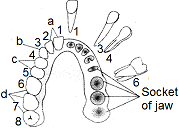
-
0%
a) a-Incisors, b-canines, c-premolars, d-molars.
-
100%
b) a-Incisors, b-canines, c-molars, d-premolars.
-
0%
c) a-Incisors, b-molars, c-canines, d-premolars.
-
0%
d) a-Incisors, b-premolars, c-canines, d-molars
Q.34.
on Q103) Choose the incorrect statement regarding human digestive system with reference to normal person.
-
0%
a) Human saliva is slightly acidic
-
50%
b) In human beings, four pairs of salivary gland secrete saliva
-
50%
c) The quantity of saliva in adult may be 1-1.5L day
-
0%
d) Enzyme amylase present in saliva is responsible for the breakdown of starch into simple sugar.
Q.35.
on Q104) Given diagram represents the transverse section of alimentary canal. Label it correctly and choose the correct option accordingly:
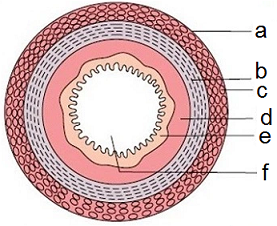
-
50%
a) a- Mucosa, b-Inner longitudinal, c-Outer circular, d-Submucosa, e-Serosa, f-Lumen.
-
0%
b) a- Serosa, b- Inner longitudinal, c-Outer circular, d-Submucosa, e-Mucosa, f-Lumen.
-
0%
c) a-Serosa, b-Inner circular, c-Outer longitudinal, d-Submucosa, e-Mucosa, f-Lumen.
-
50%
d) a-Mucosa, b-Inner circular, c-Outer longitudinal, d-Submucosa, e- Serosa, f-Lumen
Q.36.
on Q106) Label the given diagram of transverse section of mucosa of small intestine showing finger like projections. Choose the correct options accordingly:
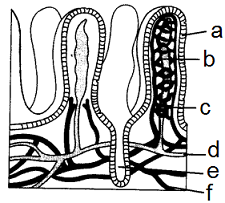
-
33%
a) a- villi, b-lacteal, c-capillaries, d-artery, e-vein, f-crypts.
-
17%
b) a- villi, b-lacteal, c-capillaries, d-artery, e-crypts, f-vein.
-
17%
c) a- villi, b-lacteal, c-capillaries, d-vein, e-crypts, f-artery.
-
33%
d) a –villi, b-capillaries, c-lacteal, d-vein, e-crypts, f-artery.
Q.37.
on Q108) The given diagram represents the duct system of pancreas, liver and gall bladder. Label the diagram.
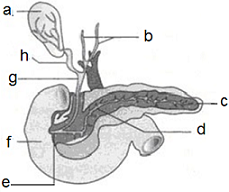
-
0%
a) a-Gall bladder, b-Ducts from liver, c-Pancreas, d-Pancreatic duct, e-Hepato-pancreatic duct, f-duodenum, g-Common bile duct, h-Duct from gall bladder.
-
0%
b) a-Gall bladder, b-Ducts from liver, c-Pancreas, d-Pancreatic duct, e-Common bile duct, f-Duodenum, g-Hepato-pancreatic duct, h-Duct from gall bladder.
-
50%
c) a-Gall bladder, b-Duct from liver, c-Pancreas, d-Hepato-pancreatic duct, e-Pancreatic duct, f-Duodenum, g-Common bile duct, h-Duct from gall bladder.
-
50%
d) a-Gall bladder, b-Duct from liver, c-Pancreas, d-Common bile duct, e-Pancreatic duct, f-Duodenum, g-Hepato-pancreatic duct, h-Duct from gall bladder.
Q.38.
on Q109) Complete the given equation and choose the correct option accordingly:
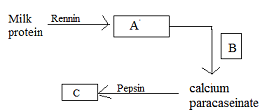
-
0%
a) A-Casein, B-Ca2+, C-Peptones.
-
50%
b) A-Ca2+, B-Peptones, C-Casein
-
50%
c) A-Paracasein, B-Ca2+, C-Peptones
-
0%
d) A-Ca2+, B-Paracasein, C-Peptones.
Q.39.
on Q110) In human beings, digestion of proteins, fats and carbohydrates starts from which of the following parts of the alimentary canal:
-
0%
a) Stomach, intestine and mouth respectively
-
0%
b) Only from stomach
-
0%
c) Intestine, stomach and mouth respectively
-
100%
d) Only from intestine
Q.40.
on Q111) Which of the following enzymatic reaction is incorrect?
-
0%
a)

-
0%
b)

-
100%
c)

-
0%
d)

Q.41.
on Q112) The smallest salivary gland is:
-
0%
a) Sublingual
-
50%
b) Zygomatic
-
50%
c) Parotid
-
0%
d) Submaxillary
Q.42.
on Q113) The salivary gland absent in humans:
-
0%
a) Sublingual
-
0%
b) Zygomatic
-
50%
c) Parotid
-
50%
d) Submaxillary.
Q.43.
on Q114) The microbes related with tooth decay is;
-
0%
a) Lactobacillus acidophilus
-
50%
b) Streptococcus mutans
-
0%
c) Streptococcus thermophiles
-
50%
d) Both (A) and (B)
Q.44.
on Q116) The protein which cannot be hydrolysed by both pepsin and trypsin is:
-
0%
a) Casein
-
50%
b) Collagen
-
50%
c) Keratin
-
0%
d) None of these
Q.45.
on Q117) Which statement is wrong regarding absorption:
-
50%
a) Absorption of digested food mainly takes place in the ileum of small intestine.
-
0%
b) Fatty acids, glycerol and monoglycerides are absorbed from small intestine into blood capillaries.
-
50%
c) Mineral salts, vitamins and certain drugs are absorbed into the blood capillaries from large intestine.
-
0%
d) Vitamin B12 combines with intrinsic factor in the stomach and is absorbed in terminal ileum.
Q.46.
on Q118) Match the gastrointestinal hormones with their organ of secretion and their function:
| Column I (Hormone) | Column II (Secreted by) | Column III (Function) |
| Gastrin | a. Small intestine | (i) Stimulates pancreas to produce water and bicarbonates. |
| Enterogasterone | b. Stomach | (ii) Stimulates the gastric gland to produce gastric juice |
| Cholecystokinin | c. Duodenum | (iii) Inhibits the secretion of gastric juice. |
| Secretin | d. Duodenum and jejunum | (iv) Stimulates the release of intestinal juices by intestinal glands. |
| GIP | e. Jejunum and ileum | (v) Contracts the gall bladder to release bile. |
| Enterokinin | - - - - | - - - - |
-
0%
a) 1-b-(ii), 2-a-(iii), 3-d-(v), 4-c-(i), 5-e-(iii), 6-a-(iv)
-
0%
b) 1-b-(iii), 2-a-(ii), 3-d-(i), 4-c-(v), 5-e-(vi), 6-a-(iii)
-
100%
c) 1-a-(ii), 2-b-(iii), 3-c-(v), 4-d-(i), 5-a-(iii), 6-e-(iv)
-
0%
d) 1-a-(iii), 2-b-(ii), 3-c-(i), 4-d-(v), 5-a-(vi), 6-a-(iv)
Q.47.
on Q119) If the liver become functionless, percentage of which will increase in blood?
-
0%
a) Uric acid
-
50%
b) Ammonia
-
0%
c) Urea
-
50%
d) Protein
Q.48.
on Q120) Paneth cells are found in:
-
0%
a) Crypts of Lieberkuhn
-
0%
b) Peyer’s patches
-
67%
c) Islets of Langerhans
-
33%
d) Organ of Corti
Q.49.
on Q121) The element that hardens tooth is:
-
0%
a) Sodium
-
0%
b) Iodine
-
0%
c) Fluorine
-
100%
d) Calcium
Q.50.
on Q122) During prolonged starvation, body derives nutrition from storage of:
-
0%
a) Spleen
-
0%
b) Lungs
-
50%
c) Subcutaneous fat
-
50%
d) Liver