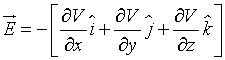
Q.1.
At a certain distance from a point charge the electric field is 500 V/m and the potential is 3000 V. What is this distance
-
71%
a) 6 m
-
16%
b) 12 m
-
10%
c)36 m
-
3%
d)144 m
Q.2.
A dielectric slab of thickness d is inserted in a parallel plate capacitor whose negative plate is at x=0 and positive plate is x=3d. The slab is equidistant from the plates. The capacitor is given some charge. As x goes from 0 to 3d
-
18%
a) the magnitude of the electric field remains the same
-
34%
b) the direction of the electric field remains the same
-
22%
c)the electric potential remains constant
-
26%
d)the electrical potential increases at first, then decreases and again increases
Q.3.
The diameter of the plate of parallel plate condenser is 6cm. If its capacity is equal to a sphere of diameter 200cm, the separation between the plates of the condenser is
-
18%
a) 4.5 ×10⁻⁴ m
-
48%
b) 2.25 ×10⁻⁴ m
-
25%
c) 6.75 ×10⁻⁴ m
-
10%
d) 9 × 10⁻⁴ m
Q.4.
The study of the effect associated with electric field at rest is known as [AFMC 1999]
-
83%
a) electrostatics
-
10%
b) electromagnetism
-
5%
c) magneto static
-
2%
d) none of these
Q.5.
When we touch the terminal of a high voltage capacitor, even after a high voltage has been cut off. Then the capacitor has the tendency to [AFMC 2000]
-
20%
a) affect dangerously
-
26%
b) discharge energy
-
12%
c) restore energy
-
43%
d) both (a) and (b)
Q.6.
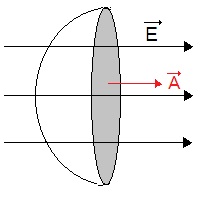
In a region of space having a uniform electric field E, a hemi-spherical bowl of radius r is placed. The electric flux φ through the bowl is
-
39%
a) πr2E
-
28%
b) 2πr2E
-
20%
c)2πrE
-
12%
d)4πr2E
Explanation
Q.7.
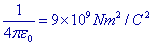
A short electric dipole has a dipole moment of 16 × 10-9 C m. The electric potential due to the dipole at a point at a distance of 0.6 m from the centre of the dipole, situated on a line making an angle of 60° with the dipole axis is : [NEET 2020]
-
25%
a) 400 V
-
23%
b) zero
-
17%
c) 50 V
-
35%
d) 200 V
Q.8.
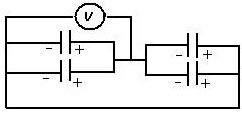
Four capacitors each of 25 μF are connected as shown in diagram. The DC voltmeter reads 200 volt. The charge on each plate of capacitor will be [AFMC1997]
-
18%
a) 5×10⁻²C
-
23%
b)2× 10⁻²C
-
49%
c)5× 10⁻³ C
-
10%
d) 2× 10⁻³
Q.9.
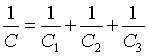
Three capacitors of 2.0, 3.and 6.0 μF connected in series to a 10 V source. The charge on 3.0 μ F capacitor is [AFMC1998]
-
18%
a) 15μC
-
13%
b) 12μC
-
21%
c) 5 μ C
-
49%
d) 10 μ C
Explanation
Q.10.
There is an electric field E in X-direction. If the work done in moving a charge 0.2 C through a distance of 2m along a line making an angle 60o with x-axis is 4J, the value of E is [AFMC1998]
-
25%
a) 2√3 N/C
-
29%
b) 5 N/C
-
16%
c) 4 N/C
-
30%
d) None of these
Q.11.
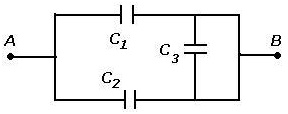
The equivalent capacitance of the combination of three capacitors, each of capacitance C between A and B as shown in the given figure, is
-
7%
a) C/2
-
42%
b) 3C/2
-
21%
c) C/3
-
30%
d) 2C
Q.12.
The electric field intensity on the surface of a charged conductor is
-
31%
a) zero
-
50%
b) directed normally to the surface
-
11%
c)directed tangetially to the surface
-
8%
d)directed along 45° to the surface
Q.13.
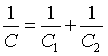
The capacitors of capacitance 4 μF and 6 μF are connected in series. A potential difference of500 volt is applied to the outer plates of two capacitor system. Then the charge on each plate of each capacitor is numerically [AFMC 2000]
-
15%
a) 6000 μC
-
55%
b) 1200 μC
-
23%
c) l2000 μC
-
8%
d) 6000 μC
Explanation
Q.14.
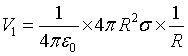
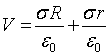
The concentric spheres of radii R and r have similar charges with equal surface densities (σ). What is the electric potential at their common center? [AFMC 2001]
-
23%
a)

-
51%
b)

-
9%
c) Rσ /ε0
-
17%
d) σ /ε0
Explanation
Q.15.
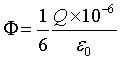
A charge Q µC is placed at the center of a cube the flux coming out from any surface will be [AFMC 2001]
-
7%
a)

-
14%
b)

-
73%
c)

-
7%
d)

Explanation

Q.16.
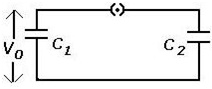
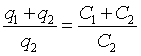
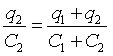
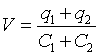
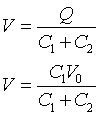
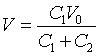
A capacitor C1 is charged by a potential difference Vo as shown in the figure. This charging battery is then removed and the capacitor is connected to an uncharged capacitor CWhat is the final potential difference V across the combination? [AFMC 2001]
-
16%
a)

-
22%
b)

-
50%
c)

-
12%
d)

Explanation
Q.17.
The electric field required to keep a water drop of mass m just to remain suspended, when charged with one electron is [AFMC 2001]
-
13%
a) em/g
-
65%
b) mg/e
-
11%
c) emg
-
11%
d) mg
Q.18.
The formation of dipole is due to two equal and dissimilar point charges placed at a [ CBSE-PMT 1996]
-
69%
a)short distance
-
17%
b) long distance
-
6%
c)above each other
-
8%
d)none of these
Q.19.
A charge Q is placed at the corner of a cube. The electric flux through all the six faces of the cube is .. [ CBSE-PMT 2000]
-
10%
a) Q/ 3 ε0
-
39%
b) Q/ 6 ε0
-
21%
c)Q/ 8 ε0
-
31%
d)Q/ ε0
Q.20.
An electric dipole of moment P is lying along a uniform electric field E. The work done in rotating the dipole by 90° is .. [ CBSE-PMT 2006]
-
12%
a) PE/2
-
22%
b) 2PE
-
58%
c)PE
-
8%
d)PE√2
Q.21.
The mean free path of electrons in metal is 4×10⁻⁸ m. The electric field which can give on an average 2eV energy to an electron in the metal will be in units of V/m [ CBSE-PMT 2009]
-
15%
a) 5×10-11
-
48%
b) 8×10-11
-
23%
c) 5×10⁷
-
13%
d) 8×10⁷
Q.22.
From a point charge, there is a fixed point A. At A, there is an electric field of 500 V/m and potential difference of 3000V. Distance between point charge and A will be ... [ CBSE-PMT 1997]
-
63%
a)6m
-
17%
b) 12m
-
17%
c)16m
-
4%
d)24m
Q.23.
If a dipole moment P is placed in uniform electric field E, then torque acting on it is given by [ CBSE-PMT 2001]
-
27%
a) τ=P ⋅E
-
66%
b) τ=P ×E
-
4%
c)τ=P + E
-
4%
d)τ=P - E
Q.24.
A charge Q µC is placed at the centre of a cube, the flux coming out from any surface will be
-
58%
a)(Q/6ε0) ×10-6
-
31%
b) (Q/6ε0) ×10-3
-
8%
c)(Q/24ε0)
-
3%
d)(Q/24ε0)
Q.25.
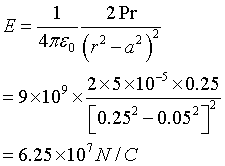
The electric intensity due to a dipole of length 10 cm and having a charge of 500µC, at a point on the axis at a distance 20cm from one of the charge in air, is [ CBSE-PMT 2001]
-
36%
a) 6.25×10⁷ N/C
-
32%
b) 9.28×10⁷N/C
-
11%
c) 13.1×10¹¹ N/C
-
20%
d) 20.5×10⁷ N/C
Explanation
Q.26.
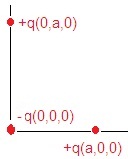
Three point charges +q, -q and +q are placed at point (x=0,y=a,z=0), (x=0, y=0,z=0) and (x=a, y=0, z=0) respectively. The magnitude and direction of the electric dipole moment vector of this charge assembly are .. [ CBSE-PMT 2007]
-
38%
a)qa√2 along the line joining points (x=0, y=0,z=0) and (x=a, y=a, z=0)
-
33%
b) qa along the line joining points ( x=0, y=0,z=0) and (x=a, y=a, z=0)
-
24%
c)qa√2 along +ve x direction
-
5%
d)qa√2 along +ve y direction
Explanation
Q.27.
The mean free path of electrons in a metal is 4×10⁻⁸ m. The electric field which can give on an average 2eV energy to an electron in metal will be in units of V/m [ CBSE-PMT 2009]
-
33%
a) 5×10-11
-
5%
b) 8×10-11
-
47%
c)5×10⁷
-
16%
d)8×10⁷
Q.28.
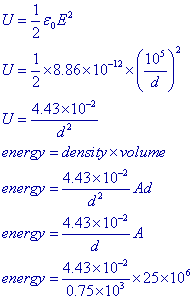
A piece of cloud has area 25×106 m2 and electric potential of 105 vots. If the height of cloud is 0.75 km, then energy density of electric field between earth and cloud will be [ Ra.PET 1997]
-
13%
a) 250 J
-
26%
b) 750 J
-
37%
c)1225 J
-
24%
d)1475 J
Explanation
Q.29.
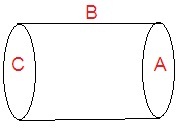
A hollow cylinder has a charge q coulomb within it. If Φ is the electric flux in units of voltmeter associated with the curved surface B, the flux linked with the plane surface A in units of voltmeter will be.. [ CBSE-PMT 2007]
-
27%
a) q /2ε0

-
45%
b) Φ / 3

-
14%
c)
-
14%
d)
Explanation

Q.30.
An electron is moving round the nucleus of a hydrogen atom in a circular orbit of radius r. The Coulomb force F between the two is ... [ CBSE-PMT 2003]
-
16%
a)

-
47%
b)

-
24%
c)

-
14%
d)

Explanation

Q.31.
A hollow insulated conduction sphere is given a positive charge 10µC. What will be the electric field at the centre of the sphere if its radius is 2metres? [ CBSE-PMT 1998]
-
56%
a)zero
-
17%
b) 5µCm-2
-
24%
c)20µCm-2
-
2%
d)8µCm-2
Q.32.
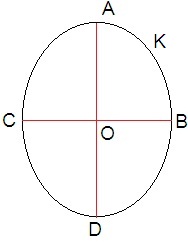
A thin conducting ring of radius R is given a charge +Q. The electric field at the centre O of the ring due to the charge on the part AKB of the ring is E. The electric field at the centre due to the charge on the part ACDB of the ring is .. [ CBSE-PMT 2008]
-
30%
a) E along KO
-
41%
b) E along OK
-
22%
c)3E along KO
-
8%
d)3E along OK
Q.33.
There is an electric field E in x-direction. If the work done on moving a charge 0.2C through a distance of 2m along a line making an angle 60° with x-axis is 4J, then what is the value of E? [ CBSE-PMT 1995]
-
6%
a) 3 N/C
-
32%
b) 4 N/C
-
12%
c)5 N/C
-
50%
d)20 N/C
Q.34.
Intensity of an electric field E depends on distance r, due to a dipole, is related as .. [ CBSE-PMT 1996]
-
20%
a) E ∝ (1/r)
-
25%
b) E ∝ (1/r2)
-
45%
c) E ∝ (1/r3)
-
9%
d) E ∝ (1/r4)
Q.35.
An electric dipole , consisting of two opposite charges of 2×10⁻⁶C each separated by a distance 3cm is placed in an electric field of 2×10⁵ N/C. Torque acting on the dipole is .. [ CBSE-PMT 1995]
-
6%
a)12×10-1N-m
-
21%
b) 12×10-2 N-m
-
53%
c)12×10-3 N-m
-
21%
d)12×10-4 N-m
Q.36.
A charge q is placed at the centre of the line joining two exactly equal positive charges Q. The system of three charges will be in equilibrium, if q is equal to .. [ CBSE PMT 1995]
-
45%
a) -Q/4
-
17%
b) +Q
-
24%
c)Q
-
14%
d)Q/2
Q.37.
A semi-circular arc of radius 'a' is charged uniformly and the charge per unit length is λ. The eletrcic field at the centre of the arc is [ CBSE-PMT 2000]
-
33%
a)

-
28%
b)

-
33%
c)

-
6%
d)

Explanation
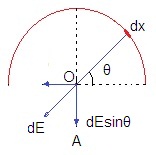
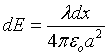
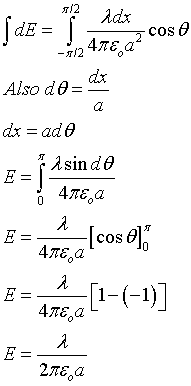
Q.38.
A charge Q is enclosed by a Gaussian spherical surface of radius R. If the radius is doubled, then the outward electric flux will [ CBSE-PMT 2011]
-
32%
a) increase four times
-
13%
b) be reduced to half
-
50%
c) remain the same
-
5%
d) be doubled
Q.39.
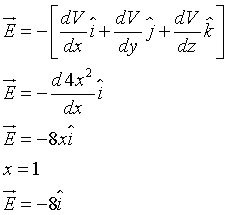
The electric potential V at any point (x,y,z) all in meters in space is given by V=4x2 volt. The eletric field at the point (1, 0, 2) in volt/meter is .. [ CBSE-PMT 2011]
-
21%
a)8 along positive x-axis
-
18%
b) 16 along negative x-axis
-
32%
c)16 along positive x-axix
-
29%
d)8 along negative x-axis
Explanation
Q.40.
The electric field at a distance 3R/2 from the centre of a charged conducting spherical shell of radius R is E. The electric field at a distance R/2 from the centre of the sphere is .. [ CBSE PMT 2010]
-
5%
a) E/2
-
57%
b) Zero
-
22%
c)E
-
16%
d)E/2
Q.41.
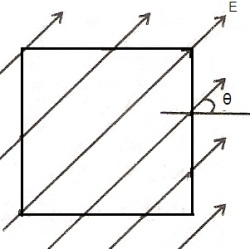
A square surface of side L meter in the plane of the paper is placed in a uniform electric field E volt/m acting along the same plane at an angle θ with the horizontal side of the square as shown in Figure. The electric flux linked to the surface in units of volt m is .. [ CBSE-PMT 2010]
-
3%
a) EL2
-
42%
b) EL2cosθ
-
23%
c)EL2sinθ
-
32%
d)zero
Q.42.
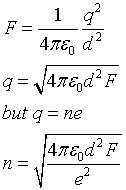
Two positive ions,each carrying a charge q, are separated by a distance d. If F is the force of repulsion between the ions, the number of electrons missing from each ion will be ( e charge on electron) [CBSE-PMT 2010]
-
22%
a)

-
30%
b)

-
42%
c)

-
5%
d)

Explanation
Q.43.
Point charges +4q, -q and +4q are kept on the x-axis at points x=0, x=a and x=2a respectively.. [ CBSE-PMT 1988]
-
3%
a)none of the charges is in equilibrium
-
25%
b) only -q is in stable equilibrium
-
42%
c)all the charges are in unstable equilibrium
-
31%
d)all the charges are in stable equilibrium
Q.44.
Point Q lies on the perpendicular bisector of an electric dipole of dipole moment P. if the distance of Q from the dipole is r( much larger than the size of the dipole), then the electric field at Q is proportional to .. [ CBSE-PMT 1998]
-
9%
a) P-1 and r-2
-
25%
b) P and r-2
-
31%
c)P2 and r-3
-
34%
d)P and r-3
Explanation

Q.45.
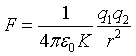
When air is replaced by a dielectric medium of force constant K, the maximum force of attraction between two charges, separated by a distance.. [ CBSE-PMT 1999]
-
34%
a) decreases K times
-
20%
b) increases K times
-
34%
c)remains unchanged
-
11%
d)becomes 1/ K2 times
Explanation
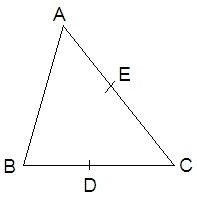
Q.46.
Three charges , each +q, are placed t the corners of an isosceles triangle ABC of sides BC and AC of length 2a. . D nd E are the mid points of BC and CA. The work done in taking a charge Q from D to E is [ CBSE - PMT 2011]
-
12%
a)

-
22%
b)

-
50%
c) zero

-
16%
d)
Q.47.
If the potential of a capacitor having capacity 6µF is increased from 10V to 20V, then increase in its energy will be [ CBSE-PMT 1995]
-
9%
a)4×10⁻⁴ J
-
36%
b) 6×10⁻⁴ J
-
39%
c)9×10⁻⁴
-
15%
d)12×10-6 J
Q.48.
The capacitance of a parallel plate condenser is 10µF, when the distance between its plates is 8cm. If the distance between the plates is 8cm. If the distance between plates is reduced to 4cm then the capacity of this parallel plate condenser will be [ CBSE-PMT 2001]
-
13%
a) 5µF
-
42%
b) 10µF
-
45%
c)20µF
-
0%
d)40µF
Q.49.
The electric field at a point on equatorial line of dipole, and direction of the dipole moment [ MPPMT 1995]
-
19%
a) will be parallel
-
46%
b) will be in opposite direction
-
32%
c) will be perpendicular
-
3%
d) are not related
Q.50.
The electric potential at a point (x, y, z) is given by V=-x2y -xz3 +4 . The electric field E at that point is [ CBSE-PMT 2009]
-
16%
a) E=2xy + (x2+y2)j+(3xz - y2)k
-
16%
b)E=z3 i + xyxj +z2 k
-
46%
c)E=(2xy-z3)i + xy2j+3z2xk
-
22%
d)E=( 2xy +z3)i +x2j+3xz2
Explanation