Q.1.
If the charge is moved against the coulomb force of an electric field
-
50%
a)work is done by the electric field
-
25%
b) Energy strength of the field is decreased
-
25%
c)the strength of the field is decreased
-
0%
d)the energy of the system is decreased
Q.2.
The electric potential V at any point X,Y, Z ( all in meters) in space is given by V=4X2 Volt. THe electric field at the point (1 ,0.2, 0) in volt/meter is
-
33%
a) 8 along negative X-axis
-
0%
b) 8 along positive X-axis
-
67%
c)16 along negative X-axis
-
0%
d)16 along positive X-axis
Q.3.
If unit positive charge is taken from one point to another over an equipotential surface, then
-
67%
a) work is done on the charge
-
0%
b) work is done by the charge
-
0%
c)work done is constant
-
33%
d)no work is done
Q.4.
A uniform electric field having a magnitude Eo and direction along the positive X-axis exists. If the potential V is zero at x=0, then its value at X=+x ill be
-
33%
a) V(x)=+xEo
-
33%
b) V(x)=-xEo
-
33%
c) V(x)=+x2Eo
-
0%
d) V(x)=-x2Eo
Q.5.
Two equal negative charge -q are fixed at the points (0, a) and (0, -a) on the Y-axis. A positive charge Q is released from rest at the point (2a, 0) on the x-axis. The charge will
-
67%
a)execute simple harmonic motion about the origin
-
33%
b) move to the origin and remain at rest
-
0%
c)move to infinity
-
0%
d)execute oscillatory but not simple harmonic motion
Q.6.
The charge on two particles A and B at rest is q on each. THe direction of motion of a charged particles C placed at a point on straight line joining two charges depends on
-
33%
a) only on magnitude of the charges on A and B
-
33%
b) Only on the position of charge C
-
33%
c)Only on the magnitude of charge C
-
0%
d)the charge on C and also on its position
Q.7.
In absence of other conductors, the surface charge density
-
0%
a) is proportional to the charge on the conductor and its surface area
-
33%
b) inversely proportional to the charge and directly proportional to the surface area
-
67%
c)directly proportional to the charge and inversely proportional to the surface area
-
0%
d)inversely proportional to the charge and the surface area
Q.8.
Electric field at a point varies as ro for
-
67%
a) an electric dipole
-
0%
b) a point charge
-
33%
c) a plane infinite sheet of charge
-
0%
d) a line charge of infinite length
Q.9.
A conductor with a positive charge
-
33%
a)is always at positive potential
-
0%
b) is always at negative potential
-
33%
c)is always at zero potential
-
33%
d)may be at positive, negative or zero potential
Q.10.
A charged particle is free to move in an electric field. It will travel
-
33%
a) always along the line force
-
0%
b) along line of force, if its initial velocity is zero
-
67%
c)along the line of force, if it has some initial velocity in the direction of an actual angle with the line of force
-
0%
d)none of these
Q.11.
There are two metallic spheres of same radii but one is solid and the other is hollow, then
-
33%
a) solid sphere can be given more charge
-
33%
b) hollow sphere can be given more charge
-
33%
c)they can be charged equally (maximum)
-
0%
d)none of these
Q.12.
In general, metallic ropes are suspended on the carriers which take inflammable material. THE reason is -
-
33%
a) there speed is controlled
-
33%
b) to keep the centre of gravity of the carrier nearer to the earth
-
33%
c) to keep the body of the carrier in contact with earth
-
0%
d) nothing should be placed under the carrier
Q.13.
Two point charges Q and -3Q are placed at some distance apart. If the field at the location of Q is E, then at the locality of -Q, it is
-
0%
a)-E
-
33%
b) E/3
-
33%
c)-3E
-
33%
d)-E/3
Q.14.
Electric charges q, q, -2q are placed at the corners of an equilateral triangle ABC of sides l. The magnitude of electric dipole moment of the system is
-
0%
a) ql
-
33%
b) 2ql
-
67%
c)√3 (ql)
-
0%
d)4ql
Q.15.
Conduction electrons are almost uniformly distributed with in a conducting plate. When placed in an electrostatic field E, the electric field with in the plate
-
33%
a) depends on E
-
0%
b) depends on direction of E
-
67%
c)is zero
-
0%
d)depends on the atomic number of the conducting material
Q.16.
The electric field near a conducting surface having a uniform surface charge density σ is given by
-
67%
a) σ/εo and is parallel to the surface
-
0%
b) 2σ/εo and is parallel to the surface
-
0%
c) σ/εo and is normal to the surface
-
33%
d) 2σ/εo and is normal to the surface
Q.17.
An electric dipole of moment p oscillates with small amplitude in an electric field of intensity E. If its amplitude in an electric field of intensity E. If its moment of inertia about the axis of oscillation id I, then the period of oscillation is
-
0%
a) √(pE/I
-
33%
b) 2π√(pE/I)
-
67%
c) 2π√(I/pE)
-
0%
d) (1/&2π)√(I/pE)
Q.18.
Four charges of equal magnitude are to be put at the four corners of a square, one charge at each corner. So that the potential at the centre of the square is zero. Which one of the following statement is necessary and sufficient
-
0%
a)one charge +q and rest -9
-
0%
b) two charge +q and rest -q
-
50%
c)two charge +q and the rest -q but similar charges placed at oppsoite corner
-
50%
d)two charge +q and the rest -q but dissimilar charges placed at opposite corner
Q.19.
A small uncharged metallic sphere is positioned exactly at a point midway between two equal and opposite point charges. If the sphere is slightly displaced towards the positive charge and released, then
-
0%
a) it will oscillate about its original position
-
0%
b) it will move further towards the positive charge
-
100%
c)its kinetic energy will increase and its electric potential energy will decrease
-
0%
d)its total energy remains constant but is non-zero
Q.20.
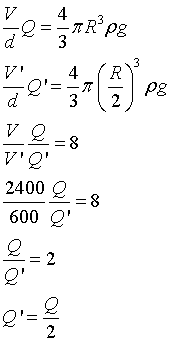
in Millikan's oil drop experiment an oil drop carrying a charge Q is held stationary by a potential difference 2400 V between the plates. To keep a drop of half the radius stationary the potential difference had to be made 600V. What is the charge on the second drop
-
0%
a) Q/4
-
0%
b) Q/2
-
0%
c)Q
-
100%
d)3Q/2
Explanation
Q.21.
A charge of 5C experiences a force of 5000N when when it is kept in uniform electric field. What is the potential difference between two points separated by distance 1cm
-
50%
a) 10 V
-
50%
b) 250 V
-
0%
c) 1000V
-
0%
d) 2500V
Q.22.
Two equal charges q of opposite sign separated by a distance 2a constitute an electric dipole of dipole moment p. If P is a point at a distance r from the centre of the dipole and the line joining the centre of dipole to this point makes an angle θ with the axis of the dipole, then the potential at P is given by ( r > > 2a)
-
100%
a)

-
0%
b)

-
0%
c)

-
0%
d)

Q.23.
Two infinitely long parallel wires having linear charge density λ1 and λ2 respectively are placed at a distance of R meters wire will be
-
50%
a)

-
50%
b)

-
0%
c)

-
0%
d)

Q.24.
The electric field potential V is given as function of distance by V=5x2 +10x -9 volt. Value o electric field at x=1 m is
-
0%
a) 20 V/m
-
0%
b) 6 V/m
-
100%
c)11 V/m
-
0%
d)-23 V/m
Q.25.
Two metal pieces having a potential difference of 800V are 0.02 m apart horizontally. A particle of mass 1.96×10⁻¹⁵ kg is suspended in equilibrium between the plates. If e is elementary charge, then charge on the particle is
-
50%
a) e
-
50%
b) 3e
-
0%
c) 6e
-
0%
d) 8e
Q.26.
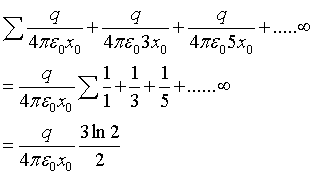
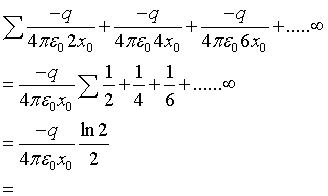
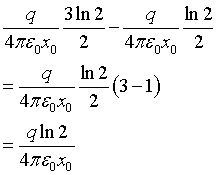
A charge +q is fixed each of the points x=xo, x=3xo, x=5xo ...∞ on the x axis and charge -q is fixed at each point s x=2xo, x=4xo , x=6xo....∞ . Here xo is a positive constant. Take the electric potential at a point due to a charge q at a distance from it to be q/(πεor), then, the potential at the origin due to the system of charge is
-
50%
a)0

-
0%
b)

-
0%
c)∞
-
50%
d)
Explanation
Q.27.
A non-conducting ring of radius 0.5m carries a total charge of 1.11×10⁻¹C distributed non-uniform;y on its circumference producing electric field everywhere in space. The value of the line integration of -E.dl form infinity to l=0 centre of ring is in volt is..
-
0%
a) +2
-
0%
b) -1
-
50%
c)-2
-
50%
d)zero
Q.28.
Point charges +4q, -q and -4q are kept on the x-axis at points x=0, x=a, and x=2a respectively, then
-
33%
a) only -q is in stable equilibrium
-
33%
b) none of the charges are in equilibrium
-
0%
c)all the charges are in unstable equilibrium
-
33%
d)all the charges are in stable equilibrium
Q.29.
In electric field, a 6.75µC charge experiences 2.5N force, when placed at distance of 5m from the origin. Then the potential gradient at this pont will be
-
0%
a) 5.71×10⁵
-
50%
b) 3.71×10⁵
-
50%
c) 18.81×10⁵
-
0%
d) 1.881×10⁵
Q.30.
A solid conducting sphere having a charge Q is surrounded by an uncharged concentric conducting hollow spherical shell. Let the potential difference between the surface of the solid sphere and that of the outer surface of the hollow shell be V. If the shell is now given a charge of 3Q the new potential difference between the same two surface is
-
0%
a)V
-
100%
b)2V
-
0%
c) 4V
-
0%
d)-2V
Q.31.
The electro static pressure on a charged surface having a surface charge density σ C/m2 is
-
50%
a) σ2 / 2εo
-
0%
b) σ2 / εo
-
0%
c)Σ / εo
-
50%
d)Σ / 2εo
Q.32.
In a region where E=0, the potential V varies with distance r as
-
0%
a) V ∝ (1/r)
-
50%
b) V ∝ r
-
0%
c)V ∝ (1/r2)
-
50%
d)V=constant independent of r
Q.33.
The surface of a conductor
-
0%
a) is a nonequivalent surface
-
0%
b) has all the points at the same potential
-
0%
c) has different points at different potential
-
100%
d) has at least two points at the same potential
Q.34.
A conductor gets a charged of 60pC when it is connected to a battery of emf 6mV. Then the capacitance of the conductor is ...
-
0%
a)120×10-6 F
-
50%
b) 1.2×10⁻⁹ F
-
50%
c)10×10-9 F
-
0%
d)10×10- F
Q.35.
Farad is not equivalent to
-
0%
a) Q/V
-
0%
b) J/V2
-
50%
c)Q2 / J
-
50%
d)CV2
Q.36.
To charged conductor having capacities 2C and C potential V and V/2 respectively. The ratio in their energies will be
-
50%
a) 1 : 2
-
0%
b) 2 : 1
-
50%
c)8 : 1
-
0%
d)1 : 8
Q.37.
Two conductors having capacities 2µF and 5µF and potentials 2 volt and 10 volt respectively. The ratio in their charges after connecting by wire will be
-
0%
a) 2 : 5
-
25%
b) 5 : 2
-
75%
c) 1 : 5
-
0%
d) 5 : 1
Q.38.
A gold leaf electroscope is positively charged and an earthed conducting plate is brought neat it, then
-
33%
a)capacity remains same, potential decreases, charge increases
-
0%
b) capacity decreases, potential decreases, charge remains constant
-
67%
c)capacity increases, potential decreases, charge remains constant
-
0%
d)capacity remains same, potential increases, charge increases
Q.39.
The net charge on a condenser is
-
0%
a) 2q
-
0%
b) 9/2
-
100%
c)zero
-
0%
d)∞
Q.40.
Two capacitor C1 and C2 have equal amount of energy stored in them. The ratio of P.D across their plates is
-
0%
a) √( C2 / C1)
-
50%
b) √( C1 / C2)
-
25%
c)1 : 2
-
25%
d) 2 : 1
Q.41.
If the distance between the plates of a capacitor is d and potential difference is V then the energy density will be
-
0%
a)

-
0%
b)

-
33%
c)

-
67%
d)

Q.42.
Calculate the heat generated when a condenser of 100µF capacity and charge to 200 volts is discharged through a 2Ω resistance
-
0%
a)0
-
50%
b) 2 J
-
50%
c)1 J
-
0%
d)4 J
Q.43.
No current flows between two charged bodies connected together when they have the same
-
50%
a) capacitance or Q/V ratio
-
0%
b) charge
-
0%
c)resistance
-
50%
d)potential or Q/C ratio
Q.44.
The capacity of a parallel plate capacitor is 5µF . When glass plate is placed between the plates of the condenser, its potential becomes 1/8 th of the original value. The value of the dielectric constant will be
-
50%
a) 1.6
-
50%
b) 5
-
0%
c)8
-
0%
d)40
Q.45.
The capacity of parallel plate air condenser is 2µµF. If the distance between the plates is 4cm and the area of each plate is 0.01 m2, the value of permitivity of air and its units are respectively
-
0%
a) 8 ×10-12 farad/ meter
-
50%
b) 5 ×10-13 farad/ meter
-
50%
c) 8 ×10-14 farad meter
-
0%
d) 5 ×10-13 farad meter
Q.46.
The energy of a charged capacitor resides in
-
0%
a)the electric field only
-
0%
b) the magnetic field only
-
0%
c)both electric and magnetic field
-
100%
d)neither in electric nor magnetic field
Q.47.
A capacitor of capacity has charge Q and stored energy W. If the charge is increased to 2Q the stored energy will be
-
0%
a) 2W
-
0%
b) W/2
-
0%
c)4W
-
100%
d)W/4
Q.48.
An infinite number of capacitors of capacitance C, 4C, 16C, 64C ....∞ are connected in series, their resultant capacitance will be
-
50%
a) ∞
-
0%
b) C/2
-
0%
c)4C/3
-
50%
d)3C/4
Q.49.
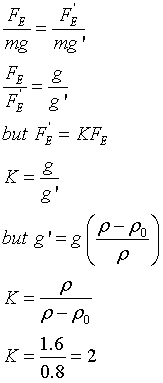
Two identical spheres are suspended in air by string of equal lengths and makes an angle 30° with each other. When suspended in liquid of density 0.5 gm cm-3 the angle remains the same. The dielectric constant of the liquid is ..[ Density of material of sphere is 1.6 gm cm-3
-
0%
a)1
-
50%
b) 2
-
0%
c)3
-
50%
d)4
Explanation
Q.50.
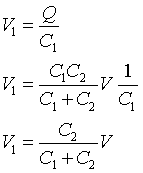
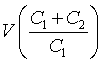
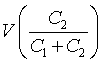
Two capacitances of capacity C1 and C2 are connected in series and potential difference V is applied across it. Then the potential difference across C1 will be
-
0%
a)

-
50%
b)
-
0%
c)
-
50%
d)
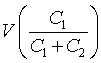
Explanation