Q.1.
in 1g of solid, there are 5×10²¹ atoms. If one electron is removed from every one of 0.01% of atoms of the solid, the charge gained by the solid is
-
75%
a) +0.08 C
-
25%
b) 0.8C
-
0%
c)-0.08C
-
0%
d)-0.8C
Q.2.
You are travelling in a car during a thunder storm. In order to protect yourself from lightning would you prefer to
-
67%
a) remain in the car
-
0%
b) take shelter under a tree
-
0%
c)get out and lie flat on the ground
-
33%
d)touch the nearest electric pole
Q.3.
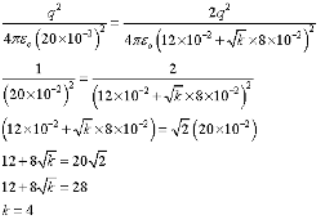
Two point charges placed at a distance of 20cm in air repel each other with certain force. When a dielectic slab of thickness 8cm and dielectric constant K is intoduced between these point charges, the force of interaction becomes half of its previous value. Then K is approximately
-
67%
a) 2
-
0%
b) 4
-
33%
c) √2
-
0%
d) 1
Explanation
Q.4.
Capacitor C, 2C, 4C, ...∞ all are connected in parallel, their effective capacitance will be
-
25%
a)C
-
0%
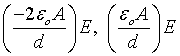
b) C/2
-
25%
c) ∞
-
50%
d)0
Q.5.
A one micro ampere beam of protons with a cross-sectional area of 0.5 sq.mm is moving with velocity of 3×10⁴ m/sec. Then the charge density of the beam is
-
33%
a)6.6 ×10⁻⁹ coulomb per metre3
-
0%
b) 6.6 ×10⁻⁷ coulomb per metre3
-
67%
c)6.6 ×10⁻⁶ coulomb per metre3
-
0%
d)6.6 ×10⁻⁵ coulomb per metre3
Q.6.
A metal sphere is held fixed on a smooth horizontal insulated plate and another small metal sphere is placed at some distance away. If the fixed sphere is given a charge, then
-
0%
a) the another sphere will be attracted towards first
-
33%
b) the another sphere will be repelled by the first
-
33%
c)there will be no effect at all
-
33%
d)the another sphere will move towards the first sphere and after contact it will be repelled
Q.7.
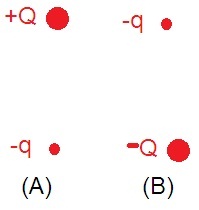
In the following diagram a particle with small charge -q is free to move up or down but not sideways near a larger fixed charge Q. The small charge is in equilibrium because in the positions shown shown the electrical upward force is equal to the weight of the particle. Which statement is true
-
100%
a)In fiure A, -q is in stable equilibrium
-
0%
b) In figure A , -q is in neutral equilibrium
-
0%
c)in figure B , -q is in stable equilibrium
-
0%
d)neither in figure A nor in B, q is in stable equilibrium
Q.8.
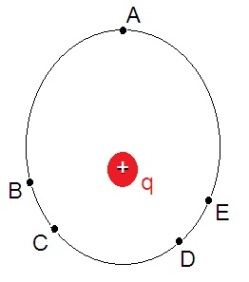
In the electric field of a point charge q, a certain charge is carried from point A to B, C, D, and E. Then work done :
-
33%
a) is least along the path AB
-
0%
b) is least along the path AD
-
33%
c) is zero along any one of the path AB, AC, AD, AE
-
33%
d) is least along AE
Q.9.
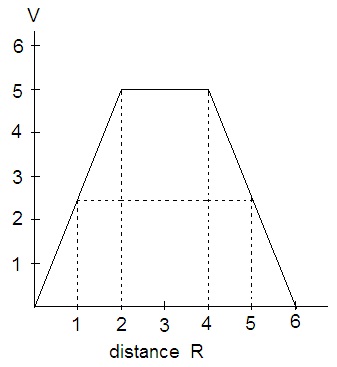
The variation of potential with distance R from a fixed point is as shown below. The electric field at R=5m is
-
0%
a)2.5 volts/m
-
33%
b) -2.5 volts/m
-
67%
c)2/5 volts/m
-
0%
d)-2/5 volts/m
Q.10.
A table tennis ball, which has been covered with a conducting paint is suspended by a silk thread so that it hangs between two metal plates. One plate is earthed, while the other plate is attached to the heigh voltage generator the ball
-
0%
a) is attracted to the high voltage plates and stay there
-
33%
b) hangs without moving
-
0%
c)swings backward and forward hitting each plate in turn
-
67%
d)is repelled by the earthed plate and stays there
Q.11.
A small circular ring has a uniform charge distribution. On a far-off axial point distant x from the centre of the ring, the electric field is proportional to
-
0%
a) x-1
-
33%
b) x-3/2
-
0%
c)x-2
-
67%
d)x5/4
Q.12.
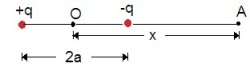
In figure A is a point on the axis of an electric dipole. The electric field at the location of A is E, If distance of of point A is doubled from O, the field will be ( assume x > a)
-
50%
a) E/4
-
0%
b) E/8
-
25%
c) E/2
-
25%
d) E
Q.13.
Two insulated charged sphere of radii 20cm and 25cm respectively and having an equal charge Q are connected by a copper wire and then they are separated
-
0%
a)Both the spheres will have the same charge Q
-
0%
b) Charge on the 20cm sphere will be greater than that on the 25cm sphere
-
67%
c) Charge on the 25cm sphere will be greater than that on the 20cm sphere
-
33%
d)Charge on each sphere will be 2Q
Q.14.
Six identical capacitors are joined in parallel, charged to a potential difference of 10V, separated and then connected in series. Then the potential difference between the free plates is
-
0%
a) 10 V
-
33%
b) 30 V
-
0%
c)60 V
-
67%
d)10/6 V
Q.15.
A parallel plate capacitor is made by taking n equally spaced plates connected alternate. If the capacitance between ant two successive plates is C, then the capacitance of equivalent system is
-
0%
a) C
-
0%
b) nC
-
67%
c)(n-1)C
-
33%
d)(n+1)C
Q.16.
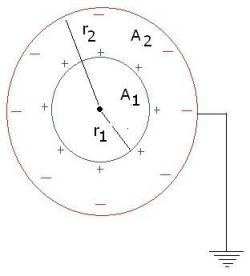
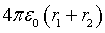
Two spherical conductors A1 and A2 of radii r1 and r2 ( r2 > r1 ) are placed concentrically in air. A1 is given a charge +Q while A2 is earthed. Then the equivalent capacitance of the system is
-
33%
a)

-
33%
b)
-
0%
c) 4πεor2
-
33%
d) 4πεor1
Q.17.
A charged conductor of radius R is connected momentarily to another uncharged spherical conductor of radius r by means of thin conducting wire, then the ratio of the surface charge density of the first to the second conductor is
-
0%
a)R2 / r2
-
50%
b) R/r
-
0%
c)r/R
-
50%
d)1/1
Q.18.
A parallel plate air capacitor has a capacitance of 100µµF. The plates are at a distance d apart. A slab of thickness (t < d) and dielectric constant 5 is introduced between the parallel plates. Then the capacitance can be
-
0%
a) 50 µµF
-
0%
b) 100 µµF
-
50%
c)200 µµF
-
50%
d)500 µµF
Q.19.
A parallel plate capacitor has circular plates of 10 cms radius separated by an air gap of 1mm. It is charged by connecting the plates to a 100V battery. Then the change in energy stored in the capacitor when the plates are moved to a distance of 1cm. When the plates are maintained in connection with battery is
-
0%
a) loss of 12.5 erg
-
0%
b) gain of 12.5 ergs
-
100%
c)gain of 125 ergs
-
0%
d)loss of 125 ergs
Explanation
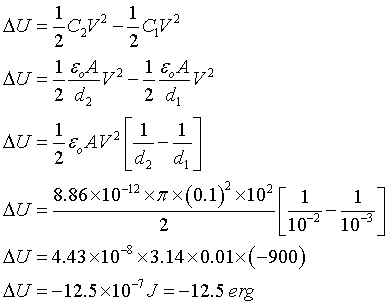
Q.20.
A foil of aluminum of negligible thickness is inserted in between the space of a parallel plate condenser. If the foil is electrically insulated, the capacity of the condenser will
-
50%
a) increase
-
0%
b) decrease
-
0%
c) remain unchanged
-
50%
d) become zero
Q.21.
A capacitor C1=4µF is connected in series with another capacitor C2=1µF. The combination is connected across a d.c. source of voltage 200 V. The ratio of potential across C2 and C1 is
-
0%
a)1:4
-
50%
b) 4:1
-
50%
c)1:2
-
0%
d)2:1
Q.22.
A parallel plate capacitor has a capacity C. The separation between plates is doubled and a dielectric medium is inserted between plates. The new capacity is 3C. The dielectric constant of medium is
-
0%
a) 1.5
-
67%
b) 3.0
-
0%
c)6.0
-
33%
d)12.0
Q.23.
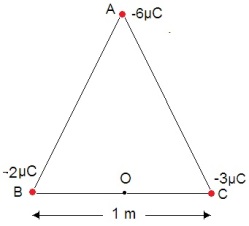
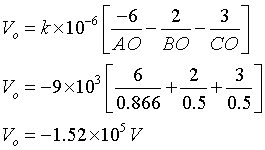
ABC is an equilateral triangle of side 1m. Charges are placed at its corners as shown in figure. O is the mid point of side BC. The potential at point is
-
33%
a)2.7×10³ V
-
33%
b) 1.52×10⁵ V
-
0%
c)1.3×10³ V
-
33%
d)-1.52×10⁵ V
Explanation
Q.24.
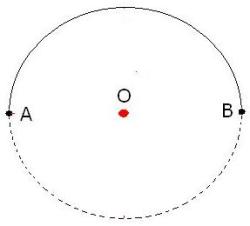
A charge particle of charge qo is moved around a charge +q along the circular path from A to B . the work done is :
-
50%
a)

-
0%
b)

-
50%
c)

-
0%
d)zero
Q.25.
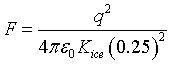
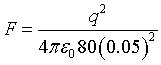
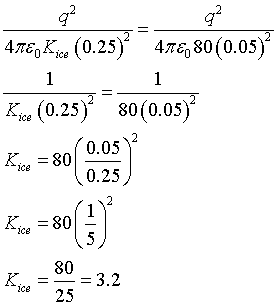
two balls with equal charges are in vessel with ice at -10°C at a distance of 25cm from each other. On forming water at 0°C, the balls are brought nearer to 5cm from the interaction between them to be same. If the dielectric constant of water at 0°C is 80, the dielectric constant of ice at -10°C is
-
50%
a) 40
-
0%
b) 3.2
-
0%
c)20
-
50%
d)6.4
Explanation
Q.26.
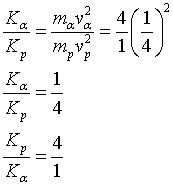
A free proton and a free α-particle initially at a separation of 1Å are released, the kinetic energy of proton and that of α particle when at infinite distance, bears the ratio
-
0%
a) 1 :1
-
50%
b) 1:2
-
0%
c) 14:4
-
50%
d) 4:1
Explanation
Q.27.
In the given figure the resultant capacity will be
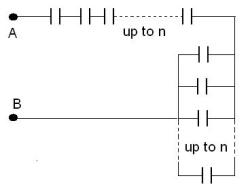
-
33%
a) n ( n+1)C
-
33%
b) n (n2+1)C
-
33%
c)nC / (n2 + 1)
-
0%
d)n2C /(n2 + 1)
Q.28.
A charge +q is carried from a point A(r,135°) to point B(r, 45°) following a path which is quadrant of circle of radius r. If the dipole moment is P. the ork done by the external agent is
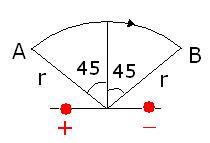
-
50%
a)zero

-
50%
b)

-
0%
c)

-
0%
d)
Explanation
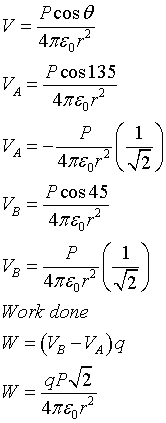
Q.29.
A metallic plate of thickness t and face area of one side A is inserted between the plates of parallel plate air capacitor with a separation d and face area A. Then the equivalent capacitance is
-
50%
a) εoA/d
-
0%
b) εoA/ (d×A)
-
0%
c)εoA/ (d-t)
-
50%
d)εoA/ (d+t)
Q.30.
A parallel plate capacitor is charged and then isolated. What is the effect of increasing the plate separation
-
0%
a) Charge remains constant, Potential remains constant, Capacitance decreases
-
0%
b) Charge increases, Potential increases , Capacitance decreases
-
0%
c)Charge remains constant, Potential decreases, Capacitance increases
-
100%
d)Charge remains constant, Potential remains increases, Capacitance decreases
Q.31.
If two conducting spheres are separately charged and then brought in contact ---
-
0%
a) the total energy of the two spheres is conserved
-
0%
b) the total charge on the two spheres is conserved
-
50%
c) both the total energy and charge are conserved
-
50%
d) the final potential is always the mean of the potential of the two spheres
Q.32.
A parallel plate capacitor is charged and then disconnected from the battery. If the plates of the capacitor are then moved away from each other by the use of insulated handel, then there is increase in
-
0%
a)the charge on either plate
-
0%
b) the capacitance of the capacitor
-
100%
c)voltage across the capacitor
-
0%
d)all the above three
Q.33.
Two identical air filled parallel capacitors are charged to the same potential in the manner shown in figure by closing the switch S. If now the switch is opened and the space between the plates if filled with a dielectric of relative permitivity εr then
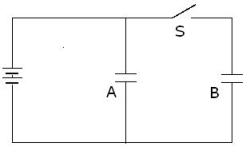
-
50%
a) the p.d across A remains constant and the charge on B remains unchanged
-
0%
b) the p.d. across B remains constant while the charge on A remains unchanged
-
0%
c)the p.d. as well as charge on each capacitor goes up by a factor εr
-
50%
d)the p.d as well as the charge on each capacitor down up by a factor εr
Q.34.
What physical quantity may X and Y represent? ( Y represent first mentioned quantity)
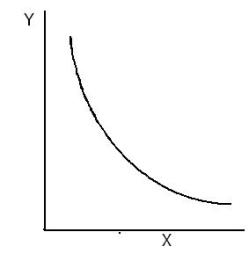
-
0%
a)pressure v/s temperature of given gas at constant volume
-
50%
b) kinetic energy v/s velocity of particle
-
0%
c)capacitance v/s charge to given constant potential
-
50%
d)potential v/s capacitance to given constant charge
Q.35.
The two condensers of capacitance 2 and 3µF are in series. The outer plate of the first condenser is at 1000 V and the outer plate of the second condenser is earthed. The potential of the inner plate of each condenser is
-
0%
a) 300 V
-
0%
b) 500 V
-
100%
c) 600 V
-
0%
d) 400 V
Explanation
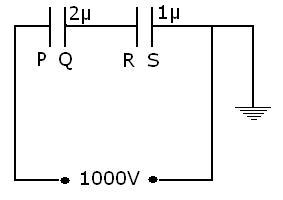
Q.36.
The area of the plates of parallel plate condenser is 100cmThe paper ( K=2.5) of thickness 0.005 cm is pit in between the plates. If the paper can tolerate a field of 5×10⁷ volts/m, the minimum potential difference up to which the condenser can be charged is
-
33%
a) 2500 Volts
-
33%
b) 7500 Volts
-
0%
c)500 Volts
-
33%
d)10000 Volts
Q.37.
The capacitance of a parallel plate capacitor is 2.5µF. When it is half filled with dielectric as shown in the figure, its capacitance becomes 5µF. The dielectric constant of the dielectric is
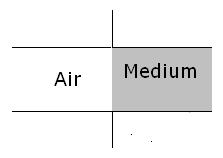
-
50%
a) 7.5
-
0%
b) 3
-
50%
c) 0.33
-
0%
d) 4
Explanation
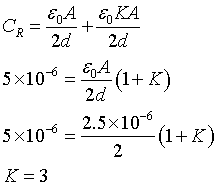
Q.38.
A number of capacitors, each of capacitance 1µF and each one of which gets punctured if a potential difference just exceeding 500V is applied, are provided. Then an arrangement suitable for giving a capacitor of capacitance 3µF across which 2000V may be applied requires at least
-
0%
a)4 component capacitor
-
50%
b) 12 component capacitor
-
0%
c)48 component capacitor
-
50%
d)3 component capacitor
Q.39.
Three capacitors, with capacitance of 1µF, 2µF, 3µF, are connected in series. Each capacitor gets punctured if potential difference just exceeding 100 volt is applied. If the group is connected across a 300 Volt circuit then the capacitor most likely to puncture first is
-
0%
a) of capacitance 1µF
-
0%
b) of capacitance 2µF
-
0%
c)of capacitance 3µF
-
100%
d)of capacitance either 1µF, 2µF, 3µF
Q.40.
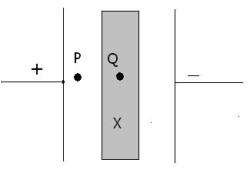
A slab X is placed between the two parallel isolated charged plates, as shown. IF Ep and Eq denotes the intensity of electric field at P and Q
-
50%
a) Ep is reduced by the presence of X if X is metallic
-
0%
b) Eq is increased by the presence of X if X is dielectric
-
0%
c)Eq is in opposite sense to Ep if X is a dielectric
-
50%
d)Eq is zero if X is metallic
Q.41.
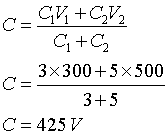
Two spherical conductors of capacitances 3.0pF and 5.0pF are charged to potentials of 300V and 500V. The two are connected resulting in redistribution of charges. Then the final potential is
-
50%
a) 300 V
-
0%
b) 500 V
-
0%
c) 425 V
-
50%
d) 400 V
Explanation
Q.42.
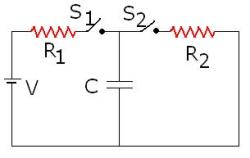
A battery of e.m.f V volts, resistors R1 and R2, a condenser C and switches S1 and S2 are connected in a circuit as shown in the figure below. The condenser will get fully charged to V volts when
-
50%
a)S1 and S2 are both closed
-
0%
b) S1 and S2 are both open
-
0%
c)S1 is open and S2 is closed
-
50%
d)S1 is closed and S2 is open
Q.43.
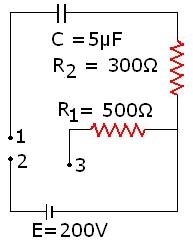
In the circuit shown in figure the key is first inserted between points 1 andThen keey is inserted between 1 andThe heat produced in 300Ω resistance is
-
100%
a) 10J
-
0%
b) 6.25 J
-
0%
c)3.75 J
-
0%
d)7.8 J
Q.44.
The amount of work done in increasing the voltage across the plates of a capacitor from 5V to 10V is W. The work done in increasing it from 10V to 15V will be
-
0%
a) 0.6W
-
0%
b) W
-
100%
c)1.25W
-
0%
d)1.67W
Q.45.
A parallel plate capacitor is charged to 100volts and then connected to an identical capacitor in aparallel. The second capacitor has some dielectric between its plates. If the common potential is 20V then the dielectric constant of the dielectric is
-
50%
a) 2.5
-
0%
b) 4
-
0%
c) 5
-
50%
d) 8
Q.46.
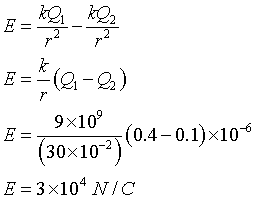
The electric field midway between two charges 0.1µC and 0.4µC separated by a distance of 60cm is
-
50%
a) 5 ×10³ N/C
-
0%
b) 9 ×10⁴ N/C
-
0%
c)5 ×10⁴ N/C
-
50%
d)3 ×10⁴ N/C
Explanation
Q.47.
Two identical parallel plate capacitors are connected in series and connected to a constant voltage source of Vo Volt. If one of the capacitors is completely immersed in a liquid of dielectric constant K, the potential difference between the plates of the other capacitor change to
-
0%
a)

-
33%
b)

-
33%
c)

-
33%
d)

Q.48.
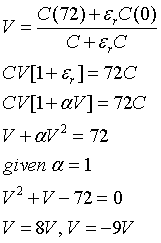
A parallel plate capacitor is filled by a dielectric whose permitivity varies with applied voltage according to relation εr=αV where α=1 volt-The same capacitor containing no dielectric charged to a voltage of 72 V is connected parallel to the first non liner uncharged capacitor. The final voltage across capacitor is
-
0%
a) 19V
-
0%
b) 6V
-
50%
c)36V
-
50%
d)8V
Explanation
Q.49.
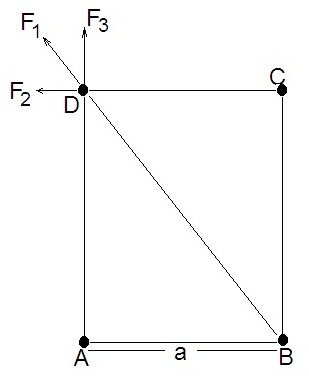
In a circuit diagram potential difference between points A and B is 200 volts, the potential difference between a and b when the switch S is open is
-
50%
a) 100 V
-
50%
b) (200/3) V
-
0%
c)(100/3)V
-
0%
d)50 V
Q.50.
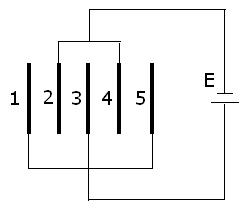
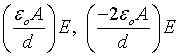
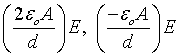
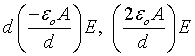
Five identical capacitor plates, each of area A , are arranged such that the adjacent plates are at a distance d apart. The plates are connected to battery of e.m.f E volts as shown
-
33%
a)
-
0%
b)
-
67%
c)
-
0%
d)