Q.1.
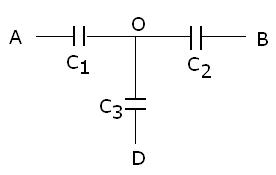
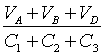
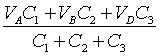
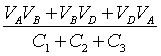
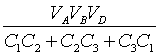
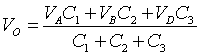
Three uncharged capacitors of capacitance C1, C2 and C3 are connected as shown in figure to one another and to point A, B, and D at potentials VA , VB , VD . then the potential at O will be
-
40%
a)
-
40%
b)
-
0%
c)
-
20%
d)
Explanation
Q.2.
The Gaussian surface for calculating the electric field due to a charge distribution is
-
20%
a) any closed surface around the charge distribution
-
40%
b) any surface near the charge distribution
-
0%
c)a spherical surface
-
40%
d)a symmetrical closed surface at every point of which electric field has a single fixed value
Q.3.
Three capacitors of capacitance 4µF, 6µF and 12µF are connected first in series and then in parallel. What is the ratio of equivalent capacitance in the two cases?
-
0%
a) 2:3
-
50%
b) 1:11
-
0%
c)11:1
-
50%
d)1:3
Q.4.
A parallel plate capacitor has a capacitance of 50pf in air and 105pf when immersed in oil. The dielectric constant of the oil is
-
25%
a) 50/105
-
0%
b) 1
-
25%
c) 2.1
-
50%
d) ∞
Q.5.
When a capacitor is connected to a battery
-
20%
a)an alternating current flows in the circuit
-
20%
b) no current flows at all
-
0%
c)a current flows for some time and finally decreases to zero
-
60%
d)current keeps on increasing and reaches maximum after some time
Q.6.
When a charge q is moved once round a circle of radius R with charge Q at the centre of the circle, work done is
-
50%
a) zero
-
25%
b) Qq / 4πεoR
-
25%
c)Qq / 4πεoR2
-
0%
d)Qq /R
Q.7.
A work of 100 J is performed in carrying a charge of -5C from infinity to a particular point in an electrostatic field. The potential of this point is
-
0%
a) 100V
-
0%
b) 5V
-
100%
c)-20V
-
0%
d)20V
Q.8.
Two copper spheres A and B of same size are charged to some potential. A is hollow and B is solid. Which of the two holds more charge>
-
25%
a) Solid sphere cannot hold any charge
-
0%
b) Hollow sphere can not hold any charge
-
25%
c) Both have zero charge
-
50%
d) Both have same charge
Q.9.
Potential energy of two equal negative point charges 2µC each held apart in air is
-
0%
a)2J
-
67%
b) 2eV
-
0%
c)4J
-
33%
d)0.036J
Q.10.
An electron initially at rest is accelerated through a P.D. of one volt. The energy acquired by electrons is
-
0%
a) 1 J
-
33%
b) 1.6×10⁻¹⁹ J
-
0%
c)10-19 J
-
67%
d)1.6×10⁻¹⁹ erg
Q.11.
The S.I. unit of surface integral of electric field is
-
0%
a) NC-1
-
25%
b) Nm2C
-
50%
c)J/C
-
25%
d)V/m
Q.12.
A bird sitting on a high power line
-
25%
a) gets killed instantly
-
0%
b) gets a mild shock
-
50%
c) is not affected practically
-
25%
d) gets a fatal shock
Q.13.
The number of lines of force that radiate outwards from one coloumb of charge is
-
33%
a)9×10⁹
-
0%
b) 8.85×10⁻¹⁰
-
33%
c)infinite
-
33%
d)1.13×10¹¹
Q.14.
The mutual interaction between two charged bodies is best understood in terms of
-
0%
a) the action at a distance view
-
33%
b) the field concept
-
0%
c)a material connection between the charges
-
67%
d)medium in between the charges
Q.15.
Torque on a dipole in an electric field is maximum when angle between p and E is
-
0%
a) 0°
-
67%
b) 90°
-
0%
c)45°
-
33%
d)180°
Q.16.
When an electric dipole is placed in a uniform electric field, it experiences
-
33%
a) a force as well as torque
-
33%
b) a torque but not force
-
0%
c) a force but not torque
-
33%
d) neither for nor torque
Q.17.
The value of a charge q at the centre of two equal and like charges Q so that the three charges are in equilibrium [ kerala P.M.T 2004]
-
33%
a)-Q/4
-
33%
b) +Q/4
-
0%
c)Q
-
33%
d)Q/2
Q.18.
A charged spherical shell does not produce an electric field at any [ kerala P.M.T. 2004]
-
67%
a) interior point
-
0%
b) outer point
-
0%
c)beyond 2 meters
-
33%
d)beyond 10 meters
Q.19.
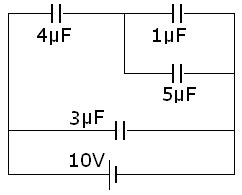
The charge on 4µF capacitor in the given circuit is
-
0%
a)12 µF
-
50%
b) 24 µF
-
25%
c)36 µF
-
25%
d)32 µF
Q.20.
Two equal metal balls are charged to 10 and -20 units of electricity. Then they are brought in contact with each other and then are brought in to original distance. The ratio of magnitudes of force between the two balls before and after contact is [ Kerala P.M.T 2004]
-
25%
a) 8:1
-
50%
b) 1:8
-
0%
c) 1:2
-
25%
d) 2:1
Q.21.
A conductor having a cavity is given a positive charge. Then field strengths EA, EB and EC at points A ( with in cavity) at B (within conductor) and C ( outside conductor) will e [ kerala P.M.T 2004]
-
0%
a)EA=0, EB=0, EC=0
-
25%
b) EA=0, EB=0, EC ≠=0
-
50%
c)EA ≠=0, EB=0, EC≠=0
-
25%
d)EA ≠=0, EB≠=0 , EC≠=0
Q.22.
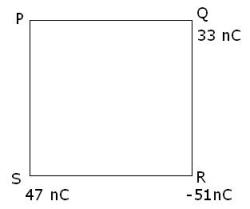
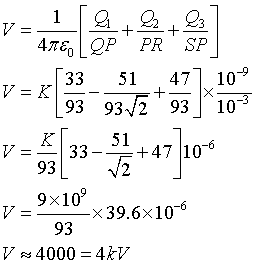
The potential at point P, which is forming a corner of a square of side 93mm with charges Q1=33 nC, Q2 -51 nC, Q3=47nC located at the other three corners is nearly [ kerala P.E.T 2004]
-
0%
a) 16 kV
-
0%
b) 4 kV
-
50%
c)400 V
-
50%
d)160 V
Explanation
Q.23.
The plates of a parallel plate capacitor are charged up to 100V. A 2mm thick plate is inserted between the plates, then to maintain the same potential difference between capacitor plates, the distance between the capacitor plate is increased by 1.6 mm. The dielectric constant of the plate is
-
50%
a)5
-
0%
b) 1.25
-
50%
c)4
-
0%
d)2.5
Q.24.
If one penetrates a uniformly charged spherical shell, the electric field strength E
-
0%
a) increases
-
0%
b) decreases
-
50%
c)remains same as surface
-
50%
d)is zero at all points
Q.25.
Two small spheres, each carrying a charge q, placed r meters apart, repel each other with a force F. If one of the spheres is taken around the other one in a circular path of radius r, the work done will be
-
0%
a) F × r
-
0%
b) F × 2πr
-
50%
c)F / 2πr
-
50%
d)zero
Q.26.
An electric dipole consists of two opposite charges each of magnitude 1.0µC separated by a distance of 2.0cm. The dipole is placed in an external field of 1.0×10⁵ N/C. The max. torque on the dipole is
-
0%
a) 0.2×10⁻³ N-m
-
0%
b) 1.0×10⁻³ N-m
-
100%
c) 2.0×10⁻³ N-m
-
0%
d) 4.0×10⁻³ N-m
Q.27.
A positively charged sphere hangs from a silk thread. We put a positive test charge qo at a point and measure F/qo then it can be predicted that the electric field strength E is
-
0%
a) > F/qo
-
0%
b)=F/qo
-
50%
c)< F/qo
-
50%
d)can not be estimated
Q.28.
A hollow metallic sphere of radius 10cm is given a charge of 3.2×10⁻⁹ C. The electric intensity at a point 4cm from the centre is
-
0%
a) 9×10⁻⁹ V
-
0%
b) 288 V
-
0%
c)2.88 V
-
100%
d)zero
Q.29.
The electric potential at the surface of an atomic nucleus ( Z=50) of radius 9.0×10⁻¹⁵ m is
-
0%
a) 80V
-
0%
b) 8 ×10⁶V
-
50%
c)9 Volts
-
50%
d)9 ×10⁵ volts
Q.30.
Hollow metal sphere of radius 5 cm is charged such that the potential on its surface is 10V. The potential at a distance of 2cm from the centre of the sphere is
-
0%
a) zero
-
0%
b) 10 V
-
0%
c) 4 V
-
100%
d) 10/3 V
Q.31.
Particle A has charge +Q and particle B has charge +4Q with each of them having the same mass. When allowed to fall from rest through same electrical potential difference, ratio of their speed VA / VB will become
-
0%
a)2:1
-
33%
b) 1:2
-
33%
c)1:4
-
33%
d)4:1
Q.32.
Which of the following is a volt
-
0%
a) erg per cm
-
50%
b) joule per coulomb
-
0%
c) erg per ampere
-
50%
d) newton/(coulomb×metre2)
Q.33.
The capacitance of an isolated conducting sphere of radius R is proportional to
-
0%
a) R2
-
0%
b)1 / R2
-
50%
c)1 /R
-
50%
d)R
Q.34.
A condenser is connected across another charged condenser. The energy in the two condenser will
-
0%
a) Be equal to the energy in the initial condenser
-
0%
b) Be less than that in the initial condenser
-
0%
c) Be more than that in the initial condenser
-
100%
d) BE more or less depending on the relative capacitances of the two condenser
Q.35.
Work done in moving a unit positive charge through a distance of x meter on an equipotential surface is [ Panjab C.E.T 1997]
-
0%
a)x joule
-
50%
b) (1/x) joule
-
0%
c)zero
-
50%
d)x2 joule
Q.36.
If a positive charge is shifted from lower potential to region of higher potential region, the electric potential energy
-
0%
a) decreases
-
0%
b) increases
-
0%
c)remains same
-
100%
d)may increase / decrease
Q.37.
If the flux of electric field through a closed surface is zero
-
0%
a) electric field must be zero everywhere on the surface
-
0%
b) electric field may be zero everywhere on the surface
-
0%
c)charge in the vicinity of the surface must be zero
-
100%
d)charge inside the surface must be zero
Q.38.
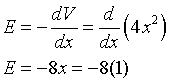
The electric potential V at any point x, y, z ( all in meters) in space is given by V=4x2 volt. The electric field at the point (1m, 0, 2m) in volt/meter is
-
33%
a) 8 V/m along negative X -axis
-
0%
b) 8 V/m along positive X -axis
-
33%
c) 16 V/m along negative X axis
-
33%
d) 16 V/m along positive Z axis
Explanation
Q.39.
A block of mass carrying a positive charge q is placed on a smooth horizontal table, which ends in a vertical wall situated at a distance d from block. An electric field E is switched on towards right. Assuming elastic collisions, find the time period of resultant oscillation
-
0%
a)

-
100%
b)

-
0%
c)

-
0%
d)

Q.40.
An electron having a charge -e located at A in the presence of a point charge +Q located at B is moved to a point C so that ABC is an equilateral . The work done in this process is
-
0%
a) Q / 4πεoAC
-
0%
b) Qe / 4πεoAC
-
50%
c)-Qe / 4πεoAC
-
50%
d)zero
Q.41.
An infinite number of charges each equal to q are placed along x-axis at x=1, x=2, x=4, x=8 and so on . the resultant potential at x=0 will be
-
0%
a) q / 2πεo
-
0%
b) q/4πεo
-
50%
c)q/8πεo
-
50%
d)q/εo
Explanation

Q.42.
A solid conducting sphere of charge Q is surrounded by an uncharged concentric conducting spherical shell. The potential difference between the sphere and the shell is V. If the shell is now given a charge of -3Q, the new potential difference between them will be
-
0%
a) V
-
33%
b) 2V
-
33%
c) 4V
-
33%
d) -2V
Q.43.
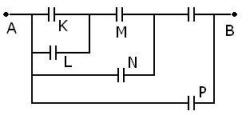
The effective capacitance between A and B is ( each capacitor is of 1µF)
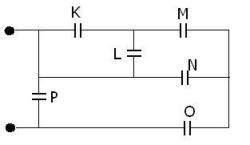
-
33%
a)(15/2) µF
-
0%
b) (17/3)µF
-
0%
c)(13/8)µF
-
67%
d)(19/8)µF
Explanation
Q.44.
Two charged metal spheres of capacitance C1 and C2 are brought in contact and then separated. The final charges Q1 and Q2 on them will satisfy the condition
-
0%
a) Q1C1=Q2C2
-
50%
b) Q1C2 > Q2C1
-
0%
c)Q1C2 < Q2C2
-
50%
d)Q1C2=Q2C1
Q.45.
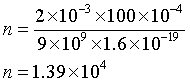
How many electrons must be added to spherical conductor of radius 10cm to produce a field of 2×10⁻³ N/C just above the surface
-
50%
a) 1.39×10⁴
-
0%
b) 1.6×10⁵
-
0%
c)3×10⁴
-
50%
d)9.1×10⁴
Explanation
Q.46.
How should 5 capacitors each of value 1µF be connected so as to produce a total capacitance (3/7)µF?
-
0%
a) Two capacitors in parallel and the combination in series with other three capacitors
-
0%
b) Three capacitors in a parallel and the combination in series with other two capacitors
-
50%
c) Four capacitors in parallel and the combination in series with fifth capacitor
-
50%
d) All capacitor in parallel
Q.47.
A neutron, a proton and an electron are placed in uniform electric field
-
0%
a)The forces acting on them will be equal
-
0%
b) Their accelerations may be equal
-
0%
c)Magnitude of acceleration may be equal
-
100%
d)Magnitude of acceleration will be different
Q.48.
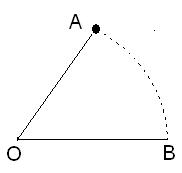
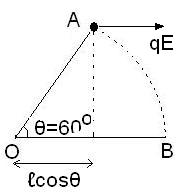
A particle of mass m and charge q is fastened to one end of a string of length l. The other end of the spring is fixed to the point O. The whole system lies on a frictionless horizontal plane. Initially, the mass is at rest at A. A uniform electric field in the direction shown is then switched on. Then
-
0%
a) the speed of the particle when it reaches B is

-
0%
b) the speed of the particle when it reaches B is

-
0%
c)the tension in the string when the particle reaches B is qE
-
100%
d)the tension in the string when the particle reaches B is zero
Explanation
Q.49.
The force between two point charges in vacuum is 15N, if brass plate is introduced between the two charges, then force between them will
-
0%
a) Become zero
-
50%
b) Remains same
-
0%
c)Becomes 30N
-
50%
d)Becomes 60N
Q.50.
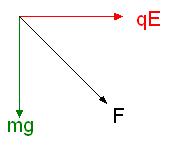
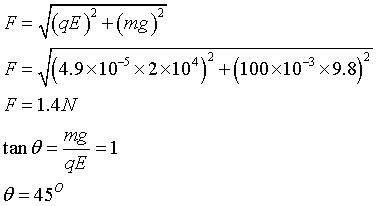
A ball of mass 100 gm and having a charge 4.9×10⁻⁵C is released from rest in vertical region where a horizontal electric field 2×10⁴ N/C exists. The resultant force acting on the ball is
-
0%
a) 1.4 N in the direction of g
-
0%
b) 1.4 N making an angle of 45° with the horizontal
-
100%
c) 0.98 N in the direction of electric field
-
0%
d) 1.96 N along vertical
Explanation