Q.1.
Which of the following are the most distantly related to one another?
-
33%
a) Sunfish and dolphins.
-
33%
b) Tree frogs and snakes.
-
0%
c) Vampire bats and birds.
-
33%
d) Bears and whales.
Q.2.
A. : Arrhenius considered the panspermia mainly responsible for transfer for germs from other planets to Earth. R. : Present day study of meteorities as Allan Hills-84001 knocked out from Mars in Antarctica is rich aromatic hydrocarbons deposited by biological activity.
-
40%
a) If A and R both are true and R is correct explanation of A
-
40%
b) If A and R both are true but R is not correct explanation of A
-
0%
c) If A is true and R is wrong
-
20%
d) If A is wrong and R is true
Q.3.
What was the resultant found in place marked E ?
-
17%
a) Glucose, fatty acids and lipids
-
33%
b) Some fatty acids and organic acids
-
33%
c) Some amino acids as glycine and alanine and
-
17%
d) Organic esters only
Q.4.
Mega – evolution is ______.
-
0%
a) Changes in the gene pool
-
40%
b) evolution due to mutations
-
60%
c) origin of a new biological group
-
0%
d) the evolution that takes centuries
Q.5.
The earliest organisms were ______.
-
20%
a) heterotrophic and anaerobic
-
0%
b) autotrophic and anaerobic
-
60%
c) heterotrophic and aerobic
-
20%
d) autotrophic and aerobic
Q.6.
A. : The first molecules formed for replicating cells were most probably RNA. R. : This was proved by origin of ribozyme in 1987 by T. Cech in Tetrahymena.
-
100%
a) If A and R both are true and R is correct explanation of A
-
0%
b) If A and R both are true but R is not correct explanation of A
-
0%
c) If A is true and R is wrong
-
0%
d) If A is wrong and R is true
Q.7.
The determine which molecules might have formed spontaneously on early earth, Stanley Miller used an apparatus with an atmosphere containing ______.
-
40%
a) oxygen, hydrogen and nitrogen
-
40%
b) oxygen, hydrogen, ammonia and water vapour
-
0%
c) oxygen, hydrogen and methane
-
20%
d) hydrogen, ammonia, methane and water vapour
Q.8.
Anaerobic photosynthetic bacteria appeared on the earth about ______.
-
25%
a) 500 million years ago
-
25%
b) 1500 million years ago
-
0%
c) 2500 million years ago
-
50%
d) 3500 million years ago
Q.9.
Which one of the following terms would most correctly describe the relationship between the flight organs of animals like locust, bat, swallow, and flying fish ?
-
50%
a) Atavism
-
25%
b) Analogous
-
25%
c) Homologous
-
0%
d) Vestigeal
Q.10.
Many of the animals and plants found on islands are ______.
-
25%
a) endemic
-
0%
b) exotic
-
50%
c) sympatric
-
25%
d) none of these
Q.11.
These are some examples of vestigial structures in man
-
25%
a) wisdom tooth vermiform appendix, hair
-
50%
b) wisdom tooth, vermiform appendix, coccyx
-
25%
c) wisdom tooth, head, nails
-
0%
d) none of these
Q.12.
A. : Ear muscles of external ear in man are poorly developed R. : These muscles are useful which move external ear freely to detect sound efficiently.
-
25%
a) If A and R both are true and R is correct explanation of A
-
25%
b) If A and R both are true but R is not correct explanation of A
-
25%
c) If A is true and R is wrong
-
25%
d) If A is wrong and R is true
Q.13.
Which one is not a vestigial organ in man ?
-
50%
a) Wisdom teeth
-
0%
b) Muscles of external ear-pinna
-
50%
c) Fossa ovalis
-
0%
d) Ileum
Q.14.
Darwin’s theory of natural selection is objected, because it
-
25%
a) stresses upon slow and small variations
-
25%
b) explains the adaption of certain inherited characters
-
50%
c) stresses on interspecific competition
-
0%
d) explains that natural calamities take a heavy annual toll of lives
Q.15.
Industrial melanism is an example of
-
100%
a) natural selection
-
0%
b) mutation
-
0%
c) adaptive convergence
-
0%
d) artificial selection
Q.16.
A. : All the finches on the Galapagos Islands descended from common ancestor. R. : They show variations only in their beaks as they got adapted to different feeding habits.
-
75%
a) If A and R both are true and R is correct explanation of A
-
0%
b) If A and R both are true but R is not correct explanation of A
-
25%
c) If A is true and R is wrong
-
0%
d) If A is wrong and R is true
Q.17.
Which of the following is from the same lineage as that of Triceratops?
-
0%
a) Stegosaurus.
-
75%
b) Tyrannosaurus.
-
25%
c) Brachiosaurus.
-
0%
d) Pteranodon.
Q.18.
Phylogenetic evolution refers to
-
100%
a) genetic relationship and evolutionary sequence
-
0%
b) similar habitat
-
0%
c) natural affinity of genes
-
0%
d) similar character
Q.19.
Neanderthal man differs from modern man is ______.
-
50%
a) receeding jaw
-
25%
b) protuding jaw
-
25%
c) could make good tools
-
0%
d) could make good picture
Q.20.
Which of the following is the most fit in an evolutionary sense?
-
50%
a) A lion who is successful at capturing prey but has no cubs.
-
25%
b) A lion who has many cubs, eight of which live to adulthood.
-
0%
c) A lion who overcomes a disease and lives to have three cubs.
-
25%
d) A lion who cares for his cubs, two of who live to adulthood
Q.21.
Which of the following is not an example of a monophyletic taxon?
-
100%
a) The first fish species and every living organism that looks like a fish
-
0%
b) The first mammal species and all its descendants.
-
0%
c) The first bird species and all its descendants
-
0%
d) All of the above.
Q.22.
In which of the following ways is natural selection not analogous to artificial selection?
-
50%
a) With natural selection "picking" is due to the fit of an organism with its environment; whereas in artificial selection, the breeder "picks" which organisms will breed.
-
25%
b) Natural selection depends upon the presence of variation, artificial selection does not.
-
0%
c) Natural selection occurs within populations, artificial selection does not.
-
25%
d) There is a limit to how much change can be brought about by natural selection, no such limit exists for artificial selection.
Q.23.
Which of the following is an example of genetic variation?
-
75%
a) Two children have different eye colors.
-
0%
b) One person is older than another
-
0%
c) One person has a scar, but her friend does not.
-
25%
d) Tod eats meat, but his brother Rod is a vegetarian
Q.24.
Select the correct group of homologous structures
-
75%
a) wings of a bird and butterfly
-
0%
b) wings of a pigeon and a bat
-
25%
c) wings of a butterfly and a bat
-
0%
d) Forelimbs of a cow,a duck and a lizard
Q.25.
Mesozoic era is called golden period of ______.
-
50%
a) birds
-
25%
b) amphibians
-
25%
c) reptiles
-
0%
d) pisces
Q.26.
The Haeckel’s theory of biogenetic Law means that ______.
-
0%
a) all organisms start as an egg
-
75%
b) life history of an organism reflects its evolutionary history
-
25%
c) nonliving matter from life
-
0%
d) progeny resembles parents
Q.27.
Coacervates were experimentally produced by .............
-
50%
a) Sydney Fox and Oparin
-
0%
b) Fischer and Huxley
-
25%
c) Jacob and Monod
-
25%
d) Urey and Miller
Q.28.
A. :The first molecules formed for replicating cells were most probably RNA. R. : This was proved by origin of ribozyme in 1987 by T. Cech in Tetrahymena.
-
25%
a) If A and R both are true and R is correct explanation of A
-
50%
b) If A and R both are true but R is not correct explanation of A
-
0%
c) If A is true and R is wrong
-
25%
d) If A is wrong and R is true
Q.29.
The first photoautotroph organisms were ______.
-
0%
a) bryophytes
-
25%
b) algae
-
75%
c) cyanobacteria
-
0%
d) bacteria
Q.30.
The sequence of origin of life may be considered as ______.
-
25%
a) Amino acid Protein Chlorophyll
-
25%
b) Chlorophyll Starch Glycogen
-
50%
c) Nucleic acid Amino acid Chlorophyll
-
0%
d) Chlorophyll Nucleic acid Amino acid
Q.31.
An old view about evolution states that the organisms were created by a super organism in the same condition as they exist now. This theory is called ______.
-
33%
a) theory of special creation
-
0%
b) theory of natural selection
-
33%
c) Lamarck’s theory of evolution
-
33%
d) theory of spontaneous generation
Q.32.
A. : Genetic drift refers to change in allelic frequencies of a gene pool due to chance and occurs both in large and small populations. R. : Small populations will, therefore, suffer more than larger ones.
-
33%
a) If A and R both are true and R is correct explanation of A
-
67%
b) If A and R both are true but R is not correct explanation of A
-
0%
c) If A is true and R is wrong
-
0%
d) If A is wrong and R is true
Q.33.
Mass extinction of the end of Mesozoic era was probably due to ?
-
33%
a) continental drift
-
67%
b) the collision of earth with large meteorites
-
0%
c) massive glaciations
-
0%
d) change in earth’s orbit
Q.34.
A. : Java man and peking men were called Homo erectus by Mayer. R. : They appeared same as both used fire.
-
67%
a) A is correct and R is its explanation.
-
33%
b) A and R both are correct but R is not an explanation to A
-
0%
c) A is correct and R is false
-
0%
d) A is false and R is correct
Q.35.
One of the oldest, best preserved and most complete hominid fossil commonly known as ‘Lucy’ belongs to the genus.
-
33%
a) Oreopithecus
-
0%
b) Dryopithecus
-
0%
c) Pithecanthropus
-
67%
d) Australopithecus
Q.36.
There are two opposing views about origin of modern man, According to the view Homo erectus in Asia were the ancestors of modern man. A study of variation of DNA however suggested African origin of modern man. What kind of observation on DNA variation could suggest this ?
-
67%
a) Greater variation in Africa than in Asia
-
33%
b) Variation only in Asia and no variation in Africa
-
0%
c) Greater variation in Asia than in Africa
-
0%
d) Similar variation in Africa and Asia
Q.37.
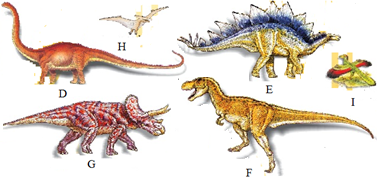
Identify the following figure:
-
0%
a) Pteranodon – H, Stegosaurus – G, Brachiosaurus – D, Archaeopteryx – F, Tyrannosaurus – E, Triceratops – I
-
33%
b) Pteranodon – H, Stegosaurus – E, Brachiosaurus – D, Archaeopteryx – I, Tyrannosaurus – F, Triceratops – G
-
33%
c) Pteranodon – H, Stegosaurus – G, Brachiosaurus – E, Archaeopteryx – F, Tyrannosaurus – I, Triceratops – D
-
33%
d) Pteranodon – H, Stegosaurus – E, Brachiosaurus – D, Archaeopteryx – F, Tyrannosaurus – I, Triceratops – G
Q.38.
Present age of human known as ______.
-
67%
a) atomic age
-
33%
b) iron age
-
0%
c) bronze age
-
0%
d) silver age
Q.39.
Assertion : According to Hardy – Weinberg Equilibrium, the frequency of an allele remains the same generation after genetation. Reason : The only way to bring about a change is by natural selection.
-
67%
a) A is correct and R is its explanation.
-
33%
b) A and R both are correct but R is not an explanation to A
-
0%
c)A is correct and R is false
-
0%
d) A is false and R is correct
Q.40.
In a population, group of individuals of similar phenotypes are formed due to differential reproduction due to
-
33%
a) genetic drift
-
33%
b) natural selection
-
0%
c) migration
-
33%
d) selective hybridization
Q.41.
A. : Mutations occurring in the germinal cells of the gonads are called germs mutations. R. : They are heritable raw materials for natural selection lead to origin of new species.
-
100%
a) If A and R both are true and R is correct explanation of A
-
0%
b) If A and R both are true but R is not correct explanation of A
-
0%
c) If A is true and R is wrong
-
0%
d) If A is wrong and R is true
Q.42.
Which statement is correct ?
-
67%
a) Lamarck theory – Struggle for existence
-
0%
b) Darwin theory – Use and disuse of organ
-
33%
c) Biogentic law – Recapitulation theory
-
0%
d) Lamarck theory – Theory of continuity of germplasm
Q.43.
Theory of Lamarck was based on
-
33%
a) adaptive collisions
-
33%
b) adaptive rediations
-
0%
c) adaptive modifications
-
33%
d) none of these
Q.44.
Sympatric speciation arises due to
-
33%
a) non-overlapping population of the same area
-
67%
b) geographical isolation
-
0%
c) overlapping population of the same area
-
0%
d) non-reproductive population of the same area
Q.45.
Potato and sweet potato ______.
-
33%
a) have edible parts which are homologous organs
-
0%
b) have edible part which are analogous organs
-
67%
c) have been introduced in India from the same place
-
0%
d) None of the above
Q.46.
Evolution and natural selection is demonstrated by
-
0%
a) DDT resistance in mosquito
-
67%
b) sickel cell anaemia in pygmies
-
0%
c) industral melanism
-
33%
d) all above
Q.47.
Which of the following leads to evolution ?
-
33%
a) Separation of species leading to evolution
-
0%
b) Differentiation of species
-
0%
c) Loss of few advanced characters
-
67%
d) Differentiation and adaption of species as unique entities
Q.48.
Postanal tail can be traced in ______.
-
33%
a) cobra
-
0%
b) earthworm
-
67%
c) scorpion
-
0%
d) centipede
Q.49.
All mammals, whale, dolphin, bat, monkey and horse have some common trait, but they also show conspicuous differences. This is due to the phenomenon of
-
33%
a) normalisation
-
33%
b) genetic drift
-
0%
c) convergence
-
33%
d) divergence
Q.50.
The best way of dating fossils recent origin is by ______.
-
25%
a) radio carbon method
-
25%
b) uranium lead method
-
0%
c) potassium argon method
-
50%
d) a combination of all these