Q.1.
Which of the following features is not of Homo habilis?
-
0%
a) First human like being.
-
60%
b) 650-800cc brain capacity.
-
20%
c) Did not eat fruit surely.
-
20%
d) Hominid.
Q.2.
Which of the following is placental mammal?
-
20%
a) Bandicoot.
-
20%
b) Numbat
-
40%
c) Wombat.
-
20%
d) Bobcat
Q.3.
Arrange the following in the order of their existence during the history of life forms: (a) Stegosaurus. (b) Brachiosaurus. (c) Triceratops. (d) Tyrannosaurus. (e) Pteranodon. (f)Crocodilian. (g)Archaeopteryx.
-
33%
a) (b) → (a) → (g) → (f) → (e) → (d) → (c).
-
0%
b) (e) → (b) → (g) → (a) → (f) → (c) → (d).
-
67%
c) (g) → (a) → (f) → (b) → (e) → (d) → (c).
-
0%
d) (c) → (a) → (f) → (g) → (d) → (e) → (b).
Q.4.
Which of the following statements is true?
-
100%
a) A British scientist created the conditions proposed by Oparin and Haldane in a closed flask with temperature of 800 degree Celsius in electric discharge along with gases methane, hydrogen, ammonia and water vapour and observed formation of amino acid.
-
0%
b) Some similar experimental setups were also prepared by other scientists and formation of sugar, nitrogenous bases, Pigments and Fats was recorded.
-
0%
c) The processes of chemical evolution were occurring elsewhere in space was concluded by the analysis of content of gaseous cloud.
-
0%
d) The first self replicating metabolic capsule of life arose 3 billion years back.
Q.5.
Why does it is said that looking at stars on a clear night sky means looking back in time?
-
67%
a) What we are seeing at that time is actually has stated its journey trillions of years back
-
0%
b) What we are seeing at that time is actually has stated its journey trillions of days back
-
0%
c) What we are seeing at that time is actually has stated its journey thousands of days back
-
33%
d) What we are seeing at that time is actually has stated its journey thousands of kilometres away.
Q.6.
__________ was a predecessor of Darwin and he developed the theory of acquired characteristics.
-
0%
a) Weismann
-
75%
b) Mendel
-
0%
c) Malthus
-
25%
d) Lamarck
Q.7.
Which of the following is an example of environmental variation?
-
50%
a) Apu is a tongue roller, but his brother Sanjay is not.
-
25%
b) Marge dyes her hair blue.
-
25%
c) Homer inherited baldness from his father's side of the family.
-
0%
d) Patti and Selma have hanging ear lobes.
Q.8.
From the statements given below, which one most likely represents an example of disruptive selection? I. Industrial melanism in peppered moth. II. Population of butterflies that are either all yellow or all blue. III. Population of rabbits that evolves more body fat in response to a cold climate. IV. Population of wrens that evolves to be smaller at sexual maturity in response to predation pressure. V. Very tall and very short pine trees being removed from a population by herbivorey.
-
50%
a) Only II
-
0%
b) II and III
-
50%
c) Only IV
-
0%
d) III and IV
Q.9.
Select the correct statement (s): (i) Microbial experiment show the pre – existing advantageous mutations when selected will result in the observation of new phenotypes. Over a few generations this would result in speciation. (ii) Neanderthal fossilis represent a human relative. (iii) In 1938, a fish caught in South Africa happened to be a coelacanth (lobe fins) which was thought to be extinct. These animals evolved into the first amphibian living both on land and water. (iv) Lichens can be used as pollution indicators. (v) Alfred Wallace, a naturalist who worked in Malay Archipelago (present Indonesia) has also been to similar conclusions on natural selection as reached by Darwin.
-
100%
a) (i) and (ii).
-
0%
b) (i), (ii), (iii) and (iv).
-
0%
c) (iii) and (iv).
-
0%
d) All of these.
Q.10.
Forelimbs of cat, lizard used in walking, forelimbs of whale used in swimming and forelimbs of bats used in flying are examples of:
-
50%
a) Analogous organs.
-
0%
b) Adaptive radiation.
-
25%
c) Homologous organs
-
25%
d) Convergent evolution.
Q.11.
Match the following correctly:
| a. Land reptile went back to water 200mya | 350mya |
| b. Agnatha evolved | Coelacanth fish |
| c. 20 feet in height huge fearsome dagger like teeth | 320mya |
| d. Sea weeds existed early as | Ichthyosaurs |
| e. Ancestors of modern day frogs | Tyrannosaurus rex |
-
0%
a) a=4, b=2, c=3, d=1, e=5
-
100%
b) a=4, b=1, c=5, d=3, e=2
-
0%
c) a=4, b=1, c=5, d=2, e=3
-
0%
d) a=4, b=1, c=3, d=5, e=2
Q.12.
Match the following regards connecting links. Find the correct pair:
-
33%
a) Lung fish – Between bony fish and cartilaginous fishes.
-
0%
b) Eutherians – Between reptiles and mammals.
-
0%
c) Euglena – Between living and non living.
-
67%
d) Neopilina– Between annelida and Arthropoda
Q.13.
Which of the following is not a source of variation in a population?
-
50%
a) Inherited genetic differences.
-
0%
b) Differences due to health.
-
50%
c) Differences due to age.
-
0%
d) None of the above.
Q.14.
Why is the advent of reproductive isolation important from an evolutionary standpoint?
-
100%
a) When the organisms comprising two populations of a species can no longer interbreed, the flow of genetic material between them stops.
-
0%
b) It is not important from an evolutionary standpoint. The question is based on a false assumption.
-
0%
c) Reproductive isolation increases the mutation rate.
-
0%
d) Reproductive isolation may slow reproduction.
Q.15.
Which of the following is the evidence for Darwin's theory of common descent?
-
50%
a) There are patterns in the fossil record that suggest other species have diverged from a single ancestor species.
-
0%
b) There are biogeographic patterns in the distribution of species, for instance distinct bird species on an island tend to resemble one another, suggesting a common ancestor.
-
0%
c) There are common stages in the early embryological development of organisms representing several distinct vertebrate groups.
-
50%
d) All of above
Q.16.
Which of the following must increase over geological time according to evolutionary biologists?
-
50%
a) Size
-
0%
b) Complexity .
-
0%
c) Speed of evolutionary processes such as mutation.
-
50%
d) All of the above.
Q.17.
How does an evolutionary biologist explain why a species of birds has evolved a larger beak size?
-
50%
a) Large beak size occurred as a result of mutation in each member of the population.
-
0%
b) The ancestors of this bird species encountered a tree with larger than average sized seeds. They needed to develop larger beaks in order to eat the larger seeds, and over time, they adapted to meet this need
-
0%
c) Some members of the ancestral population had larger beaks than others. If larger beak size was advantageous, they would be more likely to survive and reproduce. As such, large beaked birds increased in frequency relative to small beaked birds.
-
50%
d) The ancestors of this bird species encountered a tree with larger than average sized seeds. They discovered that by stretching their beaks, the beaks would get longer, and this increase was passed on to their offspring. Over time, the bird beaks became larger.
Q.18.
The earth like other planets formed from ______.
-
0%
a) aggregates of uranium
-
100%
b) cloud of gas and dust
-
0%
c) division of pre-exiting planets
-
0%
d) collisions of meteorites
Q.19.
An important evidence in favour of organic evolution is the occurence of
-
50%
a) homologous and analogous organs
-
50%
b) homologous and vestigial organs
-
0%
c) analogous and vestigial organs
-
0%
d) homologous organs only
Q.20.
Hardy – Weinberg equilibrium is known to be effected by gene flow, genetic drift, mutation, genetic recombination and
-
50%
a) evolution
-
50%
b) limiting factor
-
0%
c) saltation
-
0%
d) natural selection
Q.21.
Apes share ............... blood groups with man
-
50%
a) A, B, AB
-
50%
b) A, B, O
-
0%
c) AB, O
-
0%
d) A and B only
Q.22.
A. : From evolutionary point of view, human gestation period is believed to be shortening. R. : One major evolutionary trend in humans has been the larger head undergoing relatively faster growth rate in the foetal stage. Read the above statement the answer according
-
100%
a) If A and R both one correct and R is an explanation to A
-
0%
b) If A and R both are correct and R is an explanation to A
-
0%
c) If A is correct and R is wrong
-
0%
d) If A is wrong and R is correct
Q.23.
Which one of the following ancestors of man first time showed bipedal movement ?
-
100%
a) Australopithecus
-
0%
b) Cro-magnon
-
0%
c) Java apeman
-
0%
d) Peking man
Q.24.
Which one of the following statement is correct ?
-
100%
a) Homo erectus is the ancestor of man
-
0%
b) Fossils of Cro – magnon has been found in Ethopia
-
0%
c) Australopithecus is the real ancestor of modern man
-
0%
d) Neanderthal man is the direct ancestor of Homo sapience
Q.25.
The correct sequence of course of cultural evolution from cromagnon to modern man is
-
50%
a) Palaeoilthic – Mesolethic – Neolithic – Bronze – Iron – Atomic
-
50%
b) Mesolethic – Bronze – Neolithic – Iron – Atomic
-
0%
c) Palaeolithic – Neolithic – Iron – Bonze – Atomic
-
0%
d) None above
Q.26.
Which is not applicable to the Biological species concept ?
-
50%
a) hybridization
-
0%
b) natural population
-
50%
c) reproductive isolation
-
0%
d) gene pool
Q.27.
Which one of the following phenomena supports Darwin’s concept of natural selection in organic evolution ?
-
50%
a) Development of transgenic animals
-
50%
b) Production of ‘Dolly’ the sheep by clothing
-
0%
c) Prevalence of pesticide resistant insects
-
0%
d) Development of organs from ‘stem cells’ for organ transplantation
Q.28.
Darwin’s natural selection is based on
-
0%
a) variations
-
100%
b) prodigality, struggle for existence, survival of fittest
-
0%
c) law of use and disuse
-
0%
d) law of inheritance of acquired characters
Q.29.
In external appearance the krait and lycodon are indistinguishable. This is an example of
-
50%
a) analogy
-
0%
b) imitation
-
50%
c) mimicry
-
0%
d) homology
Q.30.
Which of the following bird will be called most successfully evolved ?
-
50%
a) Lays 2 eggs, 2 hatch and 2 reproduce
-
50%
b) Lays 9 eggs, 9 hatch and 3 reproduce
-
0%
c) Lays 5 eggs, 5 hatch and 5 reproduce
-
0%
d) Lays 10 eggs, 5 hatch and 4 reproduce
Q.31.
Serial homology is exhibited by ______.
-
100%
a) Organs of same individual occupying different levels of the body
-
0%
b) Organs of different organisms with same function
-
0%
c) appendages of various parts of prawn body
-
0%
d) both (A) and (C)
Q.32.
The first formed organism (riboorganism) used only .................for catalyzing reactions.
-
50%
a) DNA
-
50%
b) amino acids
-
0%
c) fatty acids
-
0%
d) RNA
Q.33.
How might an evolutionary biologist explain why a species of species of salamander becomes blind after colonizing a cave?
-
50%
a) It is possible that in the cave there is a source of pollution that increases the mutation rate for a gene that makes salamanders blind. Over time, due to exposure to this chemical, the members of the population lose their sight.
-
50%
b) Members of the ancestral population that colonized the cave differed in their ability to see. If maintaining the ability to see in the cave was a waste of energy, blind salamanders might actually have more offspring than those who could see.
-
0%
c) There is no way to explain this in terms of natural selection
-
0%
d) The members of this salamander species no longer needed to use their eyes. Over time, due to lack of use, they lost the ability to see.
Q.34.
Which of the following are difficult to explain in terms of natural selection?
-
100%
a) Male peacocks evolve tail feathers that would appear to make them more rather than less vulnerable to predators.
-
0%
b) Male deer evolve antlers that are not used to defend themselves against predators.
-
0%
c) A bird issues a warning cry that puts it at greater risk of being noticed by a predator
-
0%
d) Some traits appear to have no adaptive value.
Q.35.
Which of the diagrams given below will best represent stabilising selection in a population with continuous variations? X axis represents the phenotype and Quantitative variations while Y axis represents frequency of individuals:
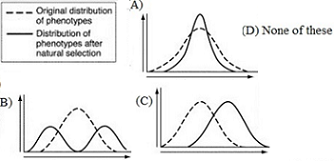
-
100%
a) (A)
-
0%
b) (B)
-
0%
c) (C)
-
0%
d) (D)
Q.36.
If the theory of natural selection is the survival of the fitness, and the fittest are identified as those who survive, why isn't it regarded as a tautology (a statement that is true only because of the meaning of the terms) ?
-
50%
a) The effect of traits on the fitness of an organism can be assessed independently of whether the organism indeed survives .
-
0%
b) It is regarded as a tautology - the question is based on a false assumption.
-
50%
c) There may be some statements in science that are useful even if they are not falsifiable or refutable in principle.
-
0%
d) A and C.
Q.37.
The variation natural selection operates on is due to random mutations. What does this imply about natural selection?
-
50%
a) Natural selection is also a random process.
-
0%
b) Natural selection is nevertheless a directed process- the likelihood one variant will be favored in a given environment over another is predictable, even if the origin is not.
-
0%
c) There is no possibility God could be involved in this process.
-
50%
d) A, B and C.
Q.38.
Speciation is the evolutionary process by which _____.
-
0%
a) a new gene pool is formed
-
50%
b) evolutionary paths of species converge
-
50%
c) hybrid species formed
-
0%
d) Shows up differences in physical traits
Q.39.
Which of the following postulates is related with Neo-Darwinism?
-
50%
a) Mutations are believed to help form new species.
-
0%
b) It incorporates isolation as an essential component of evolution.
-
0%
c) It can explain the occurrence of unchanged forms over millions of years
-
50%
d) All of the above
Q.40.
Flame cells and Malpighian tubules are the analogous organ in:
-
50%
a) Insects and arthropods respectively
-
0%
b) Arthropods and Echinodermata respectively.
-
0%
c) Helminths and arthropods with other insect respectively.
-
50%
d) Arthropods and other insect with helminths respectively
Q.41.
Which of the following statements are not true?
-
50%
a) The origin of life is considered as a unique event in the history of earth.
-
50%
b) Earth is just a speck.
-
0%
c) Universe is almost 20 million years old.
-
0%
d) Galaxies contain stars and clouds of gas and dust.
Q.42.
The theory of special creation was strongly challenged during the nineteenth century on the basis of observation made:
-
50%
a) During a sea voyage in a sail ship called H.M.S. Beagle round the Europe.
-
50%
b) During a sea voyage in a sail ship called M.H.S. Beagle round the Africa.
-
0%
c) During a sea voyage in a sail ship called H.M.S. Beagle round the world.
-
0%
d) During a sea voyage in a sail ship called M.H.S. Beagle round the world.
Q.43.
Which of the following is not the example of evolution by anthropogenic actions?
-
50%
a) Herbicide resistant varieties.
-
50%
b) Antibiotic resistant microbes.
-
0%
c) Darwin Finches.
-
0%
d) Different breeds of dogs.
Q.44.
The flourishing period of seed ferns is:
-
50%
a) Jurassic.
-
50%
b) Devonian
-
0%
c) Carboniferous.
-
0%
d) Triassic.
Q.45.
Weismann cut off tails of mice generation after generation but tails neither disappeared nor shortened showing that:
-
0%
a) Darwin was correct.
-
50%
b) Tail is an essential organ
-
50%
c) Mutation theory is wrong.
-
0%
d) Lamarckism was wrong in inheritance of acquired characters
Q.46.
The struggle for existence is a consequence of:
-
50%
a) Each organism leaving more offsprings than needed to replace itself.
-
50%
b) Innate competitive tendencies.
-
0%
c) The inevitable difficulty in coping with climatic conditions.
-
0%
d) Territories and dominance hierarchies.
Q.47.
The change of the lighter coloured variety of Peppered moth (Bistonbetularia) to its darker variety (Bistoncarbonaria) is due to:
-
100%
a) Mutation.
-
0%
b) Regeneration.
-
0%
c) Genetic isolation.
-
0%
d) Temporal isolation.
Q.48.
The experiment to show the production of mice in 21 days from a dirty shirt placed in contact with kernels of wheat was carried out by ______.
-
0%
a) Francesco Redi
-
50%
b) Jean Baptiste Van Helmont
-
50%
c) Aristotle
-
0%
d) Louis Pasteur
Q.49.
The diversity in the type of beaks of finches adapted to different feeding habits on the Galapagos Islands, as observed by Darwin, provides evidence for: (i) Intraspecific competition. (ii) Interspecific competition. (iii) Origin of species by natural selection. (iv) Intraspecific variations.
-
50%
a) (i) and (ii) are true.
-
50%
b) (ii) and (iii) are true.
-
0%
c) (i) and (iii) are true.
-
0%
d) (ii) and (iv) are true.
Q.50.
Identify the incorrect statement regarding human evolution:
-
50%
a) Ramapithecus and Dryopithecus were primates which lived around 15mya.
-
0%
b) Australopithecus lived about 1.5mya and ate fruits.
-
50%
c) The first hominid, Homo habilishad a cranial capacity of 650 – 800cc.
-
0%
d) Fossil of Homo erectus was obtained in1891 and they ate meat.