Q.1.
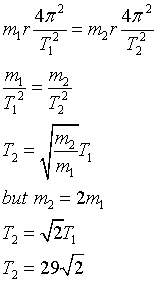
The period of moon's rotation around the Earth is nearly 29 days. If moon's mass were 2 fold of its present value, all other things remain unchanged, the period of moon's rotation would be nearly [ kerala CET 2002]
-
25%
a) 29√2
-
50%
b) 29 / √2
-
25%
c) 29×2
-
0%
d) 20 days
Explanation
Q.2.
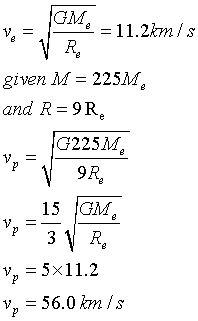
A planet has a mass 225 times and a radius 9 times that of the earth. The escape velocity for earth is known to be 11.2 km /s. The escape velocity for the planet is then [ Hariyana CET 2002]
-
50%
a)2.24 km/s
-
0%
b) 5 km/s
-
50%
c)56 km/s
-
0%
d) 280 km/s
Explanation
Q.3.
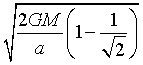
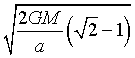
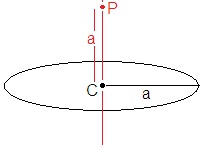
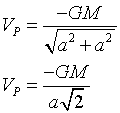
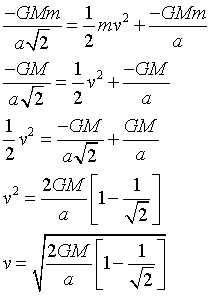
A point P lies on the axis of a ring of mass M and radius a, at a distance a from its center C. A small particle starts from P and reaches C under gravitation only. Its speed at C will be
-
0%
a)

-
50%
b)
-
50%
c)
-
0%
d)zero
Explanation

Q.4.
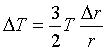
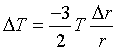
Two small satellites move in a circular orbits around the earth, at distance r and (r + dr) from the center of the earth. Their time periods of rotation are T and T + dT ( Δr << r , ΔT << T) Then
-
50%
a)
-
0%
b)
-
0%
c)
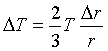
-
50%
d)

Explanation
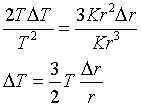
Q.5.
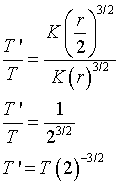
A satellite moves in a circle around the earth. The radius of this circle is equal to one half of the radius of the moon's orbit. The satellite completes one revolution in.. [ J and K CET 2005]
-
50%
a) (1/2) lunar month
-
0%
b) (2/3) lunar month
-
50%
c) 2-3/2 lunar month
-
0%
d) 23/2 lunar month
Explanation
Q.6.
If a rocket is to be launched from the surface of the earth so as to escape from the earth altogether, then
-
50%
a)it can have any velocity at start
-
50%
b) it must have a minimum velocity of 11.2 km/s
-
0%
c)the minimum velocity at start will be 11.2 km/s it it shoots up ony vertically
-
0%
d)none of above
Q.7.
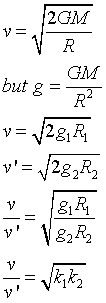
The ratio of the radii of the planet P1 and P2 is kThe ratio of the acceleration due to the gravitation on them is kThe ratio of the escape velocities from them will be
-
0%
a) k1k2
-
0%
b) √(k1k2)
-
100%
c) √(k1 / k2)
-
0%
d) √(k2/ k1)
Explanation
Q.8.
The orbital speed of Jupiter is
-
50%
a) greater than the orbital speed of earth
-
0%
b) less than the orbital speed of the earth
-
0%
c)equal to the orbital speed of the earth
-
50%
d)zero
Q.9.
The period of a satellite in a circular orbit around a planet is independent of
-
0%
a) the mass of the planet
-
50%
b) the radius of the planet
-
50%
c) the mass of the satellite
-
0%
d) all of there parameters a, b, c
Explanation

Q.10.
In planetary motion
-
50%
a)the angular speed remains constant
-
0%
b) the total angular momentum remains constant
-
0%
c)the linear speed remains constant
-
50%
d)neither the angular momentum nor angular speed remains constant
Q.11.
Inside the non uniform shell
-
0%
a) the gravitational field is zero
-
50%
b) the gravitational field is different everywhere
-
0%
c)gravitational potential is zero
-
50%
d)gravitational potential is not same everywhere
Q.12.
A satellite S is moving in an elliptical orbit around the earth. The mass of the satellite very small compared to the mass of the earth. Then
-
50%
a)the acceleration of S is don't change direction
-
0%
b) the angular momentum of S about the centre of the earth changes in direction, but magnitude remains constant
-
50%
c)the total mechanical energy energy of S varies periodically with time
-
0%
d)the linear momentum of S remains constant in magnitude
Q.13.
If the value of universal constant of gravitation is to decrease uniformly with time, then the satellite in orbit would still maintain its
-
0%
a) tangential speed
-
0%
b) radius of orbit
-
50%
c) period of revolution
-
50%
d) angular momentum
Q.14.
The speed of earth's rotation about its axis is ω. Its speed increases to x times to make the effective acceleration due to gravity equal to zero at the equator. Then x is ..
-
0%
a)1.7
-
0%
b) 8.5
-
50%
c)17
-
50%
d)3.4
Q.15.
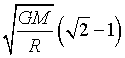
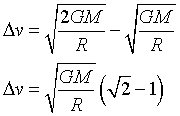
A spaceship approaches the moon, whose mass and radius are M and R, along a line which is almost tangential o the moon's surface. At the moment of maximum approach the brake rocket is fired for a short while and the spaceship is transformed into a satellite of the moon. The change in velocity of the spaceship is
-
0%
a)
-
50%
b)

-
50%
c)

-
0%
d)

Explanation
Q.16.
A person will get more kg-wt at [ J and K CET 2004]
-
0%
a) poles
-
50%
b) at latitude of 60°
-
0%
c)equator
-
50%
d)satellite
Q.17.
A body is suspended from a spring balance kept in a satellite. the reading of the balance is W1 when the satellite goes in an orbit of radius R and reading of the balance is W2 when it goes in an orbit of radius 2R. Then
-
50%
a) W1=W2
-
0%
b) W1 < W2
-
50%
c) W1 > W2
-
0%
d) W1 ≠ W2
Q.18.
A planet is revolving around the sun in an elliptical orbit, its closest distance from the sun is r and the farthest distance is R. If the orbital velocity of the planet closest to the sun be v, then what is the velocity at the farthest point.
-
0%
a) vr/R
-
0%
b) vR/r
-
100%
c) v(r/R)1/2
-
0%
d) v(r/R)1/2
Q.19.
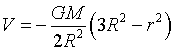
A uniform spherical shell gradually shrinks maintaining its shape. the gravitational potential at the centre
-
0%
a) increases
-
50%
b) decreases
-
0%
c) remains constant
-
50%
d) oscillates
Explanation
Q.20.
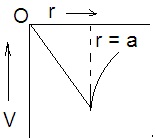
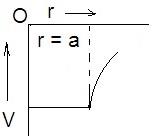
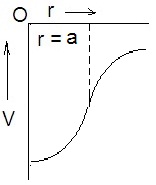
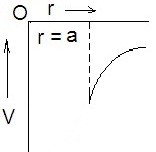
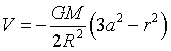
P is a point at distance r from centre of solid sphere of radius a. The gravitational potential at P is V. If V is plotted as a function of r, which is the correct curve?
-
0%
a)
-
100%
b)
-
0%
c)
-
0%
d)
Explanation
Q.21.
The eccentricity of the earth's orbit is 0.The ratio of its maximum speed in its orbit to its minimum speed is
-
0%
a) 1.67
-
50%
b) 1.034
-
0%
c) 1
-
50%
d) 0.167
Explanation
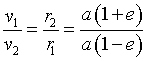
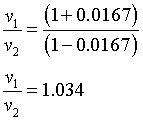
Q.22.
A body of mass 'm' taken from the earth's surface tothe height equal to twice the radius (R) of the earth.The change in potential energy of body will be…[NEET 2013]
-
50%
a) mg2R
-
0%
b) 2mgR/3
-
0%
c) 3mgR
-
50%
d) mgR/3
Explanation
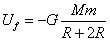



Q.23.
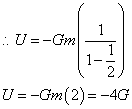
Infinite number of bodies, each of mass 2 kg aresituated on x-axis at distance 1 m, 2 m, 4 m, 8 m, .....respectively, from the origin. The resultinggravitational potential due to this system at theorigin will be
-
50%
a) - G
-
50%
b) -8G/3
-
0%
c) -4G/3
-
0%
d) -4G
Explanation
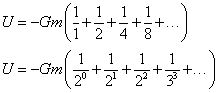

Q.24.
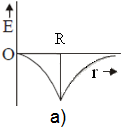
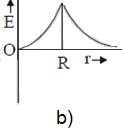
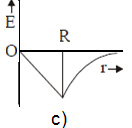
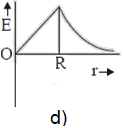
Dependence of intensityof gravitational field(E) of earth with distance (r) from centre ofearth is correctly represented by
-
0%
a)
-
50%
b)
-
0%
c)
-
50%
d)
Q.25.
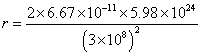
A black hole is an object whose gravitationalfield is so strong that even light cannot escapefromit.To what approximateradiuswouldearth(mass = 5.98 × 1024 kg) have to becompressed to be a black hole?
-
0%
a) 10–2 m
-
100%
b) 100m
-
0%
c) 10–9 m
-
0%
d) 10–6 m
Explanation

Q.26.
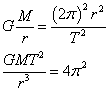
Kepler’s third law states that square of period of revolution (T) of a planet around the sun, isproportional to third power of average distance r between sun and planeti.e. T2 = Kr3 here K is constant.If the masses of sun and planet are M and m respectively then as per Newton’s law of gravitation forceof attraction between them is=G Mm/r2 , here G is gravitational constant. The relation between G and K is described as :
-
50%
a) K=1/G
-
0%
b) GK = 4π2
-
50%
c) GMK = 4π2
-
0%
d) K = G
Explanation


Q.27.
A satellite S is moving in an elliptical orbit aroundthe earth. The mass of thesatellite is very smallcompared to the mass of the earth. Then,.. [RE AIPMT 2015]
-
0%
a) the acceleration of S is always directed towardsthe centre of the earth.
-
33%
b) the angular momentum of S about the centreof the earth changes in direction, but itsmagnitude remains constant.
-
33%
c) the total mechanical energy of S variesperiodically with time.
-
33%
d) the linear momentum of S remains constant inmagnitude.
Q.28.
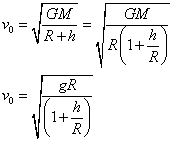
A remote - sensing satellite of earth revolves in acircular orbit at a height of 0.25 × 10⁶ m above thesurface of earth. If earth's radius is 6.38 × 10⁶ m and g=9.8 ms-2, then the orbital speed of thesatellite is :
-
0%
a) 6.67 km s-1
-
0%
b) 7.76 km s-1
-
50%
c) 8.56 km s-1
-
50%
d) 9.13 km s-1
Explanation
Q.29.
At what height from the surface of earth thegravitation potential and the value of g are –5.4 × 10⁷ J kg–2 and 6.0 ms–2 respectively ?Take the radius of earth as 6400 km : …[ AIPMT 2016]
-
0%
a) 2600 km
-
0%
b) 1600 km
-
50%
c) 1400 km
-
50%
d) 2000 km
Explanation


Q.30.
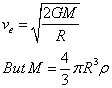
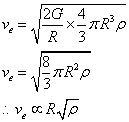
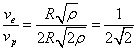
The ratio of escape velocity at earth (ve) to the escape velocity at a planet (vp)whose radius and mean density are twice as that of earth is :-
-
0%
a) 1 : 2
-
50%
b) 1 : 2√2
-
0%
c) 1 : 4
-
50%
d) 1 : √2
Explanation