Q.1.
Starting from the centre of the earth having radius R, the variation of g ( acceleration due to gravity) is shown by …[ NEET II – 2016]
-
29%
a)
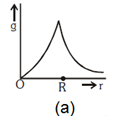
-
43%
b)
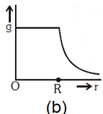
-
14%
c)
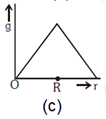
-
14%
d)
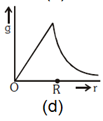
Q.2.
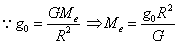
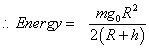
A satellite of mass m is orbiting the earth(of radius R) at a height h from its surface. The totalenergy of the satellite in terms of g0, the value ofacceleration due to gravity at the earth's surface, is …[ NEET II – 2016]
-
29%
a)

-
0%
b)

-
43%
c)

-
29%
d)

Explanation
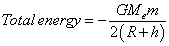
Q.3.
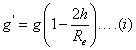
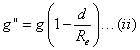
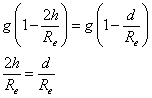
The acceleration due to gravity at a height 1 kmabove the earth is the same as at a depth d belowthe surface of earth. Then …[NEET 2016]
-
0%
a) ½ m
-
43%
b) 1 km
-
29%
c) 3/2 km
-
29%
d) 2 km
Explanation
Q.4.
Which of the following statements are correct? …[NEET 2017] (i) Centre of mass of a body always coincides withthe centre of gravity of the body. (ii) Centre of mass of a body is the point at whichthe total gravitational torque on the body is zero (iii) A couple on a body produce both translationaland rotational motion in a body. (iv) Mechanical advantage greater than one meansthat small effort can be used to lift a large load.
-
0%
a) (ii) and (iv)
-
60%
b) (i) and (ii)
-
40%
c) (ii) and (iii)
-
0%
d) (iii) and (iv)
Q.5.
Two astronauts are floating in gravitational free spaceafter having lost contact with their spaceship. Thetwo will … [ NEET 2017]
-
33%
a) Keep floating at the same distance between them
-
17%
b) Move towards each other
-
50%
c) Move away from each other
-
0%
d) Will become stationary
Q.6.
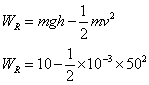
Consider a drop of rain water having mass 1 g fallingfrom a height of 1 km. It its the ground with a speedof 50 m/s. Take g constant with a value10 m/sThe work done by the (i) gravitational force and the (ii) resistive force of air is
-
0%
a) (i) – 10 J (ii) –8.25 J
-
40%
b) (i) 1.25 J (ii) –8.25 J
-
40%
c) (i) 100 J (ii) 8.75 J
-
20%
d) (i) 10 J (ii) –8.75 J
Explanation
Q.7.
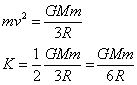
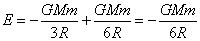
What is the minimum energy required to launch a satellite of mass m from the surface of a planetof mass M and radius R in a circular orbit at an altitude of 2R ?
-
20%
a)

-
20%
b)

-
40%
c)

-
20%
d)

Explanation



Q.8.
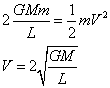
then one correct answer Q169) Two bodies, each of mass M, are kept fixed with a separation 2L. A particle of mass m isprojected from the midpoint of the line joining their centres, perpendicular to the line. Thegravitational constant is G. The correct statement(s) is (are) … [ IIT Advance 2013]
-
0%
a) The minimum initial velocity of the mass m to escape the gravitational field of the two bodies is

-
0%
b) The minimum initial velocity of the mass m to escape the gravitational field of the two bodies is

-
50%
c) The minimum initial velocity of the mass m to escape the gravitational field of the twobodies is

-
50%
d) The energy of the mass m remains constant
Explanation

Q.9.
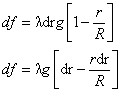
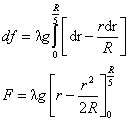
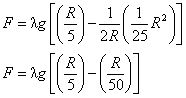
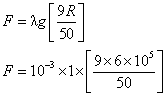
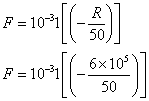
A planet of radius R =X/10 , (X radius of Earth) has the same mass density as Earth. Scientists dig a well of depth R/5 on it and lower a wire of the same length and of linearmass density 10−3 kgm−1 into it. If the wire is not touching anywhere, the force applied atthe top of the wire by a person holding it in place is (take the radius of Earth = 6 × 10⁶ m and the acceleration due to gravity on Earth is 10 ms−2) [IIT Advance 2014]
-
50%
a) 96 N
-
0%
b) 108 N
-
25%
c) 120 N
-
25%
d) 150 N
Explanation

Q.10.
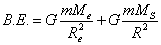
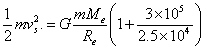
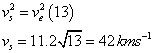
A rocket is launched normal to the surface of the Earth, away from the Sun, along the line joining the sun and the Earth. The Sun is 3 × 10⁵ times heavier than the Earth and is at a distance 2.5 ×10⁴ times larger than the radius of the Earth. The escape velocity from Earth's gravitational field is ve = 11.2 km s–The minimum initial velocity (vs) required for the rocket to be able to leave the Sun- Earth system is closest to (Ignore the rotation and revolution of the Earth and the presence of any other planet) [IIT Advance 2017]
-
25%
a) vs = 22 km s–1
-
25%
b) vs = 72 km s–1
-
25%
c) vs = 42 km s–1
-
25%
d) vs = 62 km s–1
Explanation