Q.1.
A planet is revolving around the sun in an elliptical orbit, its closest distance from the sun is r and the farthest distance is R. If the orbital velocity of the planet closest to the sun be v, then what is the velocity at the farthest point.
-
25%
a) vr/R
-
25%
b) vR/r
-
50%
c) v(r/R)1/2
-
0%
d) v(r/R)1/2
Q.2.
A uniform spherical shell gradually shrinks maintaining its shape. the gravitational potential at the centre
-
0%
a) increases
-
33%
b) decreases
-
67%
c) remains constant
-
0%
d) oscillates
Explanation
Q.3.
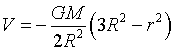
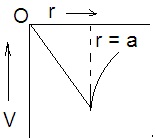
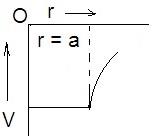
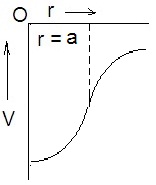
P is a point at distance r from centre of solid sphere of radius a. The gravitational potential at P is V. If V is plotted as a function of r, which is the correct curve?
-
75%
a)
-
25%
b)
-
0%
c)
-
0%
d)
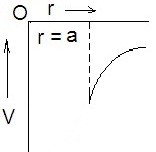
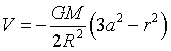
Explanation
Q.4.
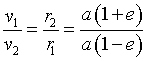
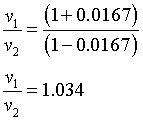
The eccentricity of the earth's orbit is 0.The ratio of its maximum speed in its orbit to its minimum speed is
-
33%
a) 1.67
-
33%
b) 1.034
-
33%
c) 1
-
0%
d) 0.167
Explanation
Q.5.
A body of mass 'm' taken from the earth's surface tothe height equal to twice the radius (R) of the earth.The change in potential energy of body will be…[NEET 2013]
-
50%
a) mg2R
-
0%
b) 2mgR/3
-
25%
c) 3mgR
-
25%
d) mgR/3
Explanation



Q.6.
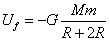
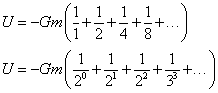
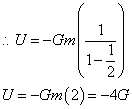
Infinite number of bodies, each of mass 2 kg aresituated on x-axis at distance 1 m, 2 m, 4 m, 8 m, .....respectively, from the origin. The resultinggravitational potential due to this system at theorigin will be
-
0%
a) - G
-
100%
b) -8G/3
-
0%
c) -4G/3
-
0%
d) -4G
Explanation

Q.7.
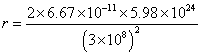
A black hole is an object whose gravitationalfield is so strong that even light cannot escapefromit.To what approximateradiuswouldearth(mass = 5.98 × 1024 kg) have to becompressed to be a black hole?
-
0%
a) 10–2 m
-
67%
b) 100m
-
33%
c) 10–9 m
-
0%
d) 10–6 m
Explanation

Q.8.
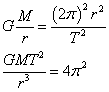
Kepler’s third law states that square of period of revolution (T) of a planet around the sun, isproportional to third power of average distance r between sun and planeti.e. T2 = Kr3 here K is constant.If the masses of sun and planet are M and m respectively then as per Newton’s law of gravitation forceof attraction between them is=G Mm/r2 , here G is gravitational constant. The relation between G and K is described as :
-
0%
a) K=1/G
-
50%
b) GK = 4π2
-
0%
c) GMK = 4π2
-
50%
d) K = G
Explanation


Q.9.
A satellite S is moving in an elliptical orbit aroundthe earth. The mass of thesatellite is very smallcompared to the mass of the earth. Then,.. [RE AIPMT 2015]
-
50%
a) the acceleration of S is always directed towardsthe centre of the earth.
-
0%
b) the angular momentum of S about the centreof the earth changes in direction, but itsmagnitude remains constant.
-
50%
c) the total mechanical energy of S variesperiodically with time.
-
0%
d) the linear momentum of S remains constant inmagnitude.
Q.10.
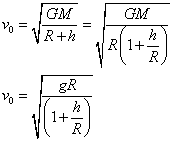
A remote - sensing satellite of earth revolves in acircular orbit at a height of 0.25 × 10⁶ m above thesurface of earth. If earth's radius is 6.38 × 10⁶ m and g=9.8 ms-2, then the orbital speed of thesatellite is :
-
50%
a) 6.67 km s-1
-
50%
b) 7.76 km s-1
-
0%
c) 8.56 km s-1
-
0%
d) 9.13 km s-1
Explanation
Q.11.
At what height from the surface of earth thegravitation potential and the value of g are –5.4 × 10⁷ J kg–2 and 6.0 ms–2 respectively ?Take the radius of earth as 6400 km : …[ AIPMT 2016]
-
0%
a) 2600 km
-
0%
b) 1600 km
-
50%
c) 1400 km
-
50%
d) 2000 km
Explanation


Q.12.
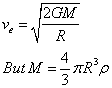
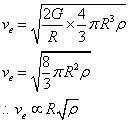
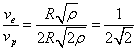
The ratio of escape velocity at earth (ve) to the escape velocity at a planet (vp)whose radius and mean density are twice as that of earth is :-
-
0%
a) 1 : 2
-
50%
b) 1 : 2√2
-
50%
c) 1 : 4
-
0%
d) 1 : √2
Explanation
Q.13.
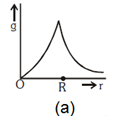
Starting from the centre of the earth having radius R, the variation of g ( acceleration due to gravity) is shown by …[ NEET II – 2016]
-
0%
a)
-
50%
b)
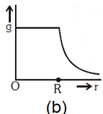
-
50%
c)
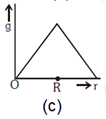
-
0%
d)
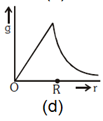
Q.14.
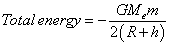
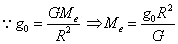
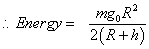
A satellite of mass m is orbiting the earth(of radius R) at a height h from its surface. The totalenergy of the satellite in terms of g0, the value ofacceleration due to gravity at the earth's surface, is …[ NEET II – 2016]
-
50%
a)

-
50%
b)

-
0%
c)

-
0%
d)

Explanation
Q.15.
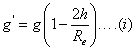
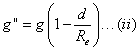
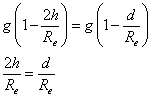
The acceleration due to gravity at a height 1 kmabove the earth is the same as at a depth d belowthe surface of earth. Then …[NEET 2016]
-
0%
a) ½ m
-
0%
b) 1 km
-
50%
c) 3/2 km
-
50%
d) 2 km
Explanation
Q.16.
Which of the following statements are correct? …[NEET 2017] (i) Centre of mass of a body always coincides withthe centre of gravity of the body. (ii) Centre of mass of a body is the point at whichthe total gravitational torque on the body is zero (iii) A couple on a body produce both translationaland rotational motion in a body. (iv) Mechanical advantage greater than one meansthat small effort can be used to lift a large load.
-
50%
a) (ii) and (iv)
-
50%
b) (i) and (ii)
-
0%
c) (ii) and (iii)
-
0%
d) (iii) and (iv)
Q.17.
Two astronauts are floating in gravitational free spaceafter having lost contact with their spaceship. Thetwo will … [ NEET 2017]
-
50%
a) Keep floating at the same distance between them
-
0%
b) Move towards each other
-
0%
c) Move away from each other
-
50%
d) Will become stationary
Q.18.
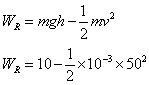
Consider a drop of rain water having mass 1 g fallingfrom a height of 1 km. It its the ground with a speedof 50 m/s. Take g constant with a value10 m/sThe work done by the (i) gravitational force and the (ii) resistive force of air is
-
50%
a) (i) – 10 J (ii) –8.25 J
-
0%
b) (i) 1.25 J (ii) –8.25 J
-
0%
c) (i) 100 J (ii) 8.75 J
-
50%
d) (i) 10 J (ii) –8.75 J
Explanation
Q.19.
What is the minimum energy required to launch a satellite of mass m from the surface of a planetof mass M and radius R in a circular orbit at an altitude of 2R ?
-
0%
a)

-
50%
b)

-
50%
c)

-
0%
d)

Explanation


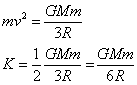
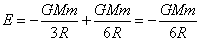

Q.20.
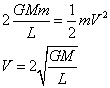
then one correct answer Q169) Two bodies, each of mass M, are kept fixed with a separation 2L. A particle of mass m isprojected from the midpoint of the line joining their centres, perpendicular to the line. Thegravitational constant is G. The correct statement(s) is (are) … [ IIT Advance 2013]
-
0%
a) The minimum initial velocity of the mass m to escape the gravitational field of the two bodies is

-
50%
b) The minimum initial velocity of the mass m to escape the gravitational field of the two bodies is

-
50%
c) The minimum initial velocity of the mass m to escape the gravitational field of the twobodies is

-
0%
d) The energy of the mass m remains constant
Explanation

Q.21.
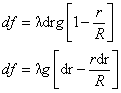
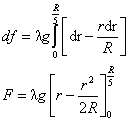
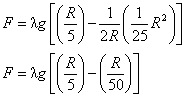
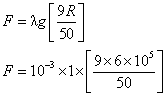
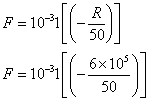
A planet of radius R =X/10 , (X radius of Earth) has the same mass density as Earth. Scientists dig a well of depth R/5 on it and lower a wire of the same length and of linearmass density 10−3 kgm−1 into it. If the wire is not touching anywhere, the force applied atthe top of the wire by a person holding it in place is (take the radius of Earth = 6 × 10⁶ m and the acceleration due to gravity on Earth is 10 ms−2) [IIT Advance 2014]
-
50%
a) 96 N
-
0%
b) 108 N
-
50%
c) 120 N
-
0%
d) 150 N
Explanation

Q.22.
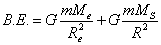
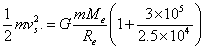
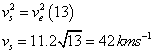
A rocket is launched normal to the surface of the Earth, away from the Sun, along the line joining the sun and the Earth. The Sun is 3 × 10⁵ times heavier than the Earth and is at a distance 2.5 ×10⁴ times larger than the radius of the Earth. The escape velocity from Earth's gravitational field is ve = 11.2 km s–The minimum initial velocity (vs) required for the rocket to be able to leave the Sun- Earth system is closest to (Ignore the rotation and revolution of the Earth and the presence of any other planet) [IIT Advance 2017]
-
50%
a) vs = 22 km s–1
-
0%
b) vs = 72 km s–1
-
0%
c) vs = 42 km s–1
-
50%
d) vs = 62 km s–1
Explanation
Q.23.
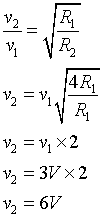
The radii of circular orbits of two satellites A and B of the earth, are 4R and R, respectively. If the speed of satellite A is 3 V, then the speed of satellite B will be: [ CBSE-PMT 2010]
-
0%
a) 3V/4
-
100%
b) 6V
-
0%
c)12V
-
0%
d)3V/2
Explanation
Q.24.
The earth ( mass=6 × 1024kg) revolves around the sun with an angular velocity 2 × 10⁻⁷ rad/sec in a circular orbit of radius=1.5 × 10⁸km. The force exerted by sun on earth in newton is ...[ AFMC 1997, 1999]
-
0%
a)36 × 1021
-
0%
b) 18 × 1025
-
100%
c)29 × 1039
-
0%
d)zero
Q.25.
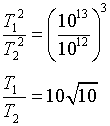
The distance of two planets from the sun are 1013 and 1012 meters respectively. The ratio of time periods of these two planets is [ CBSE PMT 1988]
-
0%
a) 1/√10
-
0%
b) 100
-
0%
c) 10√10
-
100%
d) √10
Explanation
Q.26.
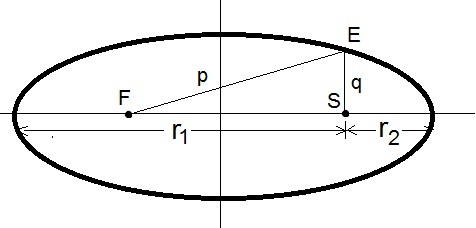
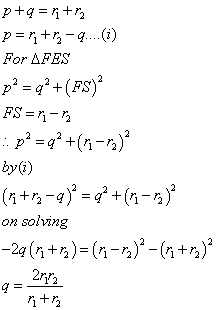
The largest and the shortest distance of the earth from the sun are r1and rIts distance from the sun when it is at perpendicular to the major-axis of the orbit drawn from the sun is [1988]
-
0%
a) (r1 + r2)/4
-
0%
b) (r1 + r2)/ (r1 - r2)
-
0%
c) 2(r1 × r2)/ (r1 + r2)
-
100%
d) (r1 + r2)/ 3
Explanation
Q.27.
If the gravitational force between two objects were proportional to 1/R (and not as 1/R2) where R is separation between them, then a particle in circular orbit under such a force would have its orbital speed v proportional to [1989]
-
33%
a) 1/R2
-
33%
b) R0
-
0%
c) R
-
33%
d) 1/R
Q.28.
A planet is moving in an elliptical orbit around the sun. If T, V, E, and L stands for kinetic energy, gravitational potential, total energy, and magnitude of angular moment bout the center of force respectively
-
0%
a) T is conserved
-
0%
b) V is always positive
-
0%
c) E is always negative
-
100%
d) L is conserved but direction of vector L changes continuously
Q.29.
For a satellite escape velocity is 11 km/s. If the satellite is launched at an angle of 60° with the vertical, then escape velocity will be [1989]
-
0%
a) 11 km/s
-
0%
b) 11 √3 km/s
-
0%
c) 11 /√3 km/s
-
100%
d) 33 km/s
Q.30.
A satellite of mass am is orbiting around the earth in a circular orbit with a velocity v. What will be its total energy? [1991]
-
0%
a) (3/4) mv2
-
0%
b) (1/2) mv2
-
0%
c) mv2
-
100%
d)-(1/2)mv2