Q.1.
The product obtained on treatmnet of ethyl chloride with potassium cyanide is reduced by heating with 20% H2SO5 at 363K, if the yield is 65%
-
22%
a) 16g
-
56%
b) 18.2g
-
11%
c) 20g
-
11%
d) 22g
Q.2.
Following reaction is example of C2H5Br + KCN(aq) → C2H5CN + KBr
-
0%
a) redox change
-
29%
b) elimation
-
29%
c) electrophilic substitution
-
43%
d) nucleophilic substitution
Q.3.
Which of the following do not form Grignard reagent 1
-
25%
a) CH3I
-
62%
b) CH3F
-
0%
c) CH3Cl
-
12%
d) CH3Br
Q.4.
Optically active compound is
-
44%
a) 2-chlorobutane
-
11%
b) 2-chloropropane
-
44%
c) 3-chloropentane
-
0%
d) 3-chlorobutane
Q.5.
The hydrogen atom in chloroform is
-
67%
a) acidic
-
0%
b) basic
-
33%
c) neutral
-
0%
d) none of these
Q.6.
The comound A forms B with sodium metal and again A froms C with PCl5, but B and C form diethyl ether. Therefore A, B, and C are
-
38%
a) C2H5OH, C2H5ONa, C2H5Cl
-
25%
b) C2H5OH, C2H5Cl, C2H5ONa
-
25%
c) C2H5OH, C2H5Cl, C2H4Cl2
-
12%
d) C2H5ONa, C2H5OH, C2H5Cl
Q.7.
Assertion: CHI3 gives a precipitate with AgNO3 solution on heating but CHCl3 Reason: C - I bond is quite weak as compared to C-Cl bond
-
12%
a) Assertion is correct but Reason is wrong
-
25%
b) Assertion is wrong but Reason is correct
-
62%
c) Both Assertion and Reason are correcr and Reason is correct explanation of Assertion
-
0%
d) Both Assertion and Reason are correcr and Reason is not correct explanation of Assertion
Q.8.
Which process does not occur during formation of CHCl3 from C2H5OH and bleaching powder?
-
12%
a) hydrolysis
-
12%
b) oxidation
-
62%
c) elimination
-
12%
d) chlorination
Q.9.
Which compound is used in cooling?
-
0%
a) CHCl3
-
38%
b) CCl4
-
12%
c) CF4
-
50%
d) CCl2F2
Q.10.
In the following reacton end product C is

-
11%
a) Propene
-
11%
b) Propyne
-
11%
c) Propan-1-ol
-
67%
d) Propan-2-ol
Q.11.
Dehydrohalogenation in haloalkanes produces
-
20%
a) single bond
-
70%
b) double bond
-
0%
c) triple bond
-
10%
d) fragmentation
Q.12.
Grignard reagent is prepared by the reaction between
-
10%
a) zinc and alkyl halide
-
10%
b) magnesium anad alkane
-
70%
c) magnesium and alkyl halide
-
10%
d) magnesium and aromatic hydrocarbon
Q.13.
Assertion: Aryl halides undergo uncleophilic substitution with ease Reason: The carbon halogen bond in aryl halides has partial double bond character
-
29%
a) Assertion is correct but Reason is wrong
-
14%
b) Assertion is wrong but Reason is correct
-
43%
c) Both Assertion and Reason are correcr and Reason is correct explanation of Assertion
-
14%
d) Both Assertion and Reason are correcr and Reason is not correct explanation of Assertion
Q.14.
Trichloro acetone reacts with lime water to form
-
25%
a) CH3OH
-
38%
b) CH3CHO
-
25%
c) CHCl3
-
12%
d) CH3Cl
Q.15.
The reaction products of the reaction between CH5NH2, CHCl3 and KOH
-
12%
a) C6H5CN + KCl
-
38%
b) C6H5NC + KCl
-
38%
c) C6H5Cl + NH4Cl + KCl
-
12%
d) C6H5OH + NH4Cl + H2O
Q.16.
n- propyl bromide reacts with ethanolic KOH
-
38%
a) propene
-
12%
b) propane
-
12%
c) propyne
-
38%
d) propyl alcohol
Q.17.
The antiseptic character of iodoform is due to
-
0%
a) unpleasent smell
-
0%
b) its poisonous nature
-
90%
c) liberation of free iodine
-
10%
d) none of the above
Q.18.
A compound A of formula C3H6Cl2 on reaction with alkali can give B of formula C3H6O or C of formula C3HB on oxidation gave a compound of the formula C3H6OC with dilute H2SO4 containing Hg2+ ion gave D of formula C3H6O, which with bromine and NaOH give the sodium salt of C2H4O2 then A is ..
-
57%
a) CH3CHClCH2Cl
-
29%
b) CH3CCl2CH3
-
0%
c) CH3CH2CHCl2
-
14%
d) CH3CHClCH2Cl
Q.19.
Vicinal and geminal dihalides can be distinguished by
-
30%
a) KOH (aq)
-
40%
b) KOH (alc.)
-
30%
c) Zn dust
-
0%
d) none of these
Q.20.
Chloroform on reduction with Zn and HCl(alc.) gives
-
50%
a) methylene dichloride
-
25%
b) formic acid
-
0%
c) chloropicrin
-
25%
d) chloroform
Q.21.
Methyl chloride on treatment with potassium cyanide followed by hydrolysis yields
-
11%
a) HCOOH
-
56%
b) CH3COOH
-
33%
c) CH3CN
-
0%
d) CH3COOK
Q.22.
In the following reaction
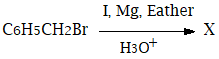
-
29%
a) C6H5CH2OCH2C6H5
-
57%
b) C6H5CH2OH
-
14%
c) C6H5CH3
-
0%
d) C6H5CH2CH2C6H5
Q.23.
Benzene reacts with n -propyl chloride in the presence of anhydrous AlCl3 to give predominantly
-
44%
a) isopropyl benzene
-
22%
b) no reaction
-
22%
c) n- propylbenzene
-
11%
d) 3-propyl-1-chlorobenzene
Q.24.
The SN1 reactivity of ethyl chloride is
-
22%
a) more or less equal to that of chlorobenzene
-
22%
b) less than that of chlorobenzene
-
33%
c) more or less equal to that of benzyl chloride
-
22%
d) less than that of benzyl chloride
Q.25.
2-bromo pentane is heated with poatassium ethoxide in ethanol. The major product
-
43%
a) trans- pent-2-ene
-
14%
b) 2-ethoxy pentane
-
0%
c) pent-1-ene
-
43%
d) cis -pent-2-ene
Q.26.
In the following sequence of raction end product (C) is

-
0%
a) Acetaldehyde
-
71%
b) Ethyl alcohol
-
14%
c) Acetone
-
14%
d) Methane
Q.27.
Which is used as a general anaesthetic in place of diethyl ether?
-
12%
a) CF3 - CHClBr
-
12%
b) CF3- CHCl2
-
50%
c) CF3 - CHBr2
-
25%
d) None of these
Q.28.
hich would be obtained by boiling CHCl3 with caustic soda?
-
50%
a) CH3COONa
-
0%
b) Na2C2O4
-
0%
c) CH3OH
-
50%
d) HCOONa
Q.29.
The number of stereoisomers of compound CH3 - CH = CH - CHBr - CH3 would be
-
0%
a) 2
-
29%
b) 3
-
71%
c) 4
-
0%
d) 5