Q.1.
An ideal gas heat engine operates in a Carnot cycle between 227°C and 127°C. It absorbs 6kcal at the higher temperature. The amount of heat (in kcal) converted into work is equal to .. [ CBSE-PMT 2003]
-
20%
a) 1.2
-
40%
b) 4.8
-
20%
c)3.5
-
20%
d)1.6
Q.2.
In thermodynamic process which of the following statement is not true [ CBSE-PMT 2009]
-
56%
a) In an isochoric process pressure remains constant
-
22%
b) In an isothermal process the temperature remains constant
-
11%
c) In an adiabatic process PVγ=constant
-
11%
d)In an adiabatic process the system is insulated from the surroundings
Q.3.
An deal gas undergoing adiabatic change has the following pressure-temperature relationship [ CBSE-PMT 1996]
-
12%
a)

-
38%
b)

-
50%
c)

-
0%
d)

Q.4.
A gas at 27°C temperature and 30 atmospheric pressure is allowed to expand to the atmospheric pressure. If the volume becomes 10 times its initial volume, then the final temperature becomes [ CBSE-PMT 2001]
-
14%
a)100°C
-
0%
b) 173°C
-
29%
c)273°C
-
57%
d)-173°C
Explanation

Q.5.
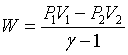
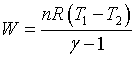
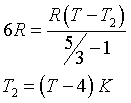
One mole of an ideal gas at an initial temperature of T K does 6R joules of work adiabatically. If the ratio of specific heats of this gas at constant pressure and at constant volume is 5/3, the final temperature of gas will be... [ CBSE-PMT 2004]
-
14%
a) (T-4) K
-
57%
b) (T+2.4)K
-
14%
c)(T-2.4)K
-
14%
d)(T+4)K
Explanation
Q.6.
During an isothermal expansion, a confined ideal gas does -150 J of work against its surroundings. This implies that.. [ CBSE-PMT 2011]
-
50%
a) 150 J heat has been removed from the gas
-
25%
b) 300 J of heat has been added to the gas
-
12%
c)no heat is transferred because the process is isothermal
-
12%
d)150J of heat has been added to the gas
Q.7.
The molar specific heat at constant pressure of an ideal gas is (7/2)R. The ratio of specific heat at constant pressure to that at constant volume is .. [ CBSE-PMT 2006]
-
0%
a) 8/7
-
17%
b) 8/7
-
50%
c) 9/7
-
33%
d) 7/5
Q.8.
First law of thermodynamics is consequence of conservation of [ CBSE-PMT 1988]
-
0%
a)work
-
71%
b) energy
-
29%
c)heat
-
0%
d)all of these
Q.9.
In for a gas R/Cv=0.67, the gas is made up of molecules which are [ CBSE-PMT 1992]
-
17%
a) diatomic
-
0%
b) mixture of diatomic and polyatomic molecules
-
50%
c)monoatomic
-
33%
d)polyatomic
Q.10.
If γ be the ratio of specific heats of a perfect gas, the number of degrees of freedom of a molecule of gas is .. [ CBSE-PMT 2000]
-
0%
a)

-
40%
b)

-
60%
c)

-
0%
d)

Q.11.
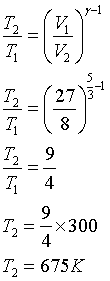
An ideal gas at 27°C is compressed adiabatically to 8/27 of its original volume. The rise in temperature is ( γ=5/3) [ CBSE-PMT 1999]
-
17%
a) 475°C
-
33%
b) 402°C
-
33%
c) 275°C
-
17%
d) 175°C
Explanation
Q.12.
The first law of thermodynamics expresses [ MPPMT 1987]
-
17%
a)law of conservation of momentum
-
50%
b) law of conservation of energy
-
0%
c)law of conservation of mass
-
33%
d)all
Q.13.
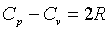
Which of the following formula is wrong?
-
0%
a)

-
20%
b)

-
40%
c)

-
40%
d)
Q.14.
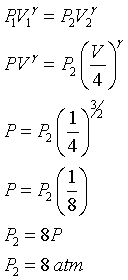
A gas at N.P.T is suddenly compressed to one-fourth of its original volume. If γ is supposed to be (3/2), then the final pressure is [ MPPMT 1991[
-
0%
a) 4 atmospheres
-
60%
b) (3/2) atmospheres
-
40%
c)8 atmospheres
-
0%
d)(1/4) atmospheres
Explanation
Q.15.
The first law of thermodynamics is the special case of ..[ CPMT 1985]
-
0%
a) Newton's law
-
83%
b) the law of conservation of energy
-
0%
c) Charlie's law
-
17%
d) the law of heat exchange
Q.16.
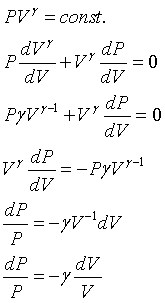
For an adiabatic expansion of perfect gas the value of (ΔP/P) is equal to ..[ PMT 1990]
-
0%
a)-γ1/2(ΔV / V)
-
0%
b) (ΔV / V)
-
100%
c)-γ(ΔV / V)
-
0%
d)-γ2(ΔV / V)
Explanation
Q.17.
A gas has .. [ CPMT 1988]
-
0%
a) one specific heat only
-
40%
b) two specific heats only
-
40%
c)infinite number of specific heats
-
20%
d)no specific heat
Q.18.
A Carnot's engine takes 300 calories of heat at 500K and rejects 150 calories of heat to sink. The temperature of the sink is.. [ MPPMT 1990]
-
0%
a) 1000 K
-
40%
b) 750 K
-
60%
c)250 K
-
0%
d)125K
Q.19.
The source and sink temperature of a carnot engine are 400K and 300K, respectively. What is its efficiency? [ NCRT 1990]
-
0%
a) 100%
-
25%
b) 75 %
-
0%
c) 33.3 %
-
75%
d) 25 %
Q.20.
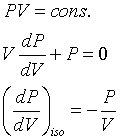
The slopes of isothermal and adiabatic curves are related as ..
-
0%
a)isothermal curve slope=adiabatic curve slope
-
50%
b) isothermal curve slope=γ × adiabatic curve slope
-
50%
c)γ × isothermal curve slope=adiabatic curve slope
-
0%
d)(1/2) × isothermal curve slope=adiabatic curve slope
Explanation
Q.21.
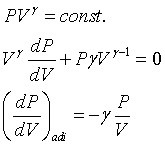
If γ denotes the ratio of the two specific heats of gas, the ratio of the slopes of adiabatic and isothermal P-V curves at their point of interaction is : [ NCRT 1990]
-
25%
a) 1 / γ
-
25%
b) γ
-
50%
c)γ - 1
-
0%
d)γ + 1
Q.22.
In reversible isochoric change [ NCRT 1990]
-
50%
a) ΔW=0
-
0%
b) Δ Q=0
-
0%
c)ΔT=0
-
50%
d)ΔU=0
Q.23.
If R=universal gas constant , the amount of of heat needed to rise the temperature of 2 moles of ideal monoatomic gas from 273 K to 37K when no work is done [ MPET 1990]
-
0%
a) 100R
-
25%
b) 150R
-
75%
c) 300R
-
0%
d) 500R
Q.24.
A sample gas expands from volume V1 to VThe amount of work done by the gas is greatest when the expansion is ..[ CBSE 1997]
-
0%
a)isothermal
-
50%
b) isobaric
-
25%
c)adiabatic
-
25%
d)equal in all case
Q.25.
Find the change in internal energy of the system when a system absorbs 2 kilocalorie's of heat and at the same times does 500 joules of work [ Andhra CET]
-
67%
a) 7900 J
-
0%
b) 8200 J
-
0%
c)5600 J
-
33%
d)6400 J
Q.26.
The temperature of 5 moles of gas which was held at constant volume was changed fro 100°C to 120°C. The change in the internal energy of the gas was found to be 80 joule, the total heat capacity of the gas at constant volume will be equal to [ CPMT 1988]
-
0%
a) 8 joule per K
-
0%
b) 0.8 joule per K
-
67%
c) 4.0 joule per K
-
33%
d) 0.4 joule per K
Q.27.
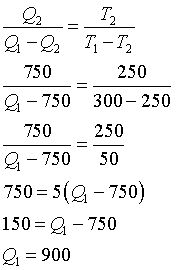
A Carnot's engine work as a refrigerator between 250K and 300K. If it receives 750 calories of heat from the reservoir at the lower temperature, the amount of heat rejected at the higher temperature is [ MPPMT 1990]
-
0%
a)900 calories
-
0%
b) 625 calories
-
67%
c)750 calories
-
33%
d)1000 calories
Explanation
Q.28.
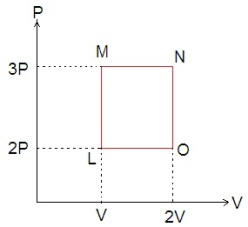
The work in an ideal monoatomic gas along the cyclic path LMNO is .. [ Raj. PMT 1996]
-
67%
a) PV
-
33%
b) 2PV
-
0%
c)3PV
-
0%
d)4PV
Q.29.
During the adiabatic expansion of 2moles of a gas the internal energy of the gas is found to decrease by 2 joule. The work done during the process on gas will be equal to [ CPMT 1988]
-
33%
a)1 joule
-
0%
b) -1 joule
-
33%
c)2 joule
-
33%
d)-2 joule
Q.30.
The temperature of 5 moles of gas which was heated at constant volume was changed from 100°C to 120°C. The change in the internal energy of the gas was found to be 80 joule, the total heat capacity of the gas at constant volume will be equal to ..[ CPMT 1988]
-
25%
a) 8 joule per K
-
0%
b) 0.8 joule per K
-
75%
c) 4.0 joule per K
-
0%
d) 0.4 joule per K