Q.1.
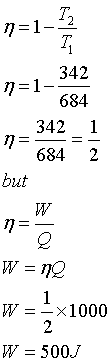
A carnot engine uses first an ideal monoatomic gas ( γ=5/3) and then ideal diatomic gas ( γ=7/5) as its working substance. The source and sink temperature are 411°C and 69°C respectively and the engine extract 1000J of heat from the source in each cycle. Then.. [ CPMT 1998]
-
0%
a) The efficiencies of the engine in the two cases are in ratio 21:25
-
33%
b) The area enclosed by the PV diagram in the first case only 500J
-
33%
c) The area enclosed by the PV diagram in both cases is 500J
-
33%
d)The heat energy rejected by the engine in the first case is 600J while that in the second case is 741.3J [ CPMT 1998]
Explanation
Q.2.
The specific heat of 1 mole of an ideal gas at constant pressure is represented by Cp and that at constant volume by Cv. One of the following statement is correct [ MNR 1992]
-
33%
a) Cp of hydrogen gas is 5R/2
-
33%
b) Cv of hydrogen is 7R/2
-
0%
c) H2 has a very small value of Cp and Cv
-
33%
d) Cp -Cv=1.99 cal/ mole K for H2
Q.3.
A gas undergoes a process, changing from its initial state to some other state. Which of the following does not depend only on the initial and final states but also on the path followed
-
33%
a)heat exchanged with systems
-
33%
b) Internal energy
-
33%
c)entropy
-
0%
d)none of the above
Q.4.
A gas undergoes a change at constant temperature. Which of the following quantities remains fixed?
-
0%
a) Pressure
-
33%
b) Entropy
-
33%
c)Heat exchanged with the system
-
33%
d)All the above may change
Q.5.
A gas does 4.5 J of external work during adiabatic expansion. Its temperature falls by 2K. Its internal energy will
-
33%
a) Increase by 4.5J
-
33%
b) Decrease by 4.5J
-
33%
c)Decrease by 2.25J
-
0%
d)Decrease by 9J
Q.6.
An ideal gas is isothermally expanded. Its internal energy will [ CPMT 1990]
-
0%
a) increase
-
33%
b) decrease
-
33%
c) increase or decrease depending upon the nature of gas
-
33%
d) remains same
Q.7.
The difference between Cp and Cv is ...
-
0%
a)zero for solids and liquids
-
0%
b) same for solids, liquid and gases
-
100%
c)positive for solids, liquids and gases
-
0%
d)more for 1 gm molecules of oxygen than for 1 gm molecule of hydrogen
Q.8.
When 1g water freezes at at 0°C and 1×10⁵N/m2 pressure, it is converted into 1.091 cc ice at 0°C. The external work done nearly
-
0%
a) +0.0091 J
-
0%
b) -0.0091J
-
33%
c)+0.0182J
-
67%
d)-0.0182J
Q.9.
When a gas is heated at constant pressure, the percentage of heat energy supplied, which goes as the internal energy of the gas is ..
-
33%
a) more for a diatomic gas for a monoatomic gas
-
33%
b) same for monoatomic, diatomic and triatomic gases
-
33%
c)100% for all gas
-
0%
d)less for a triatomic gas than for a diatomic gas
Q.10.
The molar specific heat of oxygen at constant pressure, Cp=7.03 Cal mole-1°C-1 and R=8.31 Joule mole-1°C-The amount of heat taken by 5 mole of oxygen when heated at constant volume from 10°C to 20°C will be approximately [ MPPMT 1987]
-
0%
a) 25 cal
-
67%
b) 50 cal
-
33%
c) 250 cal
-
0%
d) 500 cal
Q.11.
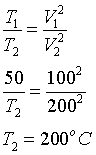
A bullet travelling with velocity 100 m/sec hits a concrete wall. All its kinetic energy is converted into heat energy in the bullet with the result that there is an increase of 50°C in the temperature of the bullet. What will be the increase in the temperature if the bullet were travelling with a velocity 200 m/sec?
-
67%
a)100°C
-
0%
b) 50°C
-
33%
c)200°C
-
0%
d)400°C
Explanation
Q.12.
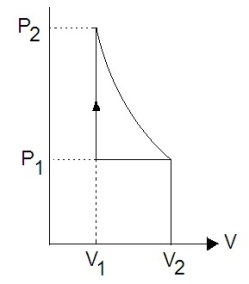
Carbon monoxide is carried around a closed cycle abc, in which bc is an isothermal process, as shown in the figure. The gas absorbs 7000J of heat, as its temperature increases from 300K to 1000 K in going from a to b. The quantity of heat rejected by the gas during the process ca is ..[ SCRA 1994]
-
0%
a) 4200 J
-
33%
b) 5000 J
-
33%
c)9800 J
-
33%
d)-9800 J
Q.13.
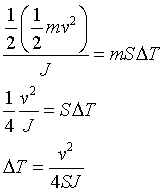
A bullet made of lead moving with velocity v hits a wall. Its 50% kinetic energy is converted into heat, then increase in temperature will be... [ Raj.PMT 1996]
-
33%
a) 2v2 / JS
-
67%
b) v2 / 4JS
-
0%
c)v2S / J
-
0%
d)v2S / 2J
Explanation
Q.14.
The molar specific heat of an ideal gas at constant pressure and volume are denoted by Cp and Cv respectively. Further Cp/Cv=γ and R is the gas constant for 1gm of gas. Then Cv is equal to ...
-
0%
a) R
-
0%
b) γR
-
100%
c) R / (γ-1)
-
0%
d) γR / (γ-1)
Q.15.
If the ratio of specific heat of gas at constant pressure to that at constant volume is γ, the change in internal energy of a mass of gas when the volume change from V to 2V at constant pressure P is .. [ CBSE 1998]
-
0%
a)R / ( γ -1)
-
0%
b) PV
-
67%
c)PV / (γ-1)
-
33%
d)γPV / (γ-1)
Q.16.
The specific heat of hydrogen gas at constant pressure is Cp=3.4×10³ calories /kg°C and at constant volume is Cv=2.4×10³ calories/ kg°C. If one kilogram hydrogen is heated from 10°C to 20°C at constant pressure, the external work done on the gas to maintain it at constant pressure is [ MPPMT 1995]
-
67%
a) 103 calories
-
33%
b) 5 ×10³ calories
-
0%
c)104 calories
-
0%
d)105 calories
Q.17.
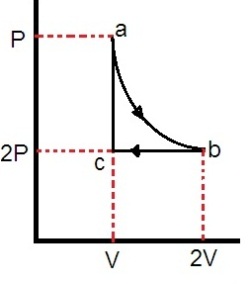
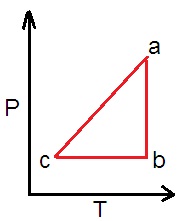
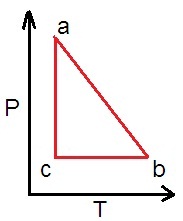
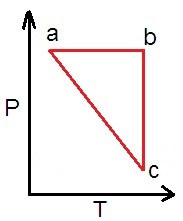
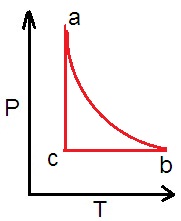
Fig. below represents a cyclic process abca for one mole of an ideal gas. If ab is isothermal process then which of the following is the P-T diagram for the cyclic process
-
33%
a)
-
0%
b)
-
33%
c)
-
33%
d)
Q.18.
A constant volume gas thermometer works on [ IIT 1980]
-
0%
a) The principle of Archimedes
-
33%
b) Boyle's law
-
33%
c) Pascal's law
-
33%
d) Charles' law
Q.19.
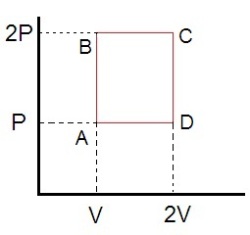
An ideal monoatomic gas is taken round the cycle ABCDA as shown in the P_V diagram. The work done during the cycle is .. [ IIT 1983]
-
67%
a)PV
-
0%
b) 2PV
-
33%
c)½ PV
-
0%
d)zero
Q.20.
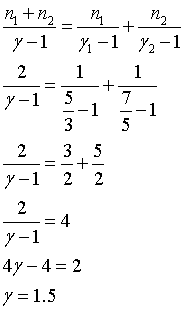
One mole of a monoatomic gas ( γ=5/3) is mixed with one mole of a diatomic gas ( γ=7/5), the value of γ for mixture is .. [ IIT 1988]
-
0%
a) 1.4
-
67%
b) 1.5
-
0%
c)1.53
-
33%
d)3.07
Explanation
Q.21.
From the following statements ideal gas at any given temperature T, select the correct one [ IIT 1995]
-
33%
a) The coefficient of volume expansion at constant pressure is the same for all ideal gases
-
33%
b) The average translational kinetic energy per molecule of oxygen gas is 3kT, k is being Boltzmann constant
-
0%
c)The mean free path of molecules increases with increase in the pressure
-
33%
d)In gaseous mixture, the average translational kinetic energy of the molecules of each component is different
Q.22.
A closed compartment containing gas is moving with some acceleration in horizontal direction. Neglect effect of gravity. Then the pressure in the compartment is ..[ IIT 1999]
-
33%
a) same everywhere
-
33%
b) lower in the front side
-
0%
c) lower in te rear side
-
33%
d) lower in the upperside
Q.23.
A gas mixture consists of 2 moles of oxygen and 4 moles of argon at temperature T. Neglecting all vibrational modes, the total internal energy of the system is [ IIT 1999s]
-
0%
a)4 RT
-
33%
b) 15 RT
-
0%
c)9 RT
-
67%
d)11 RT
Q.24.
A monoatomic ideal gas, initially at temperature T1 is enclosed in a cylinder fitted with a frictionless piston. The gas is allowed to expand adiabatically to a temperature T2 by releasing the piston suddenly. If L1 and L2 are the length of the gas column before and after expansion respectively, then T1 / T2 is given by .. [ IIT 2000]
-
33%
a)

-
33%
b)

-
0%
c)

-
33%
d)

Explanation

Q.25.
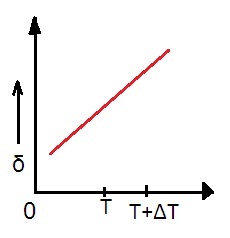
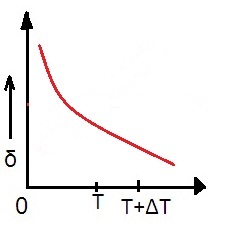
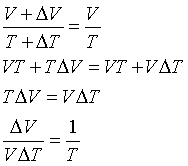
An ideal gas is initially at temperature T and volume V. Its volume is increased by ΔV due to an increase in temperature ΔT, pressure remains constant. The quantity δ=ΔV / ( VΔT) varies with temperature as .. [ IIT 2000]
-
33%
a)
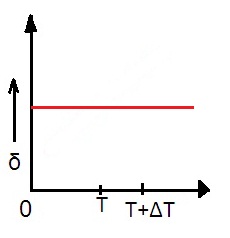
-
67%
b)
-
0%
c)
-
0%
d)
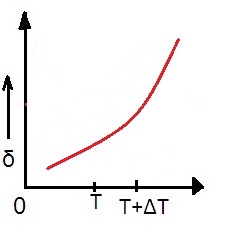
Explanation
Q.26.
In a given process on an ideal gas, dW=0 and dQ
-
33%
a) the temperature will decrease
-
0%
b) the volume will increase
-
67%
c) the pressure will remain constant
-
0%
d) the temperature will increase
Q.27.
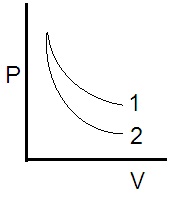
P-V plots for two gases during adiabatic process are shown in the figure. Plot 1 and 2 should correspond respectively to .. [ IIT 2001]
-
0%
a)He and O2
-
100%
b) O2 and He
-
0%
c)He and Ar
-
0%
d)O2 and N2
Q.28.
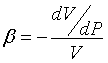
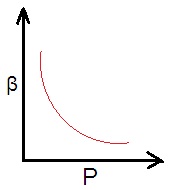
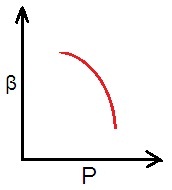
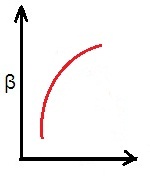
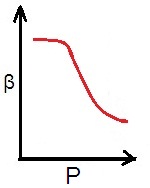
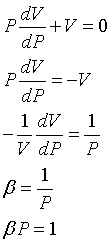
Which of the following graph correctly represents the variation of with P for an ideal gas at constant temperature? [ IIT 2002]
-
100%
a)
-
0%
b)
-
0%
c)
-
0%
d)
Explanation
Q.29.
The PT diagram for an ideal gas is shown in figure, where AC is an adiabatic process, find the corresponding PV diagram ..[ IIT 20003]
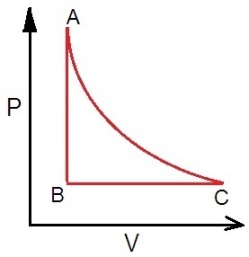
-
0%
a)
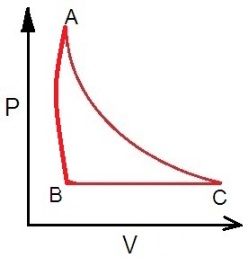
-
67%
b)
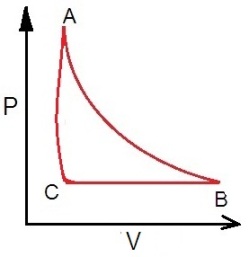
-
0%
c)
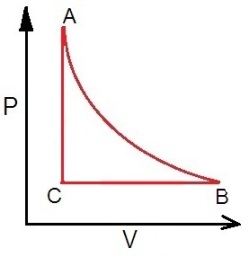
-
33%
d)
Q.30.
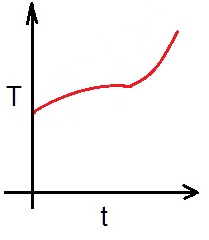
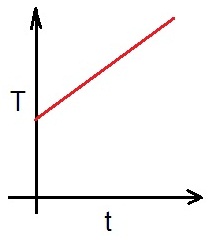
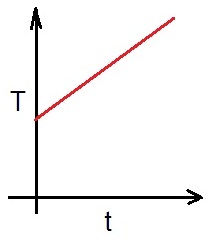
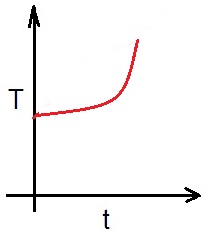
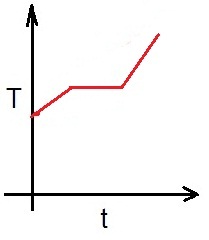
If liquefied oxygen at 1 atmospheric pressure is heated from 50K tp 300K by supplying heat at constant rate. The graph of temperature vs time will be ..[ IIT 2004]
-
33%
a)
-
0%
b)
-
67%
c)
-
0%
d)