Q.1.
Identify the wrong statement with reference to transport of oxygen [ NEET 2020]
-
34%
a) Higher H+ conc. in alveoli favours the formation of oxyhaemoglobin
-
22%
b) Low pCO2 in alveoli favours the formation of oxyhaemoglobin
-
28%
c) Binding of oxygen with haemoglobin is mainly related to partial pressure of O2
-
16%
d) Partial pressure of CO2 can interfere with O2 binding with haemoglobin
Q.2.
Select the correct sequence for transport of sperm cells in male reproductive system. ... [NEET 2019]
-
18%
a) Testis → Epididymis → Vasa efferentia → Rete testis → Inguinal canal → Urethra
-
48%
b) Seminiferous tubules → Rete testis → Vasa efferentia → Epididymis → Vas deferens → Ejaculatory duct → Urethra → Urethral meatus
-
10%
c) Seminiferous tubules → Vasa efferentia → Epididymis → Inguinal canal → Urethra
-
24%
d) Testis → Epididymis → Vasa efferentia → Vas deferens → Ejaculatory duct → Inguinal canal → Urethra → Urethral meatus
Q.3.
The contraceptive ‘SAHELI’ .....[NEET 2018]
-
22%
a) is an IUD.
-
32%
b) increases the concentration of estrogen and prevents ovulation in females.
-
33%
c) blocks estrogen receptors in the uterus, preventing eggs from getting implanted.
-
13%
d) is a post-coital contraceptive.
Q.4.
Select the option including all sexually transmitted diseases. [NEET 2020]
-
16%
a) AIDS, Malaria, Filaria
-
16%
b) Cancer, AIDS, Syphilis
-
65%
c) Gonorrhoea, Syphilis, Genital herpes
-
3%
d) Gonorrhoea, Malaria, Genital herpes
Q.5.
Meiotic division of the secondary oocyte is completed ... .. [NEET 2020]
-
29%
a) After zygote formation
-
48%
b) At the time of fusion of a sperm with an ovum
-
15%
c) Prior to ovulation
-
8%
d) At the time of copulation
Q.6.
Match the following columns and select the correct option.
| Column-I | Column-II |
| (a) Placenta | (i) Androgens |
| (b) Zona pellucida | (ii) Human Chorionic Gonadotropin (hCG) |
| (c) Bulbo-urethral | (iii) Layer of the ovum glands |
| (d) Leydig cells | (iv) Lubrication of the Penis |
-
19%
a) a →iii; b →ii; c →iv; d →i;
-
59%
b) a →ii; b →iii; c →iv; d →i;
-
16%
c) a →iv; b →iii; c →i; d →ii;
-
6%
d) a →i; b →iv; c →ii; d →iii;
Q.7.
Which of the following hormone levels will cause release of ovum (ovulation) from the graffian follicle? [NEET 2020]
-
14%
a) Low concentration of LH
-
21%
b) Low concentration of FSH
-
47%
c) High concentration of Estrogen
-
18%
d) High concentration of Progesterone
Q.8.
Which one is produced by mesoderm? ... ... [ JKMCEE 1994]
-
29%
a) Heart and notochord
-
28%
b) Heart and brain
-
33%
c) Spinal cord and notochord
-
10%
d) Brain and notochord
Q.9.
Which one is not character of haemochorial placenta ... ... [ Guj CET 2010 ]
-
20%
a) CO2 and excretory products pass from foetus to mother's body
-
24%
b) O2 and nutrients from mother's body enter the foetus
-
27%
c) Chorion villi are covered by blood sinuses of mother
-
29%
d) It protects foetus from mechanical shocks
Q.10.
Tunica albuginea is related to ... ... [ CMC 2002 ]
-
7%
a) Liver
-
9%
b) Lung
-
19%
c) Spleen
-
64%
d) Testes
Q.11.
Which differentiates a sperm from egg ... ..
| Basis for comparison | Human sperm | Human ovum |
| Size | Very small | Large in size |
| Mitochondria | In the middle piece, mitochondria form a spiral and are compactly arranged. | Mitochondria are scattered in the cytoplasm. |
| Cytoplasm | Present in the small amount | Present in large amount. |
| Nucleus | It is condensed with no nucleoplasm. The nucleus contains X or Y chromosome. | Ovum contains nucleoplasm, called as the germinal vesicle. The nucleus contains only X chromosome |
| Centrioles | Present. | Absent. |
| Produced in | Sperms are produced in the testes. | Ovum is produced in ovaries |
| Number of sperms formed | Four sperms are formed from one spermatogonium. | Only one ovum is formed from one oogonium |
| Differentiated into | Sperms are separated into head, neck, middle piece and tail. | Ovum is not externally separated into regions. |
| Movement | Can move. | Not able to move. |
| Surrounded by | Surrounded by plasma membrane only. | Ovum is surrounded by the egg envelopes.or Accessory membranes |
-
20%
a) Cytoplasm is more abundant in sperm than in egg
-
32%
b) Accessory membranes are absent in sperm but present in egg
-
29%
c) Nucleus is clear in sperm and very compact in egg
-
19%
d) Mitochondria from a sheat in egg and diffused in sperm
Q.12.
Membrane that gives protection to embryo from external shocks is ... .. [ MPPMT 1994 ]
-
27%
a) Amnion
-
15%
b) Allantois
-
20%
c) Chorion
-
38%
d) Placenta
Q.13.
Acrosome occurs in the sperm in ... .... [ MPPMT 1998 ]
-
15%
a) tail part
-
15%
b) behind the nucleus
-
17%
c) middle piece
-
53%
d) tip
Q.14.
What is incorrect during amphimixis
-
28%
a) Swelling of sperm nucleus
-
28%
b) Initial movement of male nucleus along copulation path
-
23%
c) Establishment of achromatic spindle by proximal centriole
-
21%
d) Completion of second meiotic division if not occurred already
Q.15.
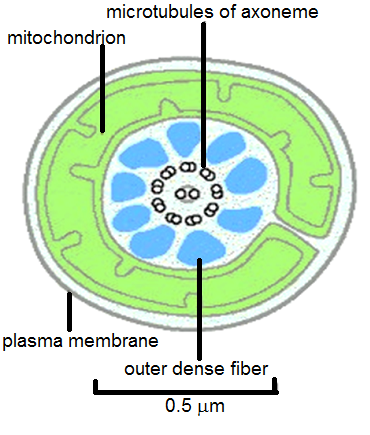
A cross section at mid point of the middle piece of human sperm will show ... ... [ AIIMS 2005 ]
-
25%
a) Centriole, mitochondria, 9+2 arrangement of microtubules
-
30%
b) Centriole and mitochondria
-
38%
c) Mitochondria and 9+2 arrangement of microtubules
-
7%
d) 9+2 arrangement of microtubules only
Q.16.
Amnion surrounds ... ... [ AMU 2000 ]
-
13%
a) Allantois
-
13%
b) Chorion
-
60%
c) Embryo
-
14%
d) Yolk sac
Q.17.
Pregnancy begins with implantation of ... ... [ Wardha 2005 ]
-
14%
a) Embryo
-
38%
b) Fertilized ovum
-
7%
c) Blastopore
-
41%
d) Blastocyst
Q.18.
Match the columns and find the correct combination ... ... [ KCET 2008]
| Column I | Column II |
| a) Oxytocin | p) Stimulates ovulation |
| b) Prolactin | q) Implantation and maintenance of pregnancy |
| c) Luteinising | r) Lactation after child birth |
| d) Progesterone | s) Uterine contraction during labour |
| - - | t) Reabsorption of warter by nephrons |
-
56%
a) a → s, b → r, c → p, d → q
-
20%
b) a → t, b → r, c → p, d → s
-
19%
c) a → s, b → q, c → r, d → t
-
6%
d) a → t, b → p, c → s, d → r
Q.19.
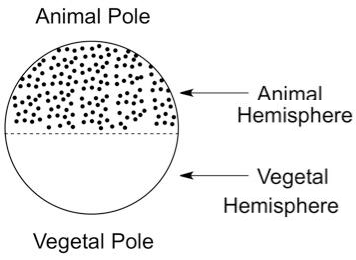
Sperm enters the egg from ... ... [ RPMT 2002 ]
-
25%
a) Animal pole
-
21%
b) Vegetal pole
-
46%
c) Micropyle
-
8%
d) Megapyle
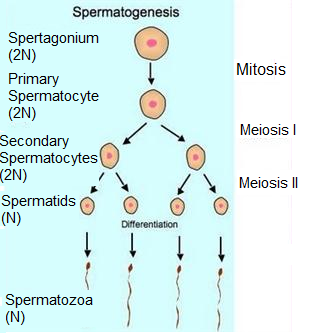
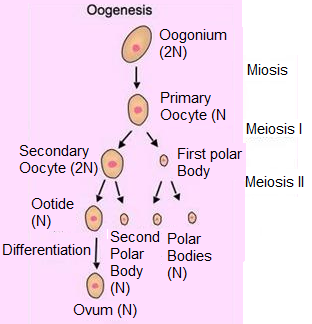
Q.20.
50 secondary oocytes in female and 50 secondary spermatocytes in male give rise to .... ... [MPPMT 1993]
-
51%
a) 50 ova and 100 sperms
-
24%
b) 100 ova and 200 sperms
-
11%
c) 200 ova and 50 sperms
-
13%
d) 100 ova and 100 sperms
Q.21.
Cleavage was first seen by ... ..
-
28%
a) Spallanzani
-
31%
b) Aristotle
-
16%
c) Hertwig
-
24%
d) Harvey
Q.22.
In man the sperm released from the testis take the following route to reach the ureter ... ....
-
76%
a) Vasa efferentia, epididymis, vas deferens and urethra
-
9%
b) Vasa efferentia, Bidder's canal, nephrostome
-
8%
c) Vasa efferentia, collecting tubules and bidder canals
-
7%
d) Vasa efferentia, Bidder canal, uriniferous tubules and nephrostome
Explanation
Q.23.
Ovulation occurs under the influence of high titre of ... ... [ AIIMS 1996 ]
-
36%
a) LH
-
13%
b) FSH
-
40%
c) Estrogen
-
11%
d) Progesterone
Q.24.
Cleavage differs from mitosis because ... ...
-
28%
a) In cleavage there is no growth phase
-
14%
b) In cleavage consumption of roman O2 increases
-
13%
c) In cleavage nucleus-cytoplasmic ratio increases
-
45%
d) All the above
Q.25.
Production of sperms from spermatids is ... ... [ AFMC 2003 ]
-
48%
a) Spermiogenesis
-
42%
b) Spermatogenesis
-
4%
c) Oogenesis
-
7%
d) Gametogenesis
Q.26.
Movement of sperm is by ... ... [ Odisha 2008 ]
-
9%
a) Head
-
11%
b) Acrosome
-
10%
c) Middle piece
-
69%
d) Tail/flagellum
Explanation
Q.27.
In human females, menstrual cycle ceases around 50 years of age. it is termed as ... ... [ HPPMT 2011 ]
-
78%
a) Menopause
-
10%
b) Menarche
-
6%
c) Diapause
-
7%
d) None of the above
Explanation
Q.28.
Which one functions as endocrine gland after ovulation ... ... [ CBSE 2007 ]
-
10%
a) Stroma
-
15%
b) Vitelline membrane
-
19%
c) Germinal epithelium
-
56%
d) Graafian follicle
Q.29.
Which layer of embryo is formed first ... ... [ CPMT 2007 ]
-
15%
a) Mesoderm
-
22%
b) Ectoderm
-
22%
c) Endoderm
-
40%
d) Both B and C
Q.30.
Menstrual cycle occurs in ... ... [ Wardha 2005 ]
-
23%
a) Human females
-
11%
b) Mammalian females
-
11%
c) Primate females
-
55%
d) All of above