Q.1.
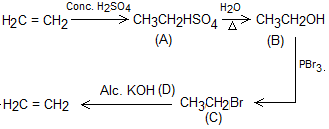
ion Q91) Identify (B) and (D) in the following sequence of reactions: [Karnataka CET 2011]

-
0%
a) CH3OH and C2H5Br
-
25%
b) C2H5HSO4 and alc. KOH
-
75%
c) C2H5OH and alc. KOH
-
0%
d) C2H5HSO4 and aq.KOH
Explanation
Q.2.
Which of the following is most reactive towards electrophilic substitution reaction? [ J & K CET 2011]
-
60%
a) Aniline
-
10%
b) Nitrobenzene
-
20%
c) Benzoic acid
-
10%
d) Acetanilide
Q.3.
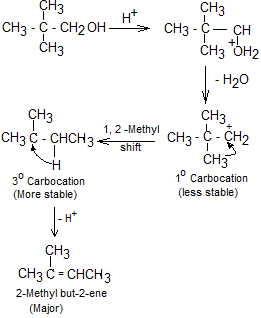
ion Q93) In the reaction given below, X is ...[ DPMT 2009]>br/>

-
43%
a) 2-methylpentane
-
0%
b) neo-pentane
-
57%
c) 2-methypent-2-ene
-
0%
d) 2-methylbut-2-ene
Explanation
Q.4.
Hydrocarbon which is liquid at room temperature is ...[ AIIMS 2001]
-
29%
a) Pentane
-
29%
b) Butane
-
29%
c) Propane
-
14%
d) Ethane
Q.5.
The complete combustion of CH4 gives ...[ BHU 2004]
-
43%
a) CO + H2
-
29%
b) CO + N2
-
0%
c) CO + N2O
-
29%
d) CO2 + H2O
Q.6.
Acetylenic hydrogens are acidic because ...[ CBSE PMT 1989]
-
86%
a) Sigma electron density of C-H bond in acetylene is nearer to carbon, which has 50% s-character
-
0%
b) Acetylene has only one hydrogen on each carbon
-
0%
c) Acetylene contains least number of hydrogens among the possible hydrocarbons having two carbons
-
14%
d) Acetylene belongs to the class of alkynes with molecular formula. CnH2n-2
Q.7.
ion Q97) In the following compound, the C-2 and C-3 bond is of the type ..[ IIT 1999]

-
43%
a) sp-sp2
-
29%
b) sp3-sp3
-
0%
c) sp-sp3
-
29%
d) sp2-sp3
Explanation

Q.8.
Which of the following metal powder is sued to convert trichloromethane into acetylene by heating the latter with it ? 9Pb CET 1995]
-
43%
a) Na
-
29%
b) Mg
-
14%
c) Ca
-
14%
d) Ag
Q.9.
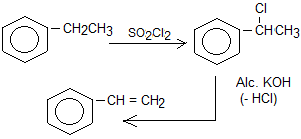
Which of the following sequence of reaction (reagents) can be used for the conversion of C6H5CH2CH3 into C6H5-CH = CH2 ? [ AIIMS 2006]
-
0%
a) SOCl2; H2O
-
57%
b) SO2Cl2; alc. KOH
-
0%
c) Cl2/hν; H2O
-
43%
d) SOCl2; alc.KOH
Explanation
Q.10.
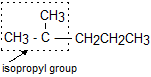
The compound which has one isopropyl group is ..[ IIT 1989]
-
0%
a) 2, 2, 3. 3-tetramethyl pentane
-
29%
b) 2, 2-dimethyl pentane
-
29%
c) 2, 2, 3-trimethyl pentane
-
43%
d) 2-methyl pentane
Explanation
Q.11.
Benzene gives mainly ..[ DPMT 2007]
-
25%
a) substitution reaction
-
25%
b) addition reaction
-
25%
c) elimination reaction
-
25%
d) all of these
Q.12.
To prepar a pure sample of n-hexane using sodium metal as one reactant, the other reactants will be ...[ CBSE PMT 1992]
-
14%
a) Ethyl chloride and n-butyl chloride
-
29%
b) Methyl bromide and n- pentyl bromide
-
43%
c) n-Propyl bromide
-
14%
d) Ethyl bromide and n-.butyl bromide
Q.13.
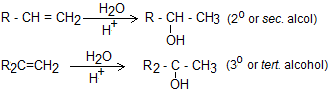
Acid catalysed hydration of alkenes except ethene leads to the formation of ...[ JCECE (Med) 2008]
-
11%
a) primary alcohol
-
44%
b) secondary or tertiary alcohol
-
33%
c) mixture of primary and secondary alcohols
-
11%
d) mixture of secondary and tertiary alcohol
Explanation
Q.14.
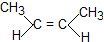
hich of the following has the lowestdipole moment? [ IIT 2002]
-
29%
a) CH2=CH-C≡CH
-
29%
b) CH3C ≡ CCH3
-
14%
c) CH2 = CH -C ≡ CH
-
29%
d)
Q.15.
Which of the following liberates methane on treatment with water? [ CMC Vellore 2007]
-
12%
a) Silicon carbide
-
25%
b) Calcium carbide
-
62%
c) Beryllium carbide
-
0%
d) Magnesium carbide
Q.16.
enzene does not go adition reactions easily because
-
29%
a) It has a cyclic structure
-
0%
b) Double bonds in it arevery strong
-
57%
c) Reasonance stabilized system is to be preserved
-
14%
d) It has six hydrogenatoms
Q.17.
-phenyl propene on acidic hydration, gives ..[ IIT 2004]
-
50%
a) 2-phenyl-2-propanol
-
12%
b) 2-phenyl-1-propanol
-
12%
c) 3-phenyl-1-propanol
-
25%
d) 1-phenyl-2-propanol
Explanation

Q.18.
The substance that would not at all be formed during the reaction of methane and chlorine in the presence of sunlight is ...
-
25%
a) CH3Cl
-
0%
b) CHCl3
-
12%
c) CH3CH3
-
62%
d) CH3CH2CH3
Q.19.
The reaction of sodium formate with soda lime gives
-
29%
a) Hydrogen
-
71%
b) Methane
-
0%
c) Ethane
-
0%
d) None of the above
Q.20.
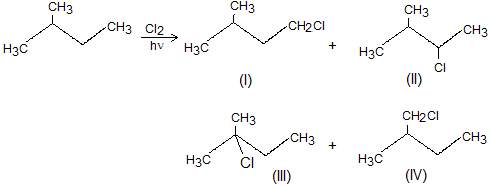
How many chiral compounds are possible on monochlorination of 2-methyl butane? [ IIT 2004]
-
57%
a) 2
-
43%
b) 4
-
0%
c) 6
-
0%
d) 8
Explanation
Q.21.
Among the given compounds, one which can be distinguished by AgNO3 is ? [ AFMC 2010]
-
14%
a) Ethane
-
14%
b) Ethylene
-
71%
c) Acetylene
-
0%
d) Diethyl ether
Explanation

Q.22.
Statement I: 1-butene on reaction with HBr in the presence of peroxide produces 1-bromobutane Statement II: It involves the formation of a primary radical
-
29%
a) Statement I is correct Statement II is correct Satement II is a correct explanation of statement I
-
14%
b) Statement I is correct statement II is correct statement II is not the correct explanation of statement I
-
57%
c) Statement I is correct, statement II is incorrect
-
0%
d) Statement I is incorrect statement II is correct
Q.23.
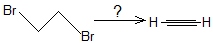
on Q113) Following compound is an ...[ DPMT 2007]
-
0%
a) alcoholic KOH
-
71%
b) alcoholic KOH followed by NaNH2
-
29%
c) aqueous KOH followed by NaNH2
-
0%
d) Zn/CH3OH
Q.24.
Which of following will not react with acetylene? [ AIEEE 2002)
-
44%
a) NaOH
-
11%
b) ammonical AgNO3
-
33%
c) Na
-
11%
d) HCl
Q.25.
Which one of the following has the lowest boiling point ... [ PMT Kerala 2011]
-
0%
a) 2-Methylbutane
-
38%
b) 2-Meyhylpropane
-
50%
c) 2,2-Dimethylpropane
-
12%
d) n-pentane
Q.26.
Which one of the following will undergo meta-substitution on monochlorination? ...[ AIIMS 1991]
-
8%
a) Ethoxybenzne
-
17%
b) Chlorobenzene
-
75%
c) Ethyl benzoate
-
0%
d) Phenol
Q.27.
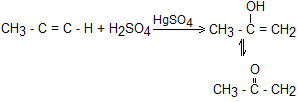
When propyne is treated with aqueous H2SO4 in the presence of HgSO4, the major product is ...[ IIT 1983]
-
29%
a) Propanal
-
29%
b) propyl hydrogen sulphate
-
29%
c) acetone
-
14%
d) propanol
Explanation
Q.28.
When an alyyne, RC≡CH, is treated with cuprous ion in an ammonical medium, one of the products is ...[ DEC 1996]
-
67%
a) RC ≡ CCu
-
17%
b) CuC ≡ CH
-
17%
c) CuC ≡ CCu
-
0%
d) RC ≡ CR
Explanation

Q.29.
Arrange in order of decreasing reactivity towards electrophilic reagent in ; chlorobenzene (I), benzene (II), toluene (III), phenol (IV) would be ...[ AIPMT 2007]
-
71%
a) IV > III > II > I
-
14%
b) IV > I > II > III
-
14%
c) II > I > IV > III
-
0%
d) I > II > IV > III
Q.30.
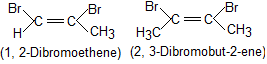
han one correct answer Q121) Which one of the following exhibits geometrical isomerism? [ Kerala PMT 2011]
-
29%
a) 1, 2-Dibromopropene
-
14%
b) 2, 3-Dimethylbut-2-ene
-
43%
c) 2,3-Dibromobut-2-ene
-
14%
d) 2-Methylbut-2-ene
Explanation