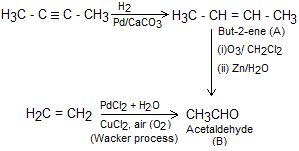
Q.1.
on Q183) This reaction is called as ...[BVP 2006]

-
20%
a) Fischer-Siper reaction
-
30%
b) Clemmensen reduction
-
40%
c) Birch reduction
-
10%
d) Arndt -Eistert synthesis
Explanation

Q.2.
Which of the following explains why propene undergoes electrophilic addition with HBr, but not with HCN?
-
11%
a) Br- is better nucleophile than CN-
-
22%
b) The C-Br bond is stronger than C-CN
-
11%
c) HCN reacts preferablly via the lone pair of electron
-
56%
d) HBr is a stronger acid than HCN and hence is a better souce of protons
Q.3.
Octane number is zerop for ..[ CET Karnataka 2002]
-
11%
a) iso-heptane
-
67%
b) n-heptane
-
0%
c) iso-octane
-
22%
d) n-octane
Q.4.
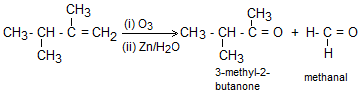
Ozonolysis of 2,3-dimethyl-1-butene followed by reduction with zinc and water gives ..[ IIT 1992]
-
0%
a) Methanoic acid and 3-methyl-2-butanone
-
25%
b) Methanal and 2-methl-2-butanone
-
62%
c) Methanal and 3-methyl-2-butanone
-
12%
d) Methanoic acid and 2-methyl-2-butanone
Explanation
Q.5.
on Q187) In the following reaction the major product 'X' is ...[ AMU 2010]

-
71%
a)

-
0%
b)

-
14%
c)

-
14%
d)

Q.6.
According to Huckel rule, an aromatic compound must possess ...[ J & K CET 2007]
-
12%
a) (4n + 1) π electrons
-
50%
b) (4n + 2) π electrons
-
38%
c) (2n+2)π electrons
-
0%
d) 4nπ electrons
Q.7.
During the preparation of alkanes by Kolbe's electroltic method using inert electrodes, the pH of the electrolyte ...
-
14%
a) decreases progressively as the reaction proceeds
-
71%
b) increases progressively as the reaction proceeds
-
14%
c) remains constant througout the reaction
-
0%
d) may decrease if the concentration of the electrolyte is not very high
Q.8.
The substituent which is predominantly orth-para directing but deactivating in aromatic electrophilic substitution ...[ Kerala PMT 2010]
-
0%
a) - BO2
-
43%
b) - cl
-
43%
c) - OCH3
-
14%
d) - CH3
Q.9.
On electrolysis of potassium succinate solution, the hydrocarbon obtained is ...[ JIPMER 2004]
-
29%
a) ethene
-
14%
b) ethane
-
29%
c) ethyne
-
29%
d) all of these
Q.10.
The order of reactivity of following alkenes, when subjected to acid catalyzed hydration is ..[ AMU 2009] I. (CH3)2C = CH2 II. CH3CH = CH2 III. H2C = CH2
-
43%
a) I > II > III
-
14%
b) I > III > II
-
29%
c) III > II > I
-
14%
d) II > I > III
Q.11.
Indicate the expected structure of the organic product when ethyl magnesium bromide is treated with heavy water (D2O) ...[ DEC 1994]
-
0%
a) C2H5- C2H5
-
29%
b) C2H5OD
-
14%
c) Sodium nezoate
-
57%
d) C2H5D
Q.12.
Elimination of bromine from 2-bromobutane results in the formation of ...[ JCEC Med. 2008]
-
0%
a) equimolar mixture of 1- and 2-butene
-
86%
b) predominantly - 2 - butene
-
0%
c) predominantly - 1 - butene
-
14%
d) predominantly - 2 - butyne
Q.13.
The products formed by the action of chlorine on ethane in saturated solution of KBr is/are [ Pb CET 1996]
-
17%
a) ClCH2CH2Cl + ClCH2CH2Br
-
33%
b) ClCH2CH2Cl
-
17%
c) ClCH2CH2Cl + BrCH2CH2Br
-
33%
d) ClCH2CH2Cl + BrCH2CH2Br+ ClCH2CH2Br
Q.14.
Which hydrocarbon is mainly present is gobar gas? [ AFMC 2003]
-
14%
a) Butane
-
0%
b) Propane
-
71%
c) Methane
-
14%
d) Ethane
Q.15.
Which species represents the electrophile in aromatic nitration? [ Pb PMT 1998]
-
14%
a) NO2-
-
71%
b) NO2+
-
0%
c) NO2
-
14%
d) NO3-
Q.16.
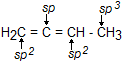
The compound 1,2-butadiene has ..[ IIT 1983]
-
0%
a) only sp-hybridised carbon atoms
-
14%
b) only sp2-hybridised carbon atoms
-
14%
c) both sp and sp2 -hybridised carbon atoms
-
71%
d) sp, sp2 and sp3 -hybridised carbon atoms
Explanation
Q.17.
Identify the reagent from the following list which can easily distinguish between 1-butyn and 2-butyne ..[ IIT2002]
-
0%
a) bromine, CCl4
-
14%
b) H2, Lindlar catalyst
-
29%
c) dilute H2SO4, HgSO4
-
57%
d) ammonical Cu2Cl2 solution
Q.18.
on Q199) Following reaction is called

-
0%
a) Wurtz's reaction
-
14%
b) Kolbe's reaction
-
71%
c) Sabatier and Sendern's reaction
-
14%
d) Carbylamine reaction
Q.19.
A compound is treated with NaNH2 to give sodium salt. Identify the compound ..[ CBSE PMT 1993]
-
29%
a) C2H2
-
29%
b) C6H6
-
29%
c) C2H6
-
14%
d) C2H4
Q.20.
Disubstituted derivatives of benzene are of type/types ...[ BCECE 2005]
-
0%
a) 1
-
43%
b) 2
-
57%
c) 3
-
0%
d) 6
Q.21.
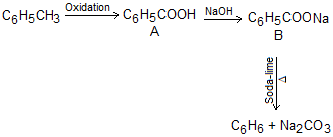
on Q202) In the reaction, the product C is ..... (BHU 1994)

-
14%
a) C6H5OH
-
57%
b) C6H6
-
0%
c) C6H5COONa
-
29%
d) C6H5ONa
Explanation
Q.22.
Which cycloalkane has the lowest heat of combustion per -CH2 group? [ CET Karnataka 2006]
-
33%
a) cyclopropane
-
0%
b) cyclobutane
-
50%
c) cyclopentane
-
17%
d) cyclohexane
Q.23.
Ethylene reacts with 1% cold alkaline KMnO4 to form ..[ Hariyana CEET 1998]
-
0%
a) Oxalic acid
-
29%
b) Ethylene glycol
-
71%
c) Ethy alcohol
-
0%
d) HCOH
Explanation

Q.24.
Which of the following reagent distinguish ethylene from acetylene? [ BHU 2006]
-
57%
a) Ammoniacal cuprous chloride
-
14%
b) Br2 water
-
14%
c) Alkaline KMnO4
-
14%
d) Chlorine dissolved in CCl4
Q.25.
Excess of CH3COOH is reacted with CH ≡ CH in presence of Hg2+, the product is ...[ BHU 1998]
-
0%
a) CH3CH(OOCCH3)2
-
43%
b) CH2= CH(OCOCH3)
-
43%
c) (CH3COO)CH2 - CH2(OOCCH3)
-
14%
d) None of these
Q.26.
Acidic hydrogen is present in ...[ IIT 1984]
-
50%
a) ethyne
-
0%
b) ethene
-
33%
c) benzene
-
17%
d) ethane
Explanation

Q.27.
Which of the following possesses the highest melting point ? [ Manipal 2001]
-
0%
a) Chlorobenzene
-
14%
b) o-dichlorobenzene
-
57%
c) m-dichlorobenzene
-
29%
d) p-dichlorobenzene
Q.28.
The compound with highest boiling point is .... [ IIT 1982]
-
50%
a) n-Hexane
-
25%
b) n-Pentane
-
0%
c) 2,2-Dimethylpropane
-
25%
d) 2-Methybutane
Q.29.
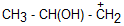
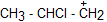
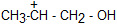
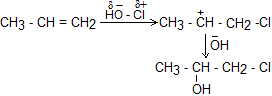
The reaction of propen with HOCl (Cl2+H2O) proceeds through the intermediate ...[ IIT 2016]
-
43%
a)

-
14%
b)
-
43%
c)
-
0%
d)
Explanation
Q.30.
on Q211) Identify the alkyne in the following sequence of reaction:... [ EAMCET 2009]

-
43%
a) H3C - C = C - CH3
-
43%
b) H3C - CH2 - C ≡ CH
-
14%
c) H2C = CH - C ≡ CH
-
0%
d) HC ≡ C - CH2 - C ≡ CH
Explanation