Q.1.
The isomers which canbe converted into another form by rotation of the molecule aronud single bond are ...[ AIIMS 1997]
-
22%
a) Geometricalisomers
-
44%
b) Conformers
-
29%
c) Enantiomers
-
5%
d) Diastereomers
Q.2.
Opticalisomerism aries from the presence of ...[ DPMT1994]
-
49%
a) An asymmetric carbon atom
-
21%
b) A centre ofsymmetry
-
14%
c) A line of symmetry
-
16%
d) Any of the above
Q.3.
Which of the following has zerodipole moment? [ Haryana CEET 1998]
-
13%
a) 1, 1-Dichloromethane
-
21%
b) cis-1, 2-Dichloroethene
-
55%
c) trans-1, 2-Dichloroethane
-
11%
d) 1-Chloroethane
Q.4.
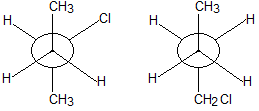
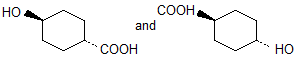
tion Q4) The pair of structures given below represent
-
13%
a) Enantiomers
-
28%
b) Diastereomers
-
33%
c) Structuralisomers
-
26%
d) Two molecules of the same compund
Q.5.
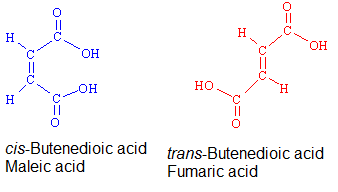
Which of the following compounds exhibits geometrical isomerism? [ BHU 1994]
-
9%
a) C2H5Br
-
39%
b) (CH)2(COOH)2
-
24%
c) CH3CHO
-
27%
d) (CH2)2(COOH)2
Explanation
Q.6.
A similarity between optical and geometrical isomerismis that ..[ AIEEE 2002]
-
14%
a) each forms equal number of isomers for a given compound
-
18%
b) if in a compound, one is present then so is the other
-
61%
c) both are included in steroisomerism
-
7%
d) they have no similarity
Q.7.
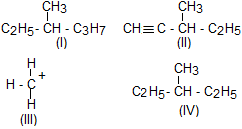
tion Q7) Among the following four structures I to IV Is it true that
-
8%
a) Only II nad IV are chiral compounds
-
20%
b) All four are chiral compounds
-
60%
c) Only I nad II are chiral compounds
-
12%
d) Only II is a chiral compound
Q.8.
(+)-Mandelic acid has a specific rotation of +158°. What would be the observed rotation of mixture of 25%(-)-mandelicacid and 75%(+)-mandelic acid ..
-
26%
a) +118.5°
-
21%
b) -118.5°
-
26%
c) -79°
-
26%
d) +79°
Q.9.
In keto-enol tautomerism of dicarbonyl compounds, the enol form is preferred in contrast to the keto-form, this is due to ..[ Pb CET1996]
-
11%
a) Presenceof carbonyl group on each side of -CH2 - group
-
83%
b) Resonance stabilization of enol form
-
6%
c) Presence of methylene group
-
0%
d) Rapid chemical exchage.
Explanation

Q.10.
ion Q10) C6H5C ≡N and are which types of isomers? [ CPMT 1997]

-
6%
a) Position
-
76%
b) Functional
-
6%
c) Tautomerism
-
12%
d) Linkage
Q.11.
cis-2-Butene and trans-2-Butene can be distingished on the basis of
-
32%
a) their properties
-
9%
b) their reduction products
-
9%
c) the products that give on ozonolysis
-
50%
d) the products they give on addition of bromine
Q.12.
Which of the following is optically active? [Haryana CEET 2000]
-
10%
a) Butane
-
29%
b) 4-Methylheptane
-
52%
c) 3-Methylheptane
-
10%
d) 2-Methylpentane
Q.13.
(S)-2-Methylbutanol oxidation with chromic acid gives
-
36%
a) (R)-2-Methylbutanoic acid
-
29%
b) (S)-2-Methylbutanoic acid
-
21%
c) (RS)-2-Methylbutanoic acid
-
14%
d) No reaction
Q.14.
Which of the following compounds exhibits stereoisomerism? [ IIT 2002]
-
20%
a) 2-Methylbutene-1
-
40%
b) 3-Methylbutyne-1
-
20%
c) 3-Methylbutanoic acid
-
20%
d) 2-Methylbutanoic acid
Q.15.
How manychain isomers couldbe obtained from the alkane C6H14 [ CBSE PMT 1988]
-
27%
a) Four
-
23%
b) Five
-
36%
c) Six
-
14%
d) seven
Q.16.
A compound with molecular formula, C7H16 shows optical isomerism, the compound will be ...[ CBSE PMT2001]
-
65%
a) 2, 3-dimethylpentane
-
18%
b) 2, 2-dimethylpentane
-
12%
c) 2-methylhexane
-
6%
d) none of these
Q.17.
Maximum number of isomers of an alkene with the molecular formula C4H8 is ..[ IIT 1982]
-
40%
a) Two
-
20%
b) Three
-
40%
c) Four
-
0%
d) Five
Q.18.
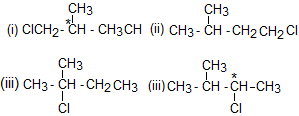
The number of possible enantiomeric pairs that can be produced during monochlorination of 2-methyl-butane is ..[ IIT 1997]
-
42%
a) 2
-
25%
b) 3
-
25%
c) 4
-
8%
d) 1
Explanation
Q.19.
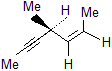
ion Q19) Hydrogen of the compound shown belowin the presence of poisoned palladium catalyst gives {IIT 2001]
-
44%
a) Optically active compound
-
22%
b) an opticallyinactive compound
-
33%
c) a racemic mixture
-
0%
d) a diasteremeric mixtures
Q.20.
The process of separation of a racemic modificationinto d- and l- enantiomers is called ..[ CBSE PMT 1994]
-
50%
a) Resolution
-
14%
b) Dehydration
-
7%
c) Revolution
-
29%
d) Dehyrohalogenation
Q.21.
Isomers of a substance must have the same ...[ CBSE PMT 1991]
-
31%
a) Structural formula
-
6%
b) Physical formula
-
6%
c) Chemical properties
-
56%
d) Molecular formula
Q.22.
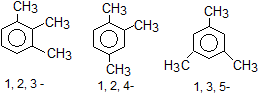
The total number of isomeric trimethylbenzene is ...[ MP CET 1998]
-
33%
a) 2
-
22%
b) 3
-
22%
c) 4
-
22%
d) 6
Explanation
Q.23.
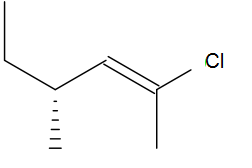
Number of stereomers of the compound,2-chloro-4-methylhex-2-ene is /are ...[ Haryana CEET 2000]
-
11%
a) 1
-
22%
b) 2
-
56%
c) 4
-
11%
d) 16
Explanation
Q.24.
Which of the following does not show geometrical isomerism? ...[ AIEEE 2002]
-
27%
a) 1,2-dichloro-1-pentene
-
0%
b) 1,3-dichloro-2-pentene
-
64%
c) 1,1-dichloro-1-pentene
-
9%
d) 1,4-dichloro-2-pentene
Q.25.
The restricted rotation about carbob-carbon double bond in 2-butene is due to [ CBSE PMT 1993]
-
9%
a) Overlap of one s- and sp2- hybridized orbitals
-
27%
b) Overlap of two sp2- hybridized orbitals
-
18%
c) Overlap of one p- and sp2- hybridized orbitals
-
45%
d) Sideways overlap of two p-orbitals
Q.26.
rism and Steroisomerism gneetStudy Companion For more NEET and AIIMS mcq on Isomerism and Steroisomerism Question Q26)The compound given below are
-
45%
a) Enantiomers
-
36%
b) Identical
-
0%
c) Regiomers
-
18%
d) Diastereomers
Q.27.
Which are isomers? [ Pb CET 1997]
-
40%
a) Ethyl alcohol and dimethyl ether
-
20%
b) Acetone and acetaldehyde
-
20%
c) Propionic acid and propanone
-
20%
d) Methyl alcohol and dimethyl ether
Q.28.
Opticallyactive isomers but not mirror images are called ... [ MPPMT 1999]
-
67%
a) Enantiomers
-
8%
b) Mesomers
-
17%
c) Tautomers
-
8%
d) Diasteremores
Q.29.
The number of structural and configurational isomers of bromo compound, C5H9Br, formed by the addition of HBr to2-pentynerespectively are ..[ IIT 1988]
-
12%
a) 1 and 2
-
75%
b) 2 and 4
-
12%
c) 4 and 2
-
0%
d) 2 and 1
Q.30.
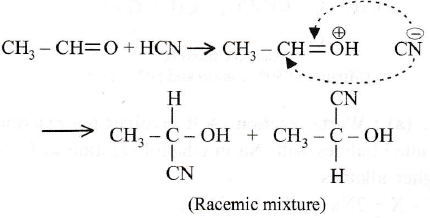
In the reaction, CH3CHO + HCN → CH3CH(OH)CN a chiral centre is produced. Thisproduct would be ..[ CBSEPMT 1995]
-
11%
a) Laevorotatory
-
33%
b) Meso-compound
-
22%
c) Dextrorotatory
-
33%
d) Racemic mixture
Explanation