Q.1.
Which of the following statements is not true . [CMC Vellore 198]
-
0%
a)The coefficient of friction between two surfaces increases as the surface in contact are made rough
-
100%
b) Rolling friction is greater than sliding friction
-
0%
c)The force of friction acts in a direction opposite to the applied force
-
0%
d)The coefficient of friction between wood and wood is less than 1
Q.2.
A force of 5 N acts on a body of weight 9.8 N. What is the acceleration produced in m/sec[NCERT 1990]
-
0%
a)49.00
-
100%
b)1.46
-
0%
c) 5.00
-
0%
d) 0.51
Q.3.
A student attempts to pull himself up by tugging on his hair. He will not succeed. [KCET 2005]
-
0%
d)As the force applied is internal to the system.
-
100%
a) As the force exerted is small
-
0%
b) Newton's law of inertia is not applicable to living beings.
-
0%
c)The frictional force while gripping, is small
Q.4.
A man is standing on a weighing machine placed in a lift. When stationary his weight is recorded as 40 kg. If the lift is accelerated upwards with an acceleration of 2m/s2, then the weight recorded in the machine will be . [MP PMT 1994]
-
0%
a) 32 kg
-
100%
b) 42 kg
-
0%
c) 40 kg
-
0%
d) 48 kg
Q.5.
A horizontal force of 10 N is necessary to just hold a block stationary against a wall. The coefficient of friction between the block and the wall is 0.the weight of the block is . [AIEEE 2003]
-
0%
a)2 N
-
100%
b) 50 N
-
0%
c) 20 N
-
0%
d)100 N
Q.6.
The maximum static frictional force is
-
0%
a) Equal to twice the area of surface in contact
-
100%
b) Equal to the area of surface in contact
-
0%
c)Independent of the area of surface in contact
-
0%
d)None of the above
Q.7.
A force of 10 Newton acts on a body of mass 20kg for 10 seconds. Change in its momentum is. [MP PET 2002]
-
0%
a)5 kg m/s
-
100%
b) 200 kg m/s
-
0%
c)100kg m/s
-
0%
d)1000kg m/s
Q.8.
A spring balance is attached to the ceiling of a lift. A man hangs his bag on the spring and the spring reads 49 N, when the lift is stationary. If the lift moves downward with an acceleration of 5m/s2 the reading of the spring balance will be . [AIEEE 2003]
-
100%
a) 49 N
-
0%
b) 74 N
-
0%
c) 24 N
-
0%
d) 15 N
Q.9.
A body of mass 2 kg moving on a horizontal surface with an initial velocity of 4 m/sec comes to rest after 2 sec. If one wants to keep this body moving on the same surface with a velocity of 4 m/sec, the force required is. [NCERT 1977]
-
0%
a)8 N
-
100%
b) Zero
-
0%
c)4 N
-
0%
d)2 N
Q.10.
A bird weighs 2 kg and is inside a closed cage of 1 kg. If it starts flying, then what is the weight of the bird and cage assembly. [AFMC 1997]
-
0%
a)1.5 kg
-
100%
b)3 kg
-
0%
c)2.5 kg
-
0%
d)4 kg
Q.11.
A wagon weighing 1000 kg is moving with a velocity 50km/h on smooth horizontal rails. A mass of 250 kg is dropped into it. The velocity with which it moves now is . [MP PMT 1994]
-
0%
a) 2.5 km/hour
-
0%
b) 40 km/hour
-
100%
c)20 km/hour
-
0%
d)50 km/hour
Q.12.
Newton's third law of motion leads to the law of conservation of. [Manipal MEE 199]
-
0%
a) Angular momentum
-
0%
b) Mass
-
100%
c) Energy
-
0%
d) Momentum
Q.13.
Consider a car moving on a straight road with a speed of 100 m/s. The distance at which car can be stopped is μk=0.5 . [AIEEE 2005]
-
0%
a)100 m
-
0%
b) 800 m
-
100%
c)400 m
-
0%
d)1000 m
Q.14.
A block weighs W is held against a vertical wall by applying a horizontal force F. The minimum value of F needed to hold the block is. [MP PMT 1993]
-
0%
a) Less than W
-
0%
b) Greater than W
-
100%
c)Equal to W
-
0%
d)Data is insufficient
Q.15.
Gravels are dropped on a conveyor belt at the rate of 0.5 kg/sec. The extra force required in newtons to keep the belt moving at 2 m/sec is. [EAMCET 1988]
-
0%
a)1
-
0%
b)4
-
100%
c)2
-
0%
d)0.5
Q.16.
A force of 98 N is required to just start moving a body of mass 100 kg over ice. The coefficient of static friction is
-
0%
a) 0.6
-
0%
b) 0.2
-
0%
c) 0.4
-
100%
d) 0.1
Q.17.
A car turns a corner on a slippery road at a constant speed of 10m/s . If the coefficient of friction is 0.5, the minimum radius of the arc in meter in which the car turns is
-
0%
a)20
-
100%
b) 5
-
0%
c)10
-
0%
d)4
Q.18.
Consider a car moving on a straight road with a speed of 100 m/s. The distance at which car can be stopped is μk=0.5 . [AIEEE 2005]
-
0%
a) 100 m
-
0%
b) 800 m
-
0%
c)400 m
-
100%
d)1000 m
Q.19.
The limiting friction is
-
0%
a) Always greater than the dynamic friction
-
0%
b) Equal to the dynamic friction
-
0%
c)Always less than the dynamic friction
-
100%
d)Sometimes greater and sometimes less than the dynamic friction
Q.20.
A man weighing 80 kg is standing in a trolley weighing 320 kg. The trolley is resting on frictionless horizontal rails. If the man starts walking on the trolley with a speed of 1 m / s, then after 4 sec his displacement relative to the ground will be. [CPMT 1988, 89,]
-
0%
a) 5 m
-
100%
b) 3.2 m
-
0%
c) 4.8 m
-
0%
d) 3.0 m
Q.21.
Work done by a frictional force is
-
0%
a)Negative
-
0%
b)Zero
-
0%
c)Positive
-
100%
d)All of the above
Q.22.
A particle is moving with a constant speed along a straight line path. A force is not required to. [AFMC 2001]
-
0%
a) Increase its speed
-
0%
b) Change the direction
-
0%
c)Decrease the momentum
-
100%
d)Keep it moving with uniform velocity
Q.23.
The coefficient of friction μ and the angle of friction λ are related as
-
0%
a)sinλ=μ
-
0%
b) tanλ=μ
-
0%
c)cosλ=μ
-
100%
d)tanμ=λ
Q.24.
A jet engine works on the principle of . [CPMT 1973; MP P]
-
0%
a) Conservation of mass
-
0%
b) Conservation of linear momentum
-
0%
c) Conservation of energy
-
100%
d) Conservation of angular momentum
Q.25.
Maximum value of static friction is called . [BHU 1995; RPET]
-
0%
a)Limiting friction
-
0%
b)Normal reaction
-
0%
c)Rolling friction
-
100%
d)Coefficient of friction
Q.26.
When two surfaces are coated with a lubricant, then they . [AFMC 1998, 99;]
-
0%
a)Stick to each other
-
0%
b) Roll upon each other
-
100%
c)Slide upon each other
-
0%
d)None of these
Q.27.
A man of weight 75 kg is standing in an elevator which is moving with an acceleration of 5 m/s in upward direction the apparent weight of the man will be (g=10) . [Pb. PMT 2004]
-
0%
a)1425 N
-
0%
b)1250 N
-
0%
c)1375 N
-
100%
d)1125 N
Q.28.
A parachutist of weight ‘w’ strikes the ground with his legs fixed and comes to rest with an upward acceleration of magnitude 3 g. Force exerted on him by ground during landing is. [EAMCET 1988]
-
0%
a) w
-
0%
b) 3w
-
100%
c) 2w
-
0%
d) 4w
Q.29.
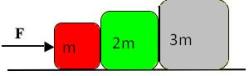
Three blocks of mass m, 2m and 3m are placed adjacent to each other on a frictionless horizontal surface as shown in figure. A constant force of magnitude F is applied to the right. Which of the following statement is true
-
100%
a)The acceleration of the blocks will very according to their mass
-
0%
b) The acceleration of each block will be same F/m
-
0%
c)The net force acting on each block is the same
-
0%
d)The net force acting on block 3m is three times that the net force acting on m
Q.30.
A free body of mass 8 kg is travelling at 2 m/s in straight line. At a certain instant, the body splits into equal parts due to internal explosion, which releases 16 joules of energy. Neither part leaves the original line of motion. Finally
-
0%
a) both parts continue to move in the same direction as that of the original body
-
0%
b) one part comes to rest and the other moves in the same direction asthat of the original body
-
100%
c)one part comes to rest and the other moves in the direction opposite to that of the original body
-
0%
d)one part moves in the same direction and the other in the direction opposite to that of the original body