Q.1.
When a body is lying on a rough inclined plane and does not move, the force of friction
-
100%
a) is equal to μR
-
0%
b) is greater than μR
-
0%
c)is less than μR
-
0%
d)is equal to R
Q.2.
Calculate the value of the air friction if a 1.2 kg ball is dropped under the action of gravity but moving at a uniform speed.
-
0%
a) 20 N
-
0%
b) 12 N
-
100%
c) 30 N
-
0%
d) 16 N
Q.3.
Which of the following equations can be used to directly calculate an object’s momentum, p?
-
0%
a)p=mv
-
100%
b) p=FΔt
-
0%
c)p=m/v
-
0%
d)Δp=FΔt
Q.4.
When comparing the momentum of two moving objects, which of the following is correct?
-
0%
a) The object with the higher velocity will have less momentum if the masses are equal.
-
100%
b) The more massive object will have less momentum if its velocity is greater.
-
0%
c)The less massive object will have less momentum if the velocities are the same.
-
0%
d)The more massive object will have less momentum if the velocities are the same
Q.5.
A roller coaster climbs up a hill at 4 m/s and then zips down the hill at 30 m/s. The momentum of the roller coaster
-
0%
a) is greater up the hill than down the hill.
-
0%
b) is greater down the hill than up the hill.
-
100%
c)remains the same throughout the ride.
-
0%
d) is zero throughout the ride.
Q.6.
A rubber ball moving at a speed of 5 m/s hit a flat wall and returned to the thrower at 5 m/s. The magnitude of the momentum of the rubber ball
-
0%
a) increased
-
100%
b) decreased.
-
0%
c) remained the same.
-
0%
d) was not conserved.
Q.7.
When a body is lying on a rough inclined plane and does not move, the force of friction
-
100%
a)is equal to μR
-
0%
b)is greater than μR
-
0%
c)is less than μR
-
0%
d)is equal to R
Q.8.
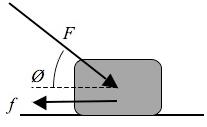
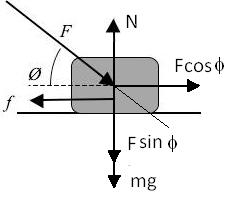
A block of mass m is pushed across a rough by an applied force F, directed angle φ relative to the horizontal as shown above. The block experiences a friction f in the opposite direction. What is the coefficient of friction between the block and the surfacae
-
0%
a) mg/ Fsinφ
-
100%
b) f/ [ Fsinφ- mg]
-
0%
c) f/ [ Fsinφ+ mg]
-
0%
d)mg/f
Explanation
Q.9.
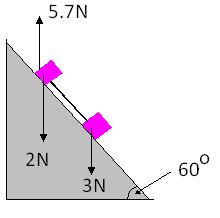
Two blocks are connected by a string, and are pulled by a force of 5.7 N on a frictionless surface as shown in the figure. If the string breaks suddenly, calculate the acceleration of the heavier block along the plane.
-
0%
a) 0.87 m s-2
-
0%
b)2.60 m s-2
-
0%
c) 8.66 m s-2
-
100%
d)5.00 m s-2
Q.10.
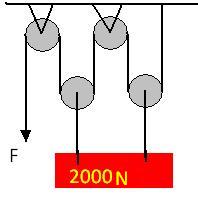
What size downward force F must be applied to lift the cart of weight 2000 N using the 4-pulley apparatus shown below
-
0%
a) 2000 N
-
100%
b) 250 N
-
0%
c) 500 N
-
0%
d) 1000 N
Q.11.
If a force is exerted on an object, which statement is true?
-
0%
a)A large force always produces a large change in the object’s momentum.
-
0%
b)A large force produces a large change in the object’s momentum only if the force is applied over a very short time interval.
-
100%
c)A small force applied over a long time interval can produce a large change in the object’s momentum.
-
0%
d)A small force always produces a large change in the object’s momentum.
Q.12.
The change in an object’s momentum is equal to
-
0%
a) the product of the mass of the object and the time interval.
-
0%
b) the product of the force applied to the object and the time interval.
-
0%
c)the time interval divided by the net external force.
-
100%
d) the net external force divided by the time interval
Q.13.
Which of the following situations is an example of a significant change in momentum?
-
0%
a) A tennis ball is hit into a net.
-
0%
b) A helium-filled balloon rises upward into the sky.
-
100%
c)An airplane flies into some scattered white clouds
-
0%
d)A bicyclist rides over a leaf on the pavement.
Q.14.
A ball with a momentum of 4.0 kg•m/s hits a wall and bounces straight back without losing any kinetic energy. What is the change in the ball’s momentum?
-
0%
a) –8.0 kg•m/s c
-
0%
b) 0.0 kg•m/s
-
100%
c) –4.0 kg•m/s
-
0%
d) 8.0 kg•m/s
Q.15.
The impulse experienced by a body is equivalent to the body’s change in
-
0%
a)velocity
-
0%
b)kinetic energy
-
100%
c)momentum.
-
0%
d)force.
Q.16.
A 75 kg person walking around a corner bumped into an 80 kg person who was running around the same corner. The momentum of the 80 kg person
-
0%
a)increased.
-
0%
b)decreased
-
100%
c)remained the same.
-
0%
d)was conserved.
Q.17.
Two objects with different masses collide and bounce back after an elastic collision. Before the collision, the two objects were moving at velocities equal in magnitude but opposite in direction. After the collision,
-
0%
a) the less massive object had gained momentum.
-
0%
b) the more massive object had gained momentum.
-
100%
c)both objects had the same momentum.
-
0%
d)both objects lost momentum.
Q.18.
A car turns a corner on a slippery road at a constant speed of 10m/s . If the coefficient of friction is 0.5, the minimum radius of the arc in meter in which the car turns is
-
0%
a) 20
-
0%
b) 5
-
100%
c) 10
-
0%
d) 4
Q.19.
Two swimmers relax close together on air mattresses in a pool. One swimmer’s mass is 48 kg, and the other’s mass is 55 kg. If the swimmers push away from each other,
-
0%
a)their total momentum triples.
-
0%
b)their total momentum doubles.
-
100%
c)their momentum are equal but opposite.
-
0%
d)their total momentum decreases.
Q.20.
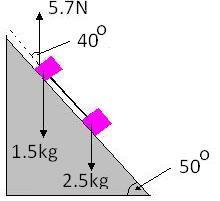
In the following figure, calculate the value of force exerted on the 1.5 kg block by the 2.5 kg block.Given that all surfaces are frictionless.
-
100%
a)25.0 N
-
0%
b)28.2 N
-
0%
c)27.6 N
-
0%
d)19.1 N
Q.21.
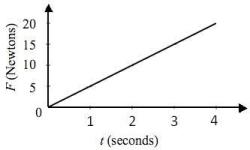
A block is pushed along a horizontal, frictionless surface, with a horizontal Force that varies as a function of time as shown in graph. At time t=3 seconds, the acceleration of the block is 5.0m/sthe mass of the block is
-
100%
a) 1 kg
-
0%
b) 2 kg
-
0%
c)3 kg
-
0%
d)5 g
Q.22.
In a two-body collision,
-
0%
a) momentum is always conserved.
-
0%
b) kinetic energy is always conserved.
-
0%
c) neither momentum nor kinetic energy is conserved.
-
100%
d) both momentum and kinetic energy are always conserved
Q.23.
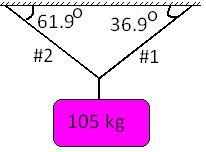
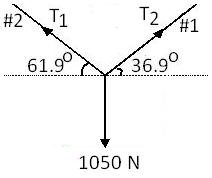
The two cables are used to suspend a 105 Kg object below the ceiling. Find the tension in each cable. The horizontal tension in cable #2 is ___N
-
100%
a)300
-
0%
b)400
-
0%
c)550
-
0%
d)750
Explanation
Q.24.
The vertical tension in cable #1 of Q385 is ___N.
-
0%
a) 300
-
0%
b)400
-
0%
c)550
-
100%
d)750
Q.25.
The total tension in cable #1 of Q385 is ___N.
-
0%
a)500
-
0%
b) 625
-
0%
c)850
-
100%
d)975
Q.26.
The total tension in cable #2 of Q385 is ___N.
-
0%
a) 500
-
0%
b) 625
-
0%
c) 850
-
100%
d) 975
Q.27.
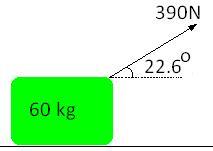
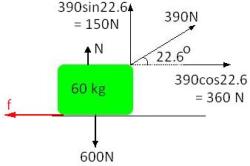
A 60 Kg crate is placed at rest on a level floor. An applied force of 390 N at 22.6° above the horizontal moves the crate from rest over a distance of 16.3 m. The coefficient of friction between crate and floor is µ=0.The force of friction acting against the block is ___N.
-
100%
a)180
-
0%
b) 270
-
0%
c) 360
-
0%
d) 420
Explanation
Q.28.
The object in Q389 accelerates at ___ m/s2
-
0%
a) 1.5
-
0%
b)2.0
-
0%
c)2.5
-
100%
d)3.0
Q.29.
The final speed of the crate in Q389 at the end of the 16.3 m distance is ___ m/s.
-
0%
a)7
-
0%
b)8
-
100%
c)9
-
0%
d)10
Q.30.
If the applied force is removed in Q389 the crate will begin to slide to rest at a rate of ___ m/s2
-
0%
a) 3
-
0%
b) 4
-
0%
c) 6
-
100%
d) 8