Q.1.
A 7 kg object is subjected to two forces ( in Newton)F1=20i + 30j and F2=8i - 5j The magnitude of resulting acceleration in m/s2 will be [ C.P.M.T 1994]
-
36%
a) 5
-
18%
b) 4
-
36%
c)3
-
9%
d)2
Q.2.
A body of mass 10kg and velocity 10m/s collides with a stationary body of mass 5kg. After collision, both bodies stick to each other. ThE common velocity would be [ Pre-Medical/ Dental 1994]
-
25%
a) (3/20) m/s
-
62%
b) (20/3) m/s
-
0%
c) (10/3) m/s
-
12%
d) 3/10 m/s
Q.3.
Two equal masses m1 and m2 moving along the same straight line with velocities 3 m/s and -5 m/s respectively, collide elastically. Their respective velocities after collision will be [ pre. Medical/Dental 1998]
-
14%
a)-3m/s , 5 m/s
-
29%
b) 4 m/s, 4 m/s
-
29%
c)-4 m/s, 4 m/s
-
29%
d)-5 m/s, 3m/s
Q.4.
For a body moving with constant speed in a horizontal circle, which of the following remains constant [M.P. P.M.T. 2000]
-
0%
a) velocity
-
14%
b) acceleration
-
57%
c)centripetal force
-
29%
d)kinetic energy
Q.5.
A 10 kg object collides with stationary 5kg object and after collision they stick to gather and move forward with velocity 4 m/s. What is the velocity with which the 10kg object hit the second one? [ kerala PET 2004]
-
0%
a) 4 m/s
-
33%
b) 6 m/s
-
67%
c) 10 m/s
-
0%
d) 12 m/s
Q.6.
Physical independence of force is a consequence of [ kerala PMT 2004]
-
0%
a)Third law of motion
-
14%
b) Second law of motion
-
43%
c)First law of motion
-
43%
d)All of these law
Q.7.
A cylinder rolls up an inclined plane, reaches some height and then rolls down ( without slipping throughout these motions) The directions of frictional force acting on the cylinder are [ IIT 2002]
-
0%
a) up the incline while ascending and down the incline while descending
-
67%
b) up the incline while ascending as well as descending
-
33%
c) down the incline while ascending and up to the incline while descending
-
0%
d)down the incline while ascending as well as descending
Q.8.
A bomb at rest explodes into three parts of same masse. The momentum of the two parts are -2pi and pj . The momentum of the third part will have a magnitude of
-
40%
a) p
-
20%
b) √(3p)
-
20%
c) p√5
-
20%
d) zero
Q.9.
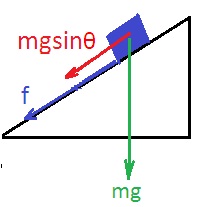
If a block moving up at θ=30° with a velocity 5m/s, stops after 0.5sec, then µ is [ C.P.M.T. 1995]
-
17%
a)0.5
-
17%
b) 1.25
-
67%
c)0.6
-
0%
d)none of the above
Explanation
Q.10.
A block of mass 3 kg in contact with a second block of mass 2kg rests on a horizontal frictionless surface. A horizontal force of 10N is applied to push the first block. The force with which the first block pushes the second block is [ J.E.E. Orissa 1998]
-
0%
a) 10N
-
20%
b) 6N
-
80%
c)4N
-
0%
d)zero
Q.11.
Which of the following is true?
-
0%
a) friction can be reduced to zero
-
0%
b) frictional force can accelerate a body
-
50%
c)frictional force is proportional to the area of contact between the two surfaces
-
50%
d)kinetic friction is always greater than rolling friction
Q.12.
Which of the following is true?
-
0%
a) friction can be reduced to zero
-
25%
b) frictional force can accelerate a body
-
0%
c)frictional force is proportional to the area of contact between the two surfaces
-
75%
d)kinetic friction is always greater than rolling friction
Q.13.
A car of mass m is driven with an acceleration a along a straight level road against a constant external resistive force R. When the velocity of the car is V, the rate at which the engine of the car is doing work [ PMT MP 1998]
-
0%
a)RV
-
25%
b) maV
-
25%
c)(R+ma)V
-
50%
d)(ma+V)R
Q.14.
The mass of a lift is 500kg. What will be the tension in its cable when it is going up with an acceleration of 2.0m/s2.. [ MPPMT 2000]
-
0%
a) 5000 N
-
40%
b) 5600 N
-
40%
c)5900 N
-
20%
d)6200 N
Q.15.
A ship of mass 3×10⁷kg initially at rest is pulled by a force of 5×10⁴N through a distance of 3m. Assuming that the resistance due to water is negligible, what will be the speed of the ship? [ MPPMT 2000]
-
0%
a) 0.01 m/s
-
25%
b) 1.5 m/s
-
75%
c)5 m/s
-
0%
d)0.2 m/s
Q.16.
The time period of a simple pendulum of length 'l' is measured in an elevator descending with acceleration g/3 [ CPMT 2000]
-
67%
a)

-
0%
b)

-
33%
c)

-
0%
d)

Explanation


Q.17.
A particle of mass 10kg is moving in a straight line. If its displacement, x with time t is given by x=(t3 - 2t -10 )m, then the force acting on it at the end of 4 seconds is [cbse 2001]
-
33%
a) 24N
-
33%
b) 240N
-
33%
c)300N
-
0%
d)1200N
Q.18.
A constant force acts on the body of mass 0.9 kg at rest for 10s. If the body moves a distance of 250m, the magnitude of the force is [ DCE 2001]
-
0%
a)3 N
-
40%
b) 3.5 N
-
40%
c)4 N
-
20%
d)4.5 N
Q.19.
25N force is required to rise 75kg mass from a pulley. If rope is pulled 12 m, then the load is lifted to 3m, the efficiency of pulley system will be [ CBSE2001]
-
33%
a) 25%
-
33%
b) 33.3%
-
33%
c) 75%
-
0%
d) 90%
Q.20.
A block of mass M is pulled along a horizontal surface by a rope of mass m by applying a force F at one end of the rope. The force which the rope exerts on the block is [ Haryana CEET 2000]
-
0%
a)

-
33%
b)

-
0%
c)

-
67%
d)

Q.21.
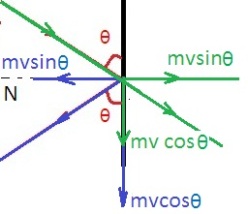
A 1 kg particle strikes a wall with velocity 1m/s at an angle of 30° with the wall and reflects at the same angle. If it remains in contact with the wall for 0.1s, then the force is (UPCPMT 2001]
-
0%
a)0
-
33%
b) 10√3 N
-
67%
c)30√3 N
-
0%
d)40√3 N
Explanation
Q.22.
The coefficient of friction of a surface is 1 /√What should be the angle of inclination so that a body placed on the surface just begins to slide down [ PbCET 2002]
-
50%
a) 30°
-
0%
b) 45°
-
50%
c)60°
-
0%
d)90°
Q.23.
A man weights 80kg. He stands on a weighing scale in the lift, which is moving upwards with uniform acceleration of 5m/sWhat would be the reading on the scale (g=10 m/s2 [ CBSE 2003]
-
33%
a) Zero
-
33%
b) 400N
-
0%
c)800 N
-
33%
d)1200 N
Q.24.
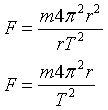
Two bodies of equal masses revolve in circular orbits of radius R1 and R2 with same period. Their centripetal forces are in the ratio [ Kerala PMT 2004]
-
33%
a)

-
67%
b)

-
0%
c)

-
0%
d)

Explanation

Q.25.
A body of mass m collides against a wall with the velocity v and rebounds with the same speed. Its change in momentum is [ kerala PMT 2004]
-
40%
a)2mv
-
20%
b) mv
-
40%
c)-mv
-
0%
d)zero
Q.26.
The recoil velocity of a 4.0kg rifle that shoots a 0.05kg bullet at a speed of 280 m/s is .. [ kerala PMT 2004]
-
0%
a) +3.5m/s
-
0%
b) - 3.5 m/s
-
0%
c)-√3.5 m/s
-
100%
d)√3.5 m/s
Q.27.
In the motion of a rocket, physical quantity which is conserved is [ kerala PMT 2004]
-
33%
a) Angular Momentum
-
33%
b) Linear momentum
-
0%
c)Force
-
33%
d)work
Q.28.
An ice cart of mass 60kg rests on a horizontal patch with coefficient of static friction 1/assuming that there is no vertical acceleration, find the magnitude of the maximum horizontal force required to move the ice cart ( g=9.8 m/s-2)( keralaPET 2004)
-
33%
a) 100 N
-
0%
b) 110 N
-
33%
c)209 N
-
33%
d)196 N
Q.29.
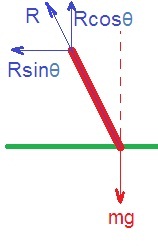
A cyclist is moving in a circular track of radius 80m with velocity v=36 km/hr. He has to lean from the vertical approximately through an angle ( take g=10 m/s2)( kerala PET 2004)
-
0%
a) tan-1(4)
-
33%
b) tan-1(1/8)
-
0%
c)tan-1(1/4)
-
67%
d)tan-1(2)
Explanation
Q.30.
A particle moves in a circular path with decreasing speed. Choose the correct statement [ IIT 2005]
-
0%
a) Angular momentum remains constant
-
33%
b) Acceleration is towards center
-
33%
c) Particle moves in a spiral path with decreasing radius
-
33%
d) The direction of angular momentum remains constant