Q.1.
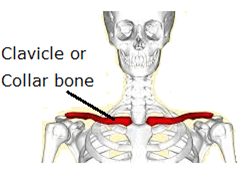
Collar bone is ... ... [ MPPMT 2012]
-
15%
a) Scapula
-
6%
b) Stapes
-
6%
c) Coracoid
-
74%
d) Clavicle
Explanation
Q.2.
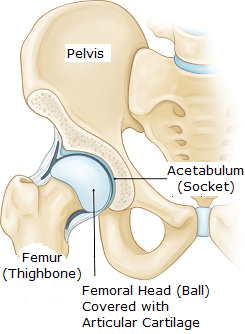
Number of ball and socket joints present in human body is .... ... [ Wardha 2003]
-
37%
a) 2
-
18%
b) 4
-
31%
c) 6
-
14%
d) 8
Q.3.
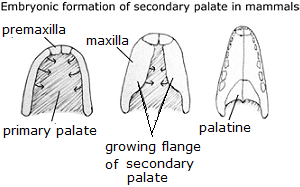
In mammals, secondary palate is formed by union of ... ... [ EAMCET 2008]
-
15%
a) Premaxilla, pterygoid and squamosal
-
28%
b) Maxilla, quadrate and palatine
-
50%
c) Premaxilla, maxilla and palatine
-
8%
d) Premaxilla, quadrate and squamosal
Explanation
Q.4.
In mammals the number of cervical vertebrae is always .... .... [ MPPMT 1994]
-
80%
a) 7
-
6%
b) 9
-
6%
c) 1
-
8%
d) 12
Q.5.
Epiphyseal plate is involved in ... ....[ BHU 1997]
-
21%
a) Formation of bone
-
45%
b) Elongation of bone
-
7%
c) Thickness of bone
-
26%
d) All the above
Q.6.
Bones become fragile due to .... ... [ DPMT 2007]
-
9%
a) Arthritis
-
72%
b) Osteoporosis
-
14%
c) Gout
-
5%
d) None of the above
Q.7.
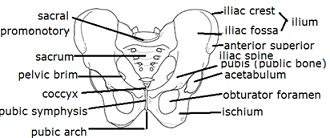
Obturator foramen occurs in ... ..... [ BHU 2007]
-
34%
a) Pelvic girdle
-
32%
b) Pectoral girdle
-
22%
c) Cranium
-
12%
d) Vertebra
Explanation
Q.8.
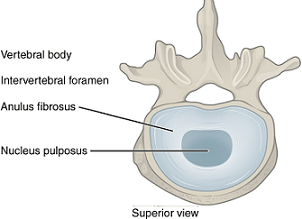
Nucleus pulposus occurs in .... ... [ AFMC 2004]
-
25%
a) Brain
-
2%
b) Liver
-
6%
c) Kidney
-
67%
d) Intervertebral disc
Explanation
Q.9.
Phalangeal/digital formula for human hand/foot is .... ...[ MHTCET 2007]
-
8%
a) 0, 2, 2, 3, 3
-
5%
b) 0, 2, 3, 3, 3
-
15%
c) 2, 2, 3, 3, 3
-
72%
d) 2, 3, 3, 3, 3
Q.10.
Red muscles have abundant ... ... [ kerala 2001]
-
5%
a) Lactic acid and acetic acid
-
22%
b) Glucose and haemoglobin
-
12%
c) Relaxin and myosin
-
60%
d) Myoglobin and cytochrome
Q.11.
Number of lumbar vertebrae in human skeleton is ... .... [ HPPMT 2005]
-
10%
a) 12
-
10%
b) 7
-
76%
c) 5
-
5%
d) 2
Q.12.
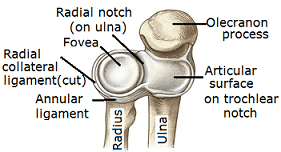
Sigmoid notch of olecranon process is found in ... ... [ CPMT 2005]
-
31%
a) Tibio-fibula
-
14%
b) Femur
-
43%
c) Radio-ulna
-
11%
d) Humerus
Explanation
Q.13.
Correct order of stages of muscle contraction is ... ... [ Guj CET 2011]
-
31%
a) Stimuli → Neurotransmitter secretion → Release of calcium → Cross-bridges formation → Excitation of T-system → Sliding of actin filament
-
37%
b) Stimuli Å Neurotransmitter secretion → Excitation of T-system → Release of Ca2+ → Cross-bridges formation → Sliding of action filaments → 'H' band diminishes
-
17%
c) Stimuli → Excitation of T-system → Neurotransmitter secretion → Cross-bridges formation → Sliding of actin filaments → 'H' band diminishes
-
14%
d) Stimuli → Neurotransmitter secretion → Cross-bridges formation → Excitation of T-system → Sliding of actin filaments
Q.14.
Part of the body having a single pair of bones is ... ... [ MPPMT 1994]
-
34%
a) Pelvic girdle
-
8%
b) External ear
-
18%
c) Wrist
-
39%
d) Lower Jaw
Q.15.
The contractile protein of muscle is ... ... [ CBSE 2006]
-
16%
a) Tubulin
-
35%
b) Myosin
-
27%
c) Tropomyosin
-
22%
d) Actin
Q.16.
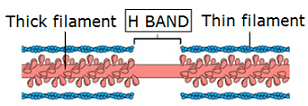
Statements:A bands are dark and contain myosin.I-bands are light and contain actinDuring action, A band contractsPart between two successive Z-lines is sarcomereCentral part of thin filament, not overlapped by thick filament is H-zone ... ... [ kerala 2007]
-
15%
a) 1,2 and 3 are correct, 2 and 4 incorrect
-
24%
b) 1, 3 and 5 correct, 2 and 4 incorrect
-
52%
c) 1, 2 and 4 correct, 3 and 5 incorrect
-
9%
d) 1, 2 correct, 3, 4 and 5 incorrect
Q.17.
Number of vertebrae in human skeleton is .... ... [ AFMC 1996]
-
22%
a) 30
-
11%
b) 32
-
54%
c) 33
-
14%
d) 35
Q.18.
Smallest bone in Man is ... ... [ JIPMER 2002]
-
83%
a) Stapes
-
6%
b) Patella
-
11%
c) Nasal
-
0%
d) Palatine
Q.19.
Substance that accumulates in a fatigued muscle is ... ... [ Har PMT 2003]
-
8%
a) Pyruvic acid
-
75%
b) Lactic acid
-
6%
c) CO2
-
11%
d) A.D.P.
Q.20.
Deltoid ridge of humerus is meant for ... ....
-
29%
a) Articulation
-
51%
b) Attachment of muscles
-
11%
c) Protection
-
9%
d) None of the above
Q.21.
Involuntary muscular contraction is called .... .... [ JIPMER 2003]
-
21%
a) Muscle sprain
-
26%
b) Muscle fatigue
-
38%
c) Muscle spasm
-
15%
d) Muscle twitch
Q.22.
Which one is correctly matched? .... ...[ CBSE 2010]
-
22%
a) Tibia and fibula - Both from part of knee joint
-
39%
b) Cartilage and Cornea - No blood supply but do require O2 for respiratory needs
-
28%
c) Shoulder Joint and elbow joint - Ball and socket joint
-
11%
d) Premolars and molar-20 in all and 3-rooted
Q.23.
Number of bones in ( one half) of lower jaw in humans is .... ...... [DPMT 1999]
-
62%
a) 1
-
18%
b) 4
-
3%
c) 6
-
18%
d) 2
Q.24.
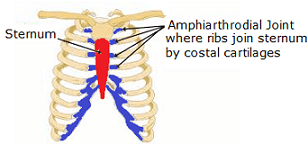
Joint of sternum and ribs is ... ... [ CBSE 2000 ]
-
68%
a) Cartilaginous
-
21%
b) Fibrous joint
-
9%
c) Angular joint
-
3%
d) Hinge joint
Explanation
Q.25.
Which one is anatomically correct ... ... [ CBSE 2008]
-
12%
a) Collar bones - 3 pairs
-
6%
b) Salivary glands - one pair
-
6%
c) Cranial nerves - 10 pairs
-
76%
d) Floating ribs - 2 pairs
Q.26.
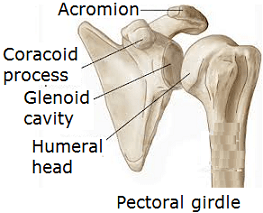
Glenoid cavity is found in ... .... [ AMU 2000]
-
17%
a) Pelvic girdle
-
6%
b) Skull
-
72%
c) Pectoral girdle
-
6%
d) Sternum
Explanation
Q.27.
Synovial joint is ... .. [ Odisha 2004]
-
6%
a) Ball and socket joint
-
18%
b) Pivot joint
-
6%
c) Hinge joint
-
70%
d) All the above
Q.28.
Joints hip and shoulder are ... ...[ JKCMEE 2002]
-
12%
a) Pivot joints
-
6%
b) Ellipsoid joints
-
9%
c) Hinge joints
-
73%
d) Ball and socket joints
Explanation
Q.29.
Which is true of muscle contraction ... ...[CET Chd. 2001]
-
49%
a) Sarcolemma becomes permeable to Ca2+ ions
-
26%
b) Sarcolemma becomes permeable to Na+ ions
-
6%
c) Sarcolemma becomes nonpermeable to Na+ ions
-
20%
d) Concentration of Ca2+ ions is reduced in myoplasm
Q.30.
Hensen's disk occurs in ... .... [ Odisha 2006]
-
39%
a) Myofibril of striated muscle
-
32%
b) Myofibril of unstriated muscle
-
19%
c) Myofibril of heart muscle
-
10%
d) None of the above
Explanation