Q.1.
Three resistances P, Q, R each of 2 Ω and an unknown resistances S form the four arms of a Wheatstone bridge circuit. When a resistance of 6 Ω is connected in parallel to S the bridges gets balanced. What is the value of S?
-
39%
3 ohm
-
27%
6 ohm
-
23%
1 ohm
-
11%
2 ohm
Q.2.
The n rows each containing m cells in series are joined in parallel. Maximum current is taken from this combination across an external resistance of 3 Ω. If the total number of cells used is 24 and internal resistance of each cell is 0.5 Ω, then
-
19%
m = 8, n = 3
-
31%
m = 6, n = 4
-
34%
m = 12, n = 2
-
16%
m = 2, n = 12
Q.3.
When a wire of uniform cross-section a, length l and resistance R is bent into a complete circle, resistance between any two of diametrically opposite point will be
-
34%
R/4
-
23%
4R
-
29%
R/8
-
14%
R/2
Q.4.
Two identical galvanometers are converted into an ammeter and a milliammeter. The shunt, which has more resistance due to the current passing through the coil will be
-
24%
less
-
28%
equal
-
32%
more
-
16%
zero
Q.5.
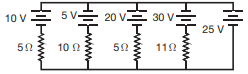
In the circuit shown, current flowing through 25 V cell is
-
8%
8 A
-
33%
10 A
-
46%
14.2 A
-
12%
12 A
Q.6.
Two resistance filaments of same length are connected first in series and then in parallel. Find the ratio of power dissipated in both cases assuming that equal current flows in the main circuit.
-
32%
1 : 4
-
41%
4 :1
-
27%
1 : 2
-
0%
1 :2
Q.7.
Kirchhoff’s first law of electric circuits is based on the law of conservation of
-
8%
only on mass
-
42%
only on charge
-
38%
on charge as well as on energy
-
12%
on charge as well as on mass
Q.8.
An ammeter and a voltmeter are joined in series to a cell. Their readings are A and V respectively. A resistance is now joined parallel with the voltmeter. Then,
-
56%
A will increase, V will decrease
-
11%
Both A and V will decrease
-
28%
A will decrease, V will increase
-
6%
Both A and V will increase
Q.9.
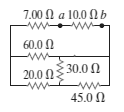
Find the equivalent resistance between point a and b
-
28%
10 ohm
-
17%
7.5 ohm
-
39%
9.5 ohm
-
17%
8 ohm
Q.10.
Kirchhoff’s I and II laws are based on conservation of
-
25%
energy and charge
-
5%
mass and charge
-
15%
charge and mass
-
55%
charge and energy
Q.11.
A constant voltage is applied between the two ends of a uniform metallic wire and some heat is developed in it . The heat developed is doubled if
-
39%
both length and radius of wire are halved
-
28%
both length and radius of wire are doubled
-
22%
radius of wire is doubled
-
11%
length of wire is doubled
Q.12.
Assertion reason type question.
(a) If both assertion and reason are true and reason is correct explanation of assertion.
(b) If both assertion and reason are true and reason is not correct explanation of assertion.
(c) Assertion is true, but reason is false.
(d) both assertion and reason are false.
Assertion: Wire carrying current is not charged.
Reason: It is because , at any instant number of electrons leaving wire is sometimes equal to the number of electrons flowing in from the battery.
-
29%
(a)
-
43%
(b)
-
14%
(c)
-
14%
(d)
Q.13.
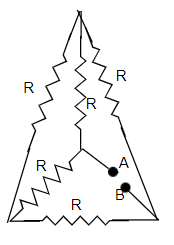
Each of the resistance in the network shown in the figure is equal to R. The resistance between terminal A and B is
-
53%
R
-
13%
5R
-
27%
3R
-
7%
6R
Q.14.
Assertion reason type question.
(a) If both assertion and reason are true and reason is correct explanation of assertion.
(b) If both assertion and reason are true and reason is not correct explanation of assertion.
(c) Assertion is true, but reason is false.
(d) both assertion and reason are false.
Assertion: Drift velocity of electrons decreases on increasing temperature of the conductor.
Reason: It is because, on increasing temperature of a conductor , the value of resistivity of its material increases.
-
25%
(a)
-
33%
(b)
-
17%
(c)
-
25%
(d)
Q.15.
Assertion reason type question.
(a) If both assertion and reason are true and reason is correct explanation of assertion.
(b) If both assertion and reason are true and reason is not correct explanation of assertion.
(c) Assertion is true, but reason is false.
(d) both assertion and reason are false.
Assertion: A potentiometer measures the potential difference more accurately then a voltmeter.
Reason: Because it has a wire of high resistance and draws a heavy current from external circuit.
-
60%
(a)
-
30%
(b)
-
10%
(c)
-
0%
(d)
Q.16.
Assertion reason type question.
(a) If both assertion and reason are true and reason is correct explanation of assertion.
(b) If both assertion and reason are true and reason is not correct explanation of assertion.
(c) Assertion is true, but reason is false.
(d) both assertion and reason are false.
Assertion: Resistors are connected in series combination in order to increase the resistance of the circuit.
Reason: In series combination potential difference across any resistor is proportional to its resistance.
-
56%
(a)
-
22%
(b)
-
0%
(c)
-
22%
(d)
Q.17.
The electric resistance of a certain wire of iron is R. If its length and radius are both doubled, then
-
42%
the resistance will be doubled and the specific resistance will be halved
-
42%
the resistance will be halved and the specific resistance will remains unchanged
-
0%
the resistance will be halved and the specific resistance will be doubled.
-
17%
the resistance and the specific resistance, will both remain unchanged.
Q.18.
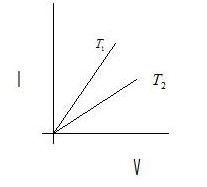
The current voltage graph for a given metallic wire at two different temperatures T1 and T2 are shown in the fig. which one of the following option is true
-
13%
T1 = T2
-
40%
T1 < T2
-
40%
T1 > T2
-
7%
none of the above
Q.19.
If the length of the potentiometer wire is increased, then the accuracy in determination of null point
-
23%
will increase
-
15%
will decrease
-
31%
will remain unaffected
-
31%
cannot be decided , until EMF of auxiliary battery is known
Q.20.
The temperature coefficient of resistance of wire is 0.00125 per ° C. At 300K, its resistance is 1 ohm. The resistance of wire would be 2 ohms at
-
23%
1154K
-
23%
1127K
-
31%
1167K
-
23%
1176K