Q.1.
The displacement of a particle is given by
$y=a+bt+ct^2-dt^4$
The initial velocity and acceleration are respectively
-
7%
b, -4d
-
18%
–b, 2c
-
71%
b, 2c
-
4%
2c, -4d
Q.2.
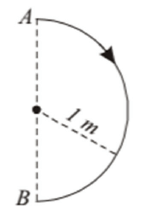
In 1.0s, a particle goes from point A to point B, moving in a semicircle of radius 1.0 m as shown in below Figure. The magnitude of average velocity is
-
12%
3.14 m/s
-
8%
0 m/s
-
65%
2 m/s
-
14%
1 m/s
Q.3.
A particle moves along a straight line such that its displacement at any time t is given by :
$x=(t^3-6t^2+3t+4)$ metres
The velocity when the acceleration is zero is
-
64%
-9 m/s
-
13%
42 m/s
-
11%
-15 m/s
-
13%
3 m/s
Q.4.
The ratio of magnitudes of average velocity to average speed, is
-
51%
always less than one
-
21%
always equal to one
-
7%
always more than one
-
21%
equal to or more than one
Q.5.
The displacement x of a particle varies with time t as $x=ae^{- \alpha t}+be^{ \beta t}$, where a, b, $\alpha$ and $\beta$ are positive constants. The velocity of the particle will
-
28%
go on decreasing with time
-
33%
be independent of $\alpha$ and $\beta$
-
6%
drop to zero when $\alpha = \beta$
-
33%
go on increasing with time
Q.6.
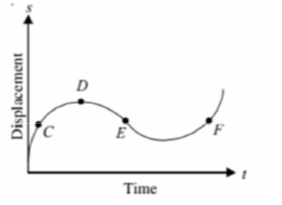
The displacement-time graph of a moving particle is shown in
-
28%
D
-
24%
E
-
17%
C
-
30%
F
Q.7.
What determines the nature of the path followed by the particle?
-
18%
Speed
-
5%
Velocity
-
11%
Acceleration
-
66%
Both (b) and (c)
Q.8.
The correct statement from the following is
-
36%
A body having zero velocity will not necessarily have zero acceleration
-
40%
A body having zero velocity will necessarily have zero acceleration
-
12%
A body having uniform speed can have only uniform acceleration
-
12%
A body having non-uniform velocity will have zero acceleration
Q.9.
A body is thrown vertically upwards. If air resistance is to be taken into account, then the time during which the body rises is
-
36%
equal to the time of fall.
-
12%
twice the time of fall.
-
29%
less than the time of fall.
-
24%
greater than the time of fall.
Q.10.
The displacement of a body is given to be proportional to the cube of time elapsed. The magnitude of the acceleration of the body, is
-
5%
constant but not zero
-
71%
increasing with time
-
16%
zero
-
8%
decreasing with time
Q.11.
A particle is thrown vertically upward. Its velocity at half of the height is 10 m/s, then the maximum height attained by it (g=$10 \ m/s^2$)
-
7%
8m
-
29%
20cm
-
59%
10cm
-
5%
16 m
Q.12.
A car moves from X to Y with a uniform speed $v_u$ and returns to Y with a uniform speed $v_d$. The average speed for this round trip is
-
5%
$\sqrt {v_u v_d} $
-
15%
$\frac {v_u v_d}{v_u + v_d}$
-
22%
$\frac {v_u + v_d}{v_u v_d}$
-
57%
$\frac {2v_u v_d}{v_u + v_d}$
Q.13.
If a ball is thrown vertically upwards with speed u, the distance covered during the last t seconds of its ascent is
-
6%
ut
-
29%
$\frac {1}{2} gt^2$
-
56%
$ut-\frac {1}{2} gt^2 $
-
9%
(u+gt)t
Q.14.
Assertion : A body can have acceleration even if its velocity is zero at a given instant of time.
Reason : A body is momentarily at rest when it reverses its direction of motion
-
41%
Both assertion and reason are true and reason is the correct explanation of the assertion.
-
26%
Both assertion and reason are true, but reason is not correct explanation of the assertion
-
15%
assertion is true, but reason is false.
-
15%
both assertion and reason are false.
-
3%
reason is true but assertion is false