Q.1.
The nucleus of the element having atomic number 25 and atomic weight 55 will contain
-
6%
55 neutrons
-
85%
25 protons and 30 neutrons
-
5%
55 protons
-
3%
25 neutrons and 30 protons
Q.2.
which one of the following pair of atoms /atoms-ion have identical ground state configuration
-
12%
F+ and Ne
-
34%
Li+ and He+
-
38%
Cl- and Ar
-
16%
Na and K
Q.3.
For a principal Quantum number n=4, which of the following is incorrect
-
26%
Total number of subshells are 4
-
21%
Total orbitals present is 16
-
33%
None of these
-
21%
The max number of electrons it can have is 32
Q.4.
Match the column
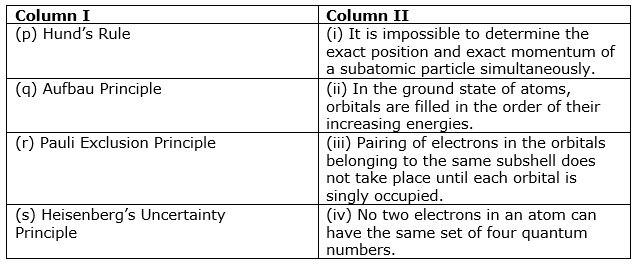
-
15%
p -> iv, q -> iii, r -> ii, s-> i
-
13%
p -> i, q -> iii, r -> ii, s-> iv
-
63%
p -> iii, q -> ii, r -> iv, s-> i
-
8%
p -> ii, q -> iii, r -> iv, s-> i
Q.5.
Match the column

-
10%
p -> ii, q -> iii, r -> iv, s-> i
-
75%
p -> iv, q -> iii, r -> ii, s-> i
-
13%
p -> i, q -> iii, r -> ii, s-> iv
-
2%
p -> ii, q -> i, r -> iv, s-> iii
Q.6.
No two electron in an atom can have
-
5%
the same azimuthal quantum numbers
-
10%
the same principal quantum numbers
-
8%
same magnetic quantum numbers
-
77%
an identical set of four quantum numbers
Q.7.
Rutherford’s experiment on scattering of particles showed for the first that atom has
-
60%
Nucleus
-
19%
electron
-
9%
Proton
-
12%
Neutron
Q.8.
which of the following statement is not correct for an electron that has quantum number n=4 and m=2?
-
27%
The electron may have the quantum number s= +1/2
-
15%
The electron may have the quantum number l=2
-
16%
The electron may have the quantum number l=3
-
42%
The electron may have the quantum number l=0,1,2,3
Q.9.
Any p -orbital can accommodate up to
-
12%
Four electrons
-
14%
two electrons with parallel spin
-
27%
Two electrons with opposite spin
-
47%
six electrons
Q.10.
which of the following is incorrect?
-
13%
Unpaired electrons in Iron are 4
-
38%
Unpaired electrons in titanium are 3
-
24%
Unpaired electrons in Chromium are 6
-
24%
Unpaired electrons in cobalt are 3
Q.11.
Identify the pairs which are not of isotopes?
-
9%
$^{14}_{6}X$,$^{15}_{6}Y$
-
73%
$^{10}_{4}X$,$^{10}_{5}Y$
-
14%
$^{36}_{18}X$,$^{37}_{18}Y$
-
4%
$^{12}_{6}X$,$^{13}_{6}Y$
Q.12.
Bohr’s model can explain
-
8%
the solar spectrum
-
39%
spectrum of atom or ion containing one electron only
-
51%
The spectrum of hydrogen atom
-
2%
The spectrum of hydrogen molecule
Q.13.
An electron has a spin quantum number ½ and a magnetic quantum number -1.it cannot be present in
-
8%
d -orbital
-
65%
s -orbital
-
10%
f -orbital
-
17%
p -orbital
Q.14.
Which of the following is responsible to rule out the existence of definite paths or trajectories of electrons?
-
15%
Aufbau principle.
-
63%
Heisenberg’s uncertainty principle.
-
9%
Pauli’s exclusion principle
-
13%
Hund’s rule of maximum multiplicity.
Q.15.
The ground state configuration of Fe3+ ion in gaseous state is ( Atomic Number of Fe=26)
-
5%
[Ar]18 3d6
-
52%
[Ar]18 3d5
-
33%
[Ar]18 3d6 4s2
-
10%
[Ar]18 3d3 4s2
Q.16.
Cathode rays are
-
22%
electromagnetic waves
-
53%
Stream of electrons
-
14%
Streams of positrons
-
12%
Stream of alpha particles
Q.17.
what is the relation for Uncertainty principle
-
7%
$E=mc^2$
-
9%
$\Delta x \times \Delta p = \frac {h}{8 \pi}$
-
7%
$\lambda = \frac {h}{p}$
-
76%
$\Delta x \times \Delta p = \frac {h}{2 \pi}$
Q.18.
The pair of ions having same electronic configuration is __________.
-
59%
$Fe^{3+}$, $Mn^{2+}$
-
20%
$Fe^{3+}$, $Co^{3+}$
-
16%
$Sc^{3+}$, $Cr^{3+}$
-
5%
$Cr^{3+}$, $Fe^{3+}$
Q.19.
electromagnetic radiation with maximum wavelength is
-
11%
Infrared
-
13%
X -rays
-
63%
Radio wave
-
13%
Ultraviolet
Q.20.
Two atoms are said to be isobars if.
-
18%
they have same number of neutrons but different number of electrons.
-
10%
they have same number of electrons but different number of neutrons.
-
56%
sum of the number of protons and neutrons is same but the number of protons is different.
-
16%
they have same atomic number but different mass number.