Q.1.
If vectors P, Qand R have magnitude 5,12 and 13 units and P + Q=R, the angle between Q and R is ..[ Hariyana CEET 1998]
-
0%
a)cos-15/12
-
40%
b)cos-15/13
-
20%
c)cos-112/13
-
40%
d)cos-17/13
Q.2.
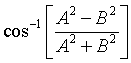
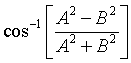
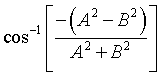
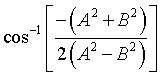
The resultant of two vectors (A+B) and (A - B) is (A2 + B2 )1/2 , then the angle between the vectors is
-
0%
a)
-
0%
b)
-
33%
c)
-
67%
d)
Q.3.
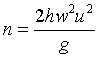
A ball rolls off the top of a staircase with a horizontal velocity u m/s. if the steps are h m high and W m wide the ball will hit the edge of the nth step is
-
0%
a)

-
0%
b)

-
50%
c)

-
50%
d)
Q.4.
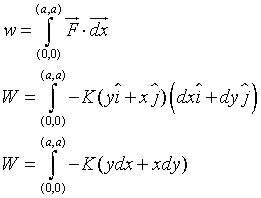
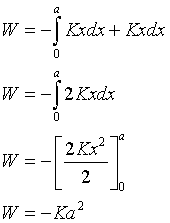
A force F=- K(yi + xj) where K is positive constant ) acts on a particle moving in the x-y plane. Starting from the origin, the particle is taken along the positive x-axis to the point (a,0) and then parallel to y-axis to the point (a,a). The total work done by the force F on the particle is [ IIT 1998]
-
0%
a)-2Ka2
-
33%
b) 2Ka2
-
67%
c)-Ka2
-
0%
d)Ka2
Explanation
Q.5.
Two like parallel forces P and 3P are 40cm apart. If the directions of P is reversed, then their resultant shifts through a distance .. [ Roorkee 1998]
-
25%
a) 30 cm
-
25%
b) 40 cm
-
50%
c)50 cm
-
0%
d)60 cm
Q.6.
If at a height of 40 m, the direction of motion of a projectile makes an angle of π/4 with horizontal, then its initial velocity and angle of projection are respectively [ Roorkee 1998]
-
0%
a) 30, ½ cos-1(-4/5)
-
33%
b) 30, ½ cos-1(-1/2)
-
33%
c) 50, ½ cos-1(-8/45)
-
33%
d) 60, ½ cos-1(-1/4)
Q.7.
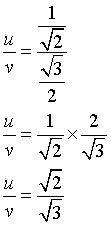
Two balls are projected making an angle of 30° and 45° respectively with the horizontal. if both have same velocity at the highest points of their path, then the ratio of their velocities of projection is [ C.S.E.P 2001]
-
33%
a) √3 : √2
-
33%
b) √2 : 1
-
17%
c) √2 : √ 3
-
17%
d) √3 : 2
Explanation
Q.8.
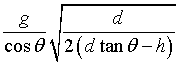
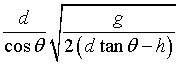
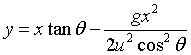
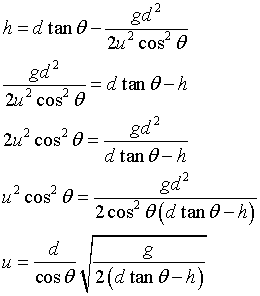
If a stone is to hit at a point which is at a distance d away and at a height h above the point from where the stone starts, then what is the value of initial speed u if stone is launched at an angle θ [ Hariyana C.E.T 2002]
-
50%
a)
-
25%
b)
-
25%
c)

-
0%
d)

Explanation
Q.9.
Let F be the force acting on a particle having position vector r and T be the torque of this force about the origin . Then.. [ AIEEE2003]
-
50%
a) r⋅T=0 and F⋅T ≠ 0
-
25%
b) r⋅T ≠ 0 and F ⋅ T=0
-
0%
c)r⋅T ≠ 0 and F⋅T ≠ 0
-
25%
d)r⋅T=0 and F⋅T=0
Q.10.
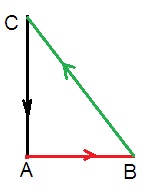
Three forces start acting simultaneously on a particle moving with velocity. These forces are represented in magnitude and direction by three sides of triangle as shown in figure. The particle will move with velocity
-
0%
a) less than v
-
25%
b) greater than v
-
0%
c)|v| in the direction of the largest force
-
75%
d)v remains unchanged
Q.11.
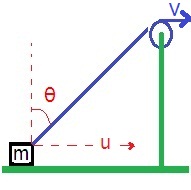
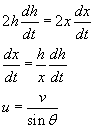
A block is dragged on a smooth plane with the help of a rope which moves with velocity v as shown in figure. The horizontal velocity of the block is
-
0%
a) v
-
0%
b) vsinθ
-
50%
c) v/sinθ
-
50%
d) v/cosθ
Explanation

Q.12.
A body is projected at time t=0 from a certain point on a planet surface with a certain velocity at a certain angle with the planet,s surface ( assumed horizontal ). The horizontal and vertical displacement x and y (in meters) respectively vary with time t (in second) as x=10t√3 and y=10t-tWhat is the magnitude and direction of the velocity with which the body is projected?
-
33%
a)20m/s at an angle of 30° with the horizontal
-
33%
b)20m/s at an angle of 60° with the horizontal
-
33%
c)10m/s at an angle of 30° with the horizontal
-
0%
d)10m/s at an angle of 60° with the horizontal
Q.13.
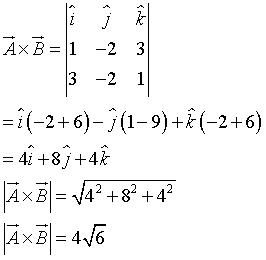
The area of the parallelogram formed from the vectorsA=i -2j + 3k and B=3i - 2j + k as adjacent sides is
-
50%
a) 4√3
-
0%
b) 4√6
-
25%
c)8√3
-
25%
d)8√6
Explanation
Q.14.
If A=4i - 2j 6k and B=i -2j-3k, the angle which the A + B makes with the x-axis is
-
0%
a) cos-1 ( 3/ √50)
-
0%
b) cos-1 ( 4/ √50)
-
67%
c) cos-1 ( 5/ √50)
-
33%
d) cos-1 ( 12/ √50)
Q.15.
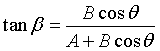
The angle between A and B is θ. R=A + B makes an angle θ/2 with A. Which of the following is true?
-
33%
a) A=2B
-
0%
b) 2A=B
-
67%
c) AB=1
-
0%
d) none of the above
Explanation
Q.16.
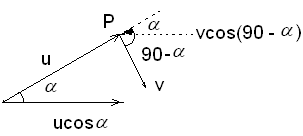
A particle is projected from a point O with velocity u in a direction making an angle α upward with the horizontal. At P, it is moving at right angle to its initial direction of projection, its velocity at P is ..
-
0%
a)u tanα
-
33%
b) ucotα
-
67%
c)ucosecα
-
0%
d)usecα
Explanation
Q.17.
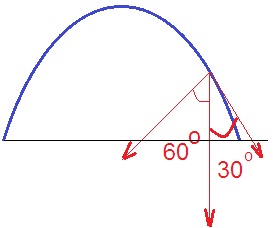
The velocity of a particle P moving freely under gravity is 4.9 m/s, the direction being 30° with the downward normal
-
0%
a) its acceleration normal to the direction of motion at P=9.8 m/s2
-
33%
b) the radius of curvature of P of the parabolic trajectory of particle is 4.9m
-
33%
c)the particle has no acceleration normal to the direction of motion
-
33%
d)the radius of curvature at P of the path depends upon the initial velocity of projection
Explanation
Q.18.
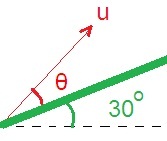
A particle is projected up an inclined as shown in figure. For maximum range over the inclined plane the value of θ should be
-
33%
a) 45°
-
0%
b) 15°
-
67%
c)30°
-
0%
d)60°
Q.19.
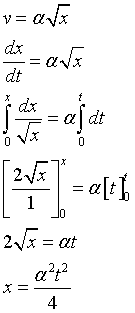
A particle located at x=0 at time t=0, starts moving along with the positive x-direction with velocity 'v' that varies as v=α√x. The displacement of the particle varies with time as [ AIEEE 2006]
-
33%
a)t2
-
0%
b) t
-
67%
c)√t
-
0%
d)t3
Explanation
Q.20.
A particle is projected at 60° to the horizontal with a kinetic energy K. The kinetic energy at the highest point is [ AIEEE 2007]
-
33%
a) K/2
-
33%
b) K
-
33%
c)zero
-
0%
d)K/4
Q.21.
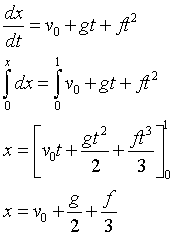
The velocity of a particle is v=vo +gt + ftIf its position is x=0 at t=0, then its displacement after unit time (t=1) is [ AIEEE 2007]
-
0%
a) vo + g/2 + f
-
50%
b) vo + 2g + 3f
-
0%
c)vo + g/2 + f/3
-
50%
d)vo + g + f
Explanation
Q.22.
A particle has an initial velocity of 3i + 4j and an acceleration of 0.4i+0.3j . Its speed after 10s is [ AIEEE 2009]
-
0%
a) 7√2 units
-
0%
b) 7 units
-
0%
c) 8.5 units
-
100%
d) 10 units
Q.23.
If the magnitudes of A, B and C are 12, 5 and 13 units respectively and A + B=C, then the angle between A and B is
-
0%
a)0
-
0%
b) π
-
50%
c)π/2
-
50%
d)π/4
Q.24.
If A=B + C and the magnitude of A, B and C are 5,4,3 units, the angle between A and C is .. [ CBSE 1990]
-
0%
a) cos-1 (3/5)
-
0%
b) cos-1(4/5)
-
100%
c)π/2
-
0%
d)sin-1(3/4)
Q.25.
Out of the following sets of forces, the resultant of which cannot be zero [ CPMT 1985]
-
0%
a) 10,10,10
-
100%
b) 10,20,40
-
0%
c)10,10,20
-
0%
d)10,20,20
Q.26.
Out of following pairs, the resultant of which cannot be 4 Newton [ CPMT 1985]
-
0%
a) 2N and 2N
-
0%
b) 2N and 6 N
-
50%
c) 2N and 4N
-
50%
d) 2N and 8N
Q.27.
A person moves 30 m North, then 20m East then 30√2 m South-West. His displacement from the original position is [ CPMT 1989]
-
0%
a)15 m East
-
0%
b) 28 m South
-
0%
c)10 m West
-
100%
d)14 m South-West
Q.28.
The length of seconds hand of watch is 1cm. the change in velocity of its tip in 15 seconds is [ MPPMT 1987]
-
0%
a) zero
-
50%
b) π/ (30√2) cm/sec
-
0%
c)(π/30) cm/sec
-
50%
d)2π/(30√2) cm/sec
Q.29.
Consider a F=4 i - 3 j. Another vector perpendicular to F is ..[ MPPMT 1987]
-
50%
a) 4i+3j
-
0%
b) 6i
-
0%
c)7k
-
50%
d)3i - 4j
Q.30.
Consider a F1=4 i + 5 k and F2=3 j - 4 k. The magnitude of the scalar product of these vector is [ MPPMT 1987]
-
0%
a) 20
-
0%
b) 23
-
50%
c) 5√(33)
-
50%
d) 26