Q.1.
A spring of force constant k is cut into lengths of ratio 1 : 2 :They are connected in series and the new force constant is \(K'\). Then they are connected in parallel and force constant is \(K''\). Then \(K' : K''\) is
-
27%
1 : 6
-
32%
1 : 9
-
23%
1 : 11
-
18%
1 : 14
Q.2.
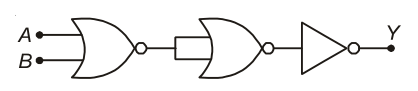
The given electrical network is equivalent to
-
24%
AND gate
-
14%
OR gate
-
38%
NOR gate
-
24%
NOT gate
Q.3.
The acceleration due to gravity at a height 1 km above the earth is the same as at a depth \(d\) below the surface of earth. Then
-
29%
\(d=\frac{1}{2}Km\)
-
19%
\(d=1Km\)
-
33%
\(d=\frac{3}{2}Km\)
-
19%
\(d=2Km\)
Q.4.
Which of the following statements are correct?
(a) Centre of mass of a body always coincides with the centre of gravity of the body.
(b) Centre of mass of a body is the point at which the total gravitational torque on the body is zero
(c) A couple on a body produce both translational and rotational motion in a body.
(d) Mechanical advantage greater than one means that small effort can be used to lift a large load.
-
20%
(b) and (d)
-
25%
(a) and (b)
-
25%
(b) and (c)
-
30%
(c) and (d)
Q.5.
A Carnot engine having an efficiency of 1/10 as heat engine, is used as a refrigerator. If the work done on the system is 10 J, the amount of energy absorbed from the reservoir at lower temperature is
-
22%
1 J
-
61%
90 J
-
6%
99 J
-
11%
100 J
Q.6.
If \(\theta_1\) and \(\theta_2\) be the apparent angles of dip observed in two vertical planes at right angles to each other, then the true angle of dip \(\theta\) is given by
-
25%
\(\cot ^2\theta \,\,=\,\,\cot ^2\theta _1+\cot ^2\theta _2\)
-
38%
\(\tan ^2\theta \,\,=\,\,\tan ^2\theta _1+\tan ^2\theta _2\)
-
19%
\(\cot ^2\theta \,\,=\,\,\cot ^2\theta _1-\cot ^2\theta _2\)
-
19%
\(\tan ^2\theta =\,\,\tan ^2\theta _1-\tan ^2\theta _2\)
Q.7.
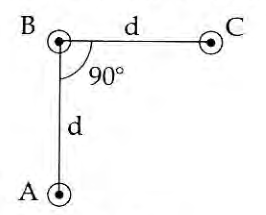
An arrangement of three parallel straight wires placed perpendicular to the plane of paper carrying the same current \(I\) along the same direction is shown in Figure. The magnitude of force per unit length on the middle wire \(B\) is given by
-
19%
\(\frac{\mu _0I^2}{2\pi d}\)
-
12%
\(\frac{2\mu _0I^2}{\pi d}\)
-
25%
\(\frac{\sqrt{2}\mu _0I^2}{\pi d}\)
-
44%
\(\frac{\mu _0I^2}{\sqrt{2\pi d}}\)
Q.8.
Two astronauts are floating in gravitational free space after having lost contact with their spaceship. The two will:
-
38%
Keep floating at the same distance between them
-
38%
Move towards each other
-
19%
Move away from each other
-
6%
Will become stationary
Q.9.
In an electromagnetic wave in free space the root mean square value of the electric field is \(E_{rms} = 6 V/m\). The peak value of the magnetic field is
-
19%
\(1.41 \times 10^{–8} T\)
-
31%
\(2.83 \times 10^{–8} T\)
-
25%
\(0.70 \times 10^{–8} T\)
-
25%
\(4.23 \times 10^{–8} T\)
Q.10.
The bulk modulus of a spherical object is \(B\). If it is subjected to uniform pressure \(p\), the fractional decrease in radius is
-
33%
\(\frac{p}{B}\)
-
42%
\(\frac{B}{3p}\)
-
8%
\(\frac{3p}{B}\)
-
17%
\(\frac{p}{3B}\)
Q.11.
The ratio of resolving powers of an optical microscope for two wavelengths \(\lambda_1 = 4000 \overset{\circ}{\mathrm {A}}\) and \(\lambda_2 = 6000 \overset{\circ}{\mathrm {A}}\) is
-
8%
8 : 27
-
15%
9 : 4
-
54%
3 : 2
-
23%
16 : 81
Q.12.
Consider a drop of rain water having mass 1 g falling from a height of 1 km. It hits the ground with a speed of 50 m/s. Take g constant with a value \(10 m/s^2\) . The work done by the (i) gravitational force and the (ii) resistive force of air is
-
13%
(i) – 10 J (ii) –8.25 J
-
27%
(i) 1.25 J (ii) –8.25 J
-
33%
(i) 100 J (ii) 8.75 J
-
27%
(i) 10 J (ii) –8.75 J
Q.13.
A spherical black body with a radius of 12 cm radiates 450 watt power at 500 K. If the radius were halved and the temperature doubled, the power radiated in watt would be
-
0%
225
-
23%
450
-
54%
1000
-
23%
1800
Q.14.
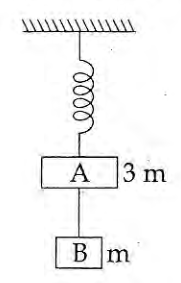
Two blocks A and B of masses 3m and m respectively are connected by a massless and inextensible string. The whole system is suspended
by a massless spring as shown in the figure. The magnitudes of acceleration of A and B immediately after the string is cut, are respectively
-
8%
\(g, \frac{g}{3}\)
-
38%
\( \frac{g}{3},g\)
-
23%
\(g,g\)
-
31%
\(\frac{g}{3}, \frac{g}{3}\)
Q.15.
Two Polaroids \(P_1\) and \(P_2\) are placed with their axis perpendicular to each other. Unpolarised light \(I_0\) is incident on \(P_1\) . A third polaroid \(P_3\) is kept in between \(P_1\) and \(P_2\) such that its axis makes an angle \(45^{\circ}\) with that of \(P_1\). The intensity of transmitted light through \(P_2\) is
-
33%
\(\frac{I_0}{2}\)
-
25%
\(\frac{I_0}{4}\)
-
25%
\(\frac{I_0}{8}\)
-
17%
\(\frac{I_0}{16}\)
Q.16.
A long solenoid of diameter 0.1 m has \(2 \times 10^4\) turns per meter. At the centre of the solenoid, a coil of 100 turns and radius 0.01 m is placed with its axis coinciding with the solenoid axis. The current in the solenoid reduces at a constant rate to \(0 A\) from \(4 A\) in 0.05 s. If the resistance of the coil is \(10\pi^2 \omega\), the total charge flowing through the coil during this time is
-
15%
\(32\pi\, \mu C\)
-
15%
\(16 \mu C\)
-
54%
\(32\, \mu C\)
-
15%
\(16\pi\, \mu C\)
Q.17.
Two discs of same moment of inertia rotating about their regular axis passing through centre and perpendicular to the plane of disc with angular velocities \(\omega_1\) and \(\omega_2\) . They are brought into contact face to face coinciding the axis of rotation. The expression for loss of energy during this process is
-
38%
\(\frac{1}{2}I\left( \omega _1+\omega _2 \right) ^2\)
-
15%
\(\frac{1}{4}I\left( \omega _1-\omega _2 \right) ^2\)
-
31%
\(I\left( \omega _1-\omega _2 \right) ^2\)
-
15%
\(\frac{1}{8}I\left( \omega _1-\omega _2 \right) ^2\)