Q.1.
Characteristics of smooth muscle fibres are
-
59%
a) spindle-shaped, unbranched, non-striated, uninucleate and involuntary
-
16%
b) cylindrical, unbranched, unstriped, multinucleate and involuntary
-
13%
c) spindle-shaped, unbranched, unstriped, multinucleate and involuntary
-
12%
d) cylindrical, unbranched, striated, multinucleate and voluntary.
Q.2.
Which of the following is not correct?
-
16%
a) Brown fat has a larger capacity for generating heat than white fat.
-
16%
b) Brown fat is mainly found in new born mammals.
-
20%
c) Brown fat cells contain many mitochondria whereas white fat cells contain relatively few.
-
48%
d) The brown adipose tissue cell has single large droplet surrounded by small amount of cytoplasm whereas the white adipose tissue cell has many small droplets of fat suspended in larger amount of cytoplasm.
Q.3.
Nucleus of which leucocytes have many lobe :-
-
18%
a) Basophils
-
46%
b) Neutrophils
-
27%
c) Monocytes
-
9%
d) Eosinophils
Q.4.
Which one of the following is the most abundant protein in the animals? [NEET 2020]
-
11%
a) Lectin
-
15%
b) Insulin.
-
25%
c) Haemoglobin
-
50%
d) Collagen
Q.5.
The ciliated epithelial cells are required to move particles or mucus in a specific direction. In humans, these cells are mainly present in ... [NEET 2019]
-
13%
a) Bile duct and Bronchioles
-
25%
b) Fallopian tubes and Pancreatic duct
-
16%
c) Eustachian tube and Salivary duct
-
45%
d) Bronchioles and Fallopian tubes
Q.6.
Cuboidal epithelium with brush border of microvilli is found in ... .. [NEET 2020]
-
36%
a) Proximal convoluted tubule of nephron
-
13%
b) Eustachian tube
-
35%
c) Lining of intestine
-
16%
d) Ducts of salivary gland
Q.7.
Goblet cells of alimentary canal are modified from ... .. [NEET 2020]
-
16%
a) Chondrocytes
-
22%
b) Compound epithelial cells
-
19%
c) Squamous epithelial cells
-
42%
d) Columnar epithelial cells
Q.8.
All glands whether exocrine or endocrine originate in mammals from
-
21%
a) some from epithelial tissues and others from connective tissues
-
20%
b) some from epithelial tissues and others from muscular tissues
-
10%
c) some from epithelial tissues and others from nerve tissues
-
50%
d) epithelial tissues
Q.9.
Glandular epithelium is made with:
-
56%
a) Cuboidal and columnar cells.
-
18%
b) Ciliated columnar cells.
-
15%
c) Squamous cells.
-
12%
d) Myocytes.
Q.10.
How many of the following statements are true regarding fibrous Astrocytes? (i) Long, thin and unbranched processes. (ii) Short, thick and branched processes. (iii) Asymmetrical. (iv) Symmetrical. (v) Located in the white matter of central nervous system. (vi) Located in the grey matter of central nervous system.
-
32%
a) (i), (iii) and (v).
-
31%
b) (ii), (iv) and (v).
-
26%
c) (ii), (iv) and (vi).
-
11%
d) (i), (iii) and (vi).
Q.11.
Haversian canals occur in
-
16%
a) scapula
-
25%
b) clavicle.
-
43%
c) humerus
-
16%
d) pubis
Q.12.
Characteristic of simple epithelium is that they
-
24%
a) continue to divide and help in organ function
-
26%
b) are arranged indiscriminately
-
36%
c) make a definite layer
-
14%
d) none of the above.
Q.13.
The type of cartilage present in the epiglottis pinna and tip of the nose is
-
9%
a) Calcified
-
20%
b) Fibrous
-
54%
c) Elastic
-
16%
d) Hyaline
Q.14.
Glands which release the terminal part of secretory cells as a part of secretion are called:
-
20%
a) Holocrine glands.
-
51%
b) Apocrine glands.
-
15%
c) Merocrine glands.
-
15%
d) Mixocrine glands.
Q.15.
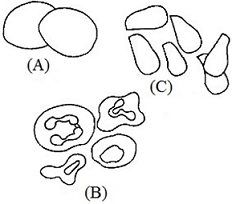
Identify the given figure and select the correct option pertaining to the series A, B and C.
-
20%
a) A – Platelets, B – WBC, C – RBC.
-
12%
b) A – Macrophages, B – RBC, C – Adipocytes.
-
14%
c) A – Adipocytes, B – RBC, C – WBC.
-
54%
d) A – RBC, B – WBC, C – Platelets .
Q.16.
Long Cytoplasmic processes of an osteoplasm is:
-
29%
a) Canaliculi.
-
32%
b) Lamellae.
-
28%
c) Lacuna of solid matrix.
-
11%
d) Harvesian canal.
Q.17.
epithelium with more than one layer of cells is seen in
-
27%
a) inner lining of intestine
-
39%
b) buccal cavity and oesophagus
-
18%
c) inner lining of stomach
-
15%
d) all parts of alimentary canal
Q.18.
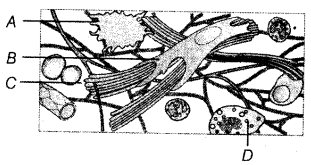
Name the diagram
-
17%
a) A- Mast cell B- Collagen fibres C – Fibroblast D- Macrophage
-
53%
b) A – macrophage B- Fibroblast C – Collagen fibres D – Mast cell
-
16%
c) A- Mast cell B – Macrophage C – Fibroblast D – Collagen fibres
-
14%
d) A – Macrophage B- Collagen fibres C – Fibroblast D – Mast cell
Q.19.
Assertion: Dense irregular connective tissue has fibroblast and many fibres that are oriented differently. Reason: Tendons which attach skeletal muscles to bones and ligaments which attach one bone to another are examples of this.
-
33%
a) Both Assertion and Reason are true and Reason is the correct explanation of Assertion.
-
29%
b) Both Assertion and Reason are true but Reason is NOT the correct explanation of Assertion.
-
36%
c) Assertion is true but Reason is false.
-
2%
d) Both Assertion and Reason are false.
Q.20.
Which of the following secrete myelin sheath in CNS?
-
14%
a) Astrocytes.
-
30%
b) Oligodendrocytes.
-
47%
c) Schwann cells.
-
8%
d) Microglia.
Q.21.
Brunner’s glands in submucosa of small intestine and mammary glands are:
-
20%
a) Simple coiled tubular glands.
-
32%
b) Simple multicellular glands.
-
30%
c) Alveolar glands.
-
18%
d) Compound alveolar glands.
Q.22.
Component of blood responsible for producing antibodies is
-
48%
a) lympocytes.
-
10%
b) erythrocytes
-
20%
c) monocytes
-
22%
d) thrombocytes
Q.23.
Which part of the body weight is formed by connective tissue:
-
37%
a) 30%.
-
31%
b) 60%.
-
12%
c) 20%.
-
20%
d) 50%.
Q.24.
Large amoeboid cells, that are a part of our innate immune system, found in the areolar tissue are called as
-
17%
a) Fibroblasts
-
27%
b) Mast cells
-
17%
c) Adipocytes
-
39%
d) Macrophages
Q.25.
Here are some statements about bones in mammals. Find the incorrect ones:
-
47%
a) Many osteoblasts are present in a space called lacuna.
-
15%
b) Bone is main tissue that provides structural framework to body.
-
28%
c) Bones have a hard and non pliable ground substance rich in calcium salts and collagen fibres, which give bones its strength.
-
9%
d) Limb bones, such as long bones of the legs, serve weight bearing functions.
Q.26.
Assertion: Mammary glands are apocrine glands. Reason: The product of secretion is shed with the whole cell leading to its destruction.
-
30%
a) Both Assertion and Reason are true and Reason is the correct explanation of Assertion.
-
28%
b) Both Assertion and Reason are true but Reason is NOT the correct explanation of Assertion.
-
34%
c) Assertion is true but Reason is false.
-
8%
d) Both Assertion and Reason are false.
Q.27.
An epithelial tissue which has thin flat cells, arranged edge to edge so as to appear like closely packed tiles, is found to be present at
-
51%
a) inner lining of cheeks.
-
19%
b) inner lining of fallopian tube
-
13%
c) outer surface of ovary
-
17%
d) inner lining of stomach
Q.28.
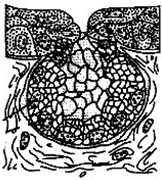
The figure given below, represents a particular tissue, identify the tissue and its location
-
9%
a) Loose connective tissue – Beneath the skin.
-
61%
b) Multicellular glandular epithelium – Salivary glands.
-
22%
c) Unicellular glandular epithelium – Goblet cells of the alimentary canal.
-
7%
d) Multilayered compound epithelium – Dry surface of the skin.
Q.29.
Match the terms under column I with the structures in which they occur, given under the column II. Choose the answer which gives the correct combination of alphabets of the two columns:
| Column I | Column Ii |
| a. Harvesian canal | p. Kidney |
| b. Dendrites. | q. Cartilage. |
| c. Sarcolema. | r. Muscles. |
| d. Chondrocytes.; | s. Nerve cells. |
| - - - - | t. Bone. |
-
9%
a) a - p ; b -r ; c - s; d - t
-
13%
b) a - q ; b -r ; c - s; d - t
-
9%
c) a - s ; b -t ; c - q; d - t
-
69%
d) a - t ; b -s ; c - r; d - q
Q.30.
Lymph differs from blood in possessing
-
30%
a) more WBC and few RBC.
-
45%
b) only WBC.
-
13%
c) more RBC and WBC
-
13%
d) more RBC and few WBC