Q.1.
Skeletal muscles contribute how much percentage of body of humans:
-
15%
a) 10%.
-
44%
b) 40%.
-
20%
c) 40-50%.
-
20%
d) 50%.
Q.2.
From the following which one is not an example for merocrine glands?
-
44%
a) Sebaceous glands.
-
22%
b) Pancreas.
-
6%
c) Intestinal glands.
-
28%
d) Sweat glands.
Q.3.
A unique characteristics of smooth muscles is:
-
13%
a) Myosin filaments are not required.
-
35%
b) It can sustain a contraction for prolonged periods.
-
35%
c) It is controlled by voluntary and involuntary nervous system.
-
16%
d) Calcium ions are not required for contraction.
Q.4.
Which of the following has the stratified cuboidal epithelial lining ?
-
17%
a) Nasal cavity
-
20%
b) Peritoneal cavity
-
50%
c) ducts of sweat glands and urinary tracts
-
13%
d) Oesphagal lumen
Q.5.
Mesenchymal epithelium is seen in
-
26%
a) kidneys
-
15%
b) liver
-
4%
c) lungs
-
56%
d) subdural and subarachnoid spaces
Q.6.
Sebaceous glands in human skin are:
-
33%
a) Simple coiled tubular glands.
-
29%
b) Branched alveolar glands.
-
25%
c) Compound alveolar glands.
-
12%
d) Branched tubular glands.
Q.7.
Which of the following statement is false regarding myelinated neuron?
-
26%
a) They carry impulses 2000 times faster than non-myelinated neurons.
-
63%
b) Absence of Nodes of Ranvier makes conduction at an easy rate.
-
11%
c) They prevents the loss of impulse during conduction.
-
0%
d) Appear white due to the presence of myelin sheath.
Q.8.
Which cells do not form layer and remains structurally separate?
-
70%
a) nerve cells
-
10%
b) muscle cells
-
15%
c) gland cells.
-
5%
d) epithelial cells
Q.9.
Flattened cells with irregular boundaries and prominent round nucleus is present in:
-
10%
a) Tessellated epithelium.
-
40%
b) Simple Squamous epithelium.
-
5%
c) Pavement epithelium.
-
45%
d) All of the above.
Q.10.
Find out the wrong statement:
-
7%
a) Each muscle is made up of cylindrical fibres and is composed of numerous fine fibrils called myofibrils.
-
67%
b) Neural tissue exerts the least control over the body’s responsiveness to changing conditions.
-
13%
c) In dense connective tissue, orientation of fibres shows an irregular pattern is called dense irregular tissue.
-
13%
d) Most of the cartilages in vertebrate embryos are replaced by bones as adults.
Q.11.
Oil in the skin is secreted by
-
5%
a) mucous glands
-
11%
b) hair follicles
-
11%
c) sweat glands
-
74%
d) sebaceous glands
Q.12.
Which of the following are non-vascular tissues?
-
0%
a) Elastic cartilage.
-
20%
b) Simple Squamous epithelium.
-
0%
c) Hyaline cartilage.
-
80%
d) All of these.
Q.13.
Many neurons possess a brown pigment appearing as a product of neuronal Lysosomes accumulating in aging neurons called _______ .
-
27%
a) Lipofuscin.
-
47%
b) Neuromelanin.
-
13%
c) Lipochrome.
-
13%
d) None of these.
Q.14.
Basement membrane is made up of
-
14%
a) epidermal cell only
-
7%
b) endodermal cell
-
43%
c) no cell product of epithelial cell
-
36%
d) both (a) and (b).
Q.15.
The cells that release heparin and histamines in the blood are
-
15%
a) Eosinophils
-
31%
b) Basophils
-
8%
c) Neutrophils
-
46%
d) Mast cells
Q.16.
Simple cuboidal epithelium lines all the following structures except the
-
33%
a) ovary
-
53%
b) fallopian tube
-
7%
c) pancreatic ducts
-
7%
d) thyroid follicles
Q.17.
Assertion: Histamine is related with allergic and inflammatory reactions. Reason: Histamine is a vasodilator.
-
77%
a) Both Assertion and Reason are true and Reason is the correct explanation of Assertion.
-
0%
b) Both Assertion and Reason are true but Reason is NOT the correct explanation of Assertion.
-
8%
c) Assertion is true but Reason is false.
-
15%
d) Both Assertion and Reason are false.
Q.18.
Which of the following statements are true/false? (1) Exocrine glands do not have any ducts and their products are called hormones. (2) Endocrine glands secrete both enzymes and hormones. (3) Goblet cells of alimentary canal is an example of unicellular gland. (4) Salivary gland is a multicellular gland.
-
20%
a) 1, 2, 4 are false but 3 is true.
-
60%
b) 1, 2 are false but 3, 4 are true.
-
0%
c) 1, 2, 3 are true but 4 is false.
-
20%
d) 1, 2 are true but 3, 4 are false
Q.19.
Adipose tissue:
-
0%
a) Is formed of bundles of collagen fibres connecting muscle to bone.
-
92%
b) Is prominent below the skin of mammals to store fat.
-
8%
c) Forms the sutures which joins the cranial bones.
-
0%
d) Has mainly fibroblast and forms the packaging tissue.
Q.20.
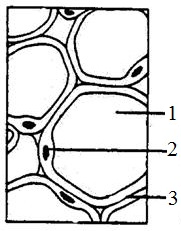
Identify 1, 2 and 3 in the given diagram:
-
57%
a) 1 – Fat storage area, 2 – Nucleus, 3 – Plasma membrane.
-
7%
b) 1 – Cell fluid, 2 – Collagen fibres, 3 – Plasma membrane.
-
21%
c) 1 – Cytoplasm, 2 – Nucleus, 3 – Cell wall.
-
14%
d) 1 – Fat storage area, 2 – Mast cell, 3 – Plasma membrane.
Q.21.
Which of the following is not true about epithelial cells?
-
50%
a) There are blood vessels supplying nourishment to epithelial cells.
-
14%
b) The cells are arranged close to each other with very little extracellular materials.
-
21%
c) It covers the external surface of the body and the internal free surface of many organs.
-
14%
d) The cells in an epithelial tissue are held together by cell junctions.
Q.22.
Bipolar neurons are found in:
-
53%
a) Brain and spinal cord.
-
0%
b) Vertebrate embryos.
-
0%
c) Cnidarians.
-
47%
d) Retina of eye.
Q.23.
The largest volume of adult tissues in he body is derived from (in vertebrates)
-
46%
a) mesoderm
-
31%
b) ectoderm and mesoderm
-
0%
c) ectoderm
-
23%
d) endoderm
Q.24.
The cells that facilitate the flow of cerebrospinal fluid and form blood-cerebrospinal fluid barrier are:
-
9%
a) Ependymal cells.
-
0%
b) Nerve cells.
-
73%
c) Neuroglial cells.
-
18%
d) Neurosecretory cells.
Q.25.
Which one of the following contains the largest quantity of extracellular material?
-
8%
a) stratified epithelium
-
25%
b) striated muscle
-
50%
c) areolar tissue
-
17%
d) myelinated nerve fibres
Q.26.
he C-shaped cartilaginous rings around the trachea are open posteriorly to
-
21%
a) prevent food from entering the trachea
-
7%
b) prevent food from entering the nasal cavity during swallowing
-
71%
c) allow for expansion of the esophagus during swallowing
-
0%
d) allow the vocal cords to relax
Q.27.
During an injury nasal septum gets damaged and for its recovery which cartilage is preferred?
-
8%
a) calcified cartilage
-
50%
b) elastic cartilage
-
8%
c) fibrous cartilage.
-
33%
d) hyaline cartilage
Q.28.
When secretory granules leave cell by exocytosis with no loss of other cellular material, the glands are called
-
20%
a) Apocrine
-
10%
b) Holocrine
-
60%
c) Merocrine
-
10%
d) Autocrine
Q.29.
At times ligaments are overstretched or torn. It is called:
-
10%
a) Tension.
-
60%
b) Sprain.
-
20%
c) Dislocation.
-
10%
d) Fractures.
Q.30.
Perichondrium and Periosteum are:
-
36%
a) Fluid filled spaces seen in bones and cartilages.
-
18%
b) Functional units of cartilage and bones.
-
45%
c) Outer covering of cartilage and bones.
-
0%
d) Outer covering of neurons and muscle fibres.