Q.1.
The major role of minor elements inside living organisms is to act as
-
0%
a) Co-factors of enzymes.
-
100%
b) Building blocks of important amino acids
-
0%
c) Constituent of hormones
-
0%
d) Binder of cell structure
Q.2.
A protein which act as a carrier and transport oxygen and carbon dioxide in human body is known as
-
100%
a) haemoglobin
-
0%
b) immunoglobulin
-
0%
c) lipids
-
0%
d) antibody
Q.3.
ead the following statements: (i) During peptide bond formation dehydration occurs. (ii) During glycosidic bond formation, dehydration occurs. (iii) In a nucleic acid, a phosphate moiety links the 3’ carbon of one sugar of one nucleotide to the 5’ carbon of the sugar of the succeeding nucleotide. (iv) The bond between the phosphate and hydroxyl group is sugar is an ester bond. (v) The backbone of DNA is formed by sugar – phosphate – sugar chain where the nitrogenous bases face outside. How many of the above statements are correct?
-
0%
a) Four.
-
0%
b) Five.
-
100%
c) Three.
-
0%
d) Two.
Q.4.
Where would you expect to find serine and alanine amino acids in a globular protein in aqueous solution?
-
100%
a) Serine would be in the interior, and alanine would be on the exterior
-
0%
b) Alanine would be in the interior, and serine would be on the exterior of the globular protein
-
0%
c) Both serine and alanine would be in the interior of the globular protein
-
0%
d) Both serine and alanine would be on the exterior of the globular protein
Q.5.
DNA has deoxyribose as the constituent sugar The position where the sugar lacks oxygen is
-
0%
a) 1
-
100%
b) 2
-
0%
c) 3
-
0%
d) 4
Q.6.
The enzyme amylase belongs to the class
-
0%
a) hydrolase
-
100%
b) isomerase
-
0%
c) transferase
-
0%
d) lyases
Q.7.
The turnover number of an enzyme depends upon
-
100%
a) Concentration of substrate molecule
-
0%
b) Active sites of enzyme molecule
-
0%
c) Size of enzyme molecule
-
0%
d) Molecular weight of enzyme
Q.8.
Ricin is extracted from:
-
100%
a) Rosary pea.
-
0%
b) Castor beans.
-
0%
c) Jack beans.
-
0%
d) Turmeric.
Q.9.
Which of the following is not consistent with the base pairings in a double stranded DNA molecule
-
0%
a) The number of C equals the number of G
-
0%
b) The number of A equals the number of T
-
100%
c) The amount of purine is equal to the amount of pyrimidines
-
0%
d) The ratio of (G+C) to (A+T) is same for each species
Q.10.
Which one of the following is not mucilage?
-
0%
a) Agar
-
0%
b) Carrageen
-
0%
c) Rayon
-
100%
d) Alginic acid
Q.11.
Lysine is an essential amino acid as:
-
0%
a) it has a high nutritive value
-
0%
b) it is very rare
-
100%
c) it is not formed in the body and has to be provided through diet
-
0%
d) it is an important constituent of all protiens
Q.12.
Which one is correct?
-
50%
a) Non – protein part constituent of an enzyme is called co – factor.
-
50%
b) Catalytic activity is lost when the cofactor is removed from an enzyme.
-
0%
c) Metal ions, coenzymes and prosthetic groups represent different types of cofactors.
-
0%
d) All of the above.
Q.13.
Which of the following statement regarding to the properties of starch is incorrect?
-
0%
a) Presence of amylose and amylopectin chains.
-
0%
b) Stored food in plants.
-
100%
c) Soluble in water.
-
0%
d) Not sweet in taste.
Q.14.
The polysaccharide that is used to determine the glomerular filtration rate is:
-
0%
a) Inulin.
-
100%
b) Chitin.
-
0%
c) Algin.
-
0%
d) Glycogen.
Q.15.
Select the incorrect statement:
-
100%
a) Adult haemoglobin molecule is composed of four polypeptide chains, two α chains and two β chains.
-
0%
b) Haemoglobin is a type of quaternary protein structure.
-
0%
c) Fibrinogen and thrombin are blood clotting proteins.
-
0%
d) In the primary structure of a protein, the first amino acid is called C – terminal amino acid
Q.16.
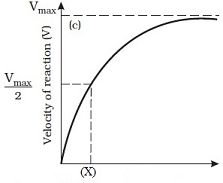
In the graphical representation of Michaelis – Menten kinetics X represent:
-
0%
a) Concentration of active mass of the substrate at which the rate of reaction is ½ Vmax.
-
0%
b) Concentration of enzyme – substrate complex at which the rate of reaction is ½ Vmax.
-
100%
c) Concentration of product at which the rate of reaction is Vmax.
-
0%
d) Concentration of enzyme at which the rate of reaction is ½Vmax.
Q.17.
In a normal adult, ascending order of concentration of following molecules is
-
100%
a) K > Na > Fe > Cu
-
0%
b) Na > K > Cu > Fe
-
0%
c) Fe > Na > K > Cu
-
0%
d) Na > Fe > K > Cu
Q.18.
Cholesterol is a precursor for each of the following except
-
0%
a) bile salts
-
100%
b) vitamin D
-
0%
c) insulin
-
0%
d) steroids
Q.19.
Which one of the following is the most appropriate definition for an enzyme?
-
0%
a) A protein, acts like biocatalyst by lowering activation energy in biochemical reactions.
-
0%
b) A protein, acts like a biocatalyst by increasing activation energy in a biochemical reaction.
-
100%
c) A protein, acts like a biocatalyst by neither lowering nor increasing activation energy in biochemical reactions.
-
0%
d) A protein, but not a biocatalyst and has nothing to do with activation energy.
Q.20.
The advantages of storing carbohydrates in the form of polysaccharides are
-
100%
a) When necessary polysaccharides are broken down by enzymes for the release of energy
-
0%
b) Unlike small carbohydrates polysaccharides are easy to store
-
0%
c) During their formation many molecules of water are removed from monosaccharides (dehydration synthesis), condensing the bulk to be stored
-
0%
d) All of these
Q.21.
A cellulose molecule is formed by the polymerisation of glucose. The number of glucose molecule present in a cellulose is
-
0%
a) 60
-
0%
b) 600
-
0%
c) 6000
-
100%
d) 60000
Q.22.
Casein of milk is:
-
0%
a) Metaloprotein
-
0%
b) Chromoprotein
-
100%
c) Phosphoprotein
-
0%
d) Glycoprotein
Q.23.
In food starch is detected by:
-
0%
a) Granular form.
-
0%
b) White appearance.
-
0%
c) Energy reserve.
-
100%
d) Blue colour with iodine.
Q.24.
Which of the following statements is correct with respect to competitive inhibitor of an enzyme?
-
100%
a) Decreases Km value without affecting Vmax.
-
0%
b) Increases Vmax without affecting Km.
-
0%
c) Decreases both Vmax and Km.
-
0%
d) Increases Km without affecting Vmax.
Q.25.
Assertion: Arachidic acid is an unsaturated fatty acid. Reason: There are one or more double bonds between carbon atoms in unsaturated fatty acids.
-
0%
a) Both Assertion and Reason are true and Reason is the correct explanation of Assertion.
-
0%
b) Both Assertion and Reason are true but Reason is NOT the correct explanation of Assertion.
-
0%
c) Assertion is true but Reason is false.
-
100%
d) Both Assertion and Reason are false.
Q.26.
How many of the following statements are correct? (i) Apoenzyme + Cofactor = Holoenzyme. (ii) Prosthetic group is an organic molecule that tightly binds to the apoenzyme. (iii) Coenzymes can serve as cofactors. (iv) Haem is the coenzyme of the enzyme peroxidise and Catalase. (v) Many coenzymes are derived from vitamins. (vi) Coenzymes are organic molecules which are loosely bound to the apoenzyme. (vii) Catalytic activity is lost when the cofactor is removed from the enzyme. (viii) Catalytic nucleic acids are known as ribozymes.
-
0%
a) 7
-
0%
b) 5
-
100%
c) 4
-
0%
d) All are correct.
Q.27.
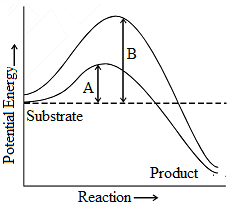
Which of the following describes the given graph correctly?
-
0%
a) Endothermic reaction with energy A in the presence of enzyme and B in the absence of enzyme
-
0%
b) Exothermic reaction with energy A in the presence of enzyme and B in the absence of enzyme
-
100%
c) Endothermic reaction with energy A in the absence of enzyme and B in the presence of enzyme
-
0%
d) Exothermic reaction with energy A in the absence of enzyme and B in the presence of enzyme
Q.28.
When the co-factor is removed from the enzyme, the catalytic activity
-
50%
a) is lost
-
0%
b) is reduced
-
0%
c) is increased
-
50%
d) is unaffected
Q.29.
Which of the following is not correct?
-
100%
a) Plant cell wall is made up of cellulose.
-
0%
b) Paper made from plant pulp is cellulose.
-
0%
c) Cotton fibre is cellulose.
-
0%
d) Cellulose gives blue colour with iodine test.
Q.30.
Observe the reactions given below: (i) Guanine + X = Guanosine. (ii) Guanosine + Y = Guanylate (GMP). Identify X and Y.
-
0%
a) X – sugar, Y – Phosphate group.
-
100%
b) X – Pentose sugar, Y – Phosphate group.
-
0%
c) X – Ribose sugar, Y – Phosphate group.
-
0%
d) X – Deoxyribose sugar, Y – Phosphate group.
Q.31.
Enzyme amylase belongs to the category:
-
0%
a) Oxidoreductases.
-
0%
b) Transferases.
-
0%
c) Hydrolases.
-
100%
d) Isomerases.
Q.32.
In a 50gm living tissue, what would be the amount of water?
-
0%
a) 15-25 gm
-
100%
b) 25 -30gm
-
0%
c) 35-45 gm
-
0%
d) 70 -90 gm
Q.33.
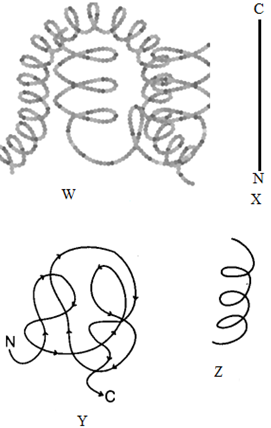
Find out the primary, secondary, tertiary and quaternary protein structures in the diagram:
-
0%
a) W – Quaternary, X – Secondary, Y – Primary, Z – Tertiary.
-
0%
b)W – Tertiary, X – Primary, Y – Quaternary, Z – Secondary.
-
0%
c) W – Quaternary, X – Primary, Y – Tertiary, Z – Secondary.
-
100%
d) W – Secondary, X – Primary, Y – Quaternary, Z – Tertiary.
Q.34.
Choose the correct one with respect to the decreasing order of abundance of elements in cell:
-
100%
a) C > O > N > H.
-
0%
b) O > C > H > N.
-
0%
c) O > N > C > H.
-
0%
d) H > N > O > C.
Q.35.
The substrate has to go through a much higher energy state ir transition state in case of
-
0%
a) Exothermic reaction only
-
0%
b) Endothermic reaction only
-
100%
c) Both exothermic and endothermic reactions
-
0%
d) Neither exothermic nor endothermic reactions
Q.36.
The linkage that joins two adjacent nucleotides in RNA is
-
0%
a) phosphate ester
-
0%
b) phosphodiester
-
0%
c) phosphate anhydride
-
100%
d) N-glycoside
Q.37.
Read the following sentences: (i) Chitin, starch, glycogen and Agar – agar are homopolymers. (ii) In a glycogen, the left end is called the non – reducing end. (iii) Starch forms helical secondary structure but cellulose does not contain complex helices. (iv) Cellulose can easily hold iodine molecules. (v) Chitin is a storage polysaccharide. How many of the above statements are correct?
-
100%
a) Two.
-
0%
b) Three.
-
0%
c) Four.
-
0%
d) Five.
Q.38.
The three monosaccharide units of Raffinose are
-
100%
a) Glucose, Levulose and galactose
-
0%
b) Glucose, Pentose and maltose
-
0%
c) Fructose, mannose and galactose
-
0%
d) Glucose, fructose and sucrose
Q.39.
Which one of the following is a fibrous polysaccharide?
-
0%
a) Mucilage
-
0%
b) Starch
-
100%
c) Glycogen
-
0%
d) Cellulose
Q.40.
Find the wrong statement about enzyme action?
-
0%
a) They are proteins with complex three dimensional structure
-
0%
b) Their molecular weight is high
-
100%
c) They act as catalyst and are required in small concentration
-
0%
d) Their diffusion rate is very high
Q.41.
Enzymes generally present in an organism have:
-
0%
a) Same pH and temperature optima.
-
100%
b) Same pH but different temperature optima.
-
0%
c) Different pH but same temperature optima.
-
0%
d) Different pH and different temperature optima.
Q.42.
The carbon atoms of the pentose sugar involved in the phosphodiester bonds in DNA and RNA are:
-
0%
a) C1 and C5.
-
100%
b) C2 and C3.
-
0%
c) C3 and C5.
-
0%
d) C4 and C5.
Q.43.
NAD is an abbreviation for
-
0%
a) Nicotine Abusive Department
-
0%
b) Nicotine Avoid Directions
-
0%
c) Nicotinamide adenine dinucleotide
-
100%
d) Nicotinamide dinucleotide
Q.44.
Lock and Key model was developed for visualization of substrate and enzyme concentration was proposed by
-
0%
a) Emil Fischer
-
100%
b) F. Sanger
-
0%
c) Erwin Chargaff
-
0%
d) Edward
Q.45.
Doctors represent sunflower oil as it is:
-
0%
a) Rich source of vitamins.
-
0%
b) Rich in energy and reduces weight.
-
100%
c) Rich in saturated fatty acids which are essential.
-
0%
d) Rich in unsaturated fatty acids which are essential.
Q.46.
In a DNA molecule, the phosphate group is attached to _____ carbon of the sugar residue of its own nucleotide and ______ carbon of the sugar residue of the next nucleotide by ______ bonds.
-
0%
a) 3’, 5’, Ester bonds.
-
0%
b) 5’. 3’, Phosphodiester bonds.
-
100%
c) 3’, 5’, Phosphodiester bonds.
-
0%
d) 5’, 3’, Ester bonds.
Q.47.
Antiparallel strand of a DNA molecule means that
-
0%
a) the phosphate group of two DNA strands, at their ends, share the same position
-
0%
b) the phosphate groups at the start of two DNA strands are in opposite position ( pole)
-
0%
c) one strand turns clockwise
-
100%
d) one strand turns anti-clockwise
Q.48.
The six most common atoms in organic molecules are
-
0%
a) Carbon, Hydrogen, Oxygen, Helium, Calcium and Sulfure
-
0%
b) Carbon, Hydrogen, Oxygen, Calcium, magnesium and Sulfur
-
100%
c) Carbon, Oxygen, Nitrogen, Sulfure, Phosphorus and Sulfur
-
0%
d) Carbon, Hydrogen, Oxygen, Nitrogen, Phosphorous and Sulfure
Q.49.
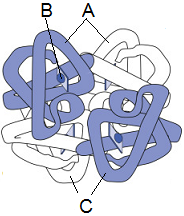
Which one out of A-D given below correctly represents the structural formula of the basic amino acid?
-
0%
a)
-
0%
b)
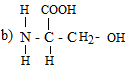
-
0%
c)
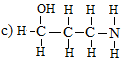
-
100%
d)
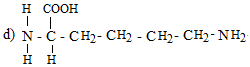
Q.50.
The β – pleated sheet protein structure is due to:
-
0%
a) Coiling of the polypeptide chain.
-
0%
b) The linking together of two or more polypeptide chains by intermolecular hydrogen bonding.
-
100%
c) Formation of peptide bonds.
-
0%
d) The folding of the coiled polypeptide chains.