Q.1.
The protein that involves in the transportation of organic compounds through phloem is
-
0%
a) Glutelin
-
50%
b) Protamine
-
50%
c) Myosin
-
0%
d) P-Protein
Q.2.
Which of the following is not correct?
-
50%
a) Peptide group is formed when R group of one amino acid reacts with the carboxyl (- COOH) group of another amino acid.
-
50%
b) Glycosidic bond is formed by the dehydration between two carbons of two adjacent monosaccharides.
-
0%
c) The bond between the phosphate and hydroxyl group of a sugar in a nucleotide is phosphoester bond.
-
0%
d) None of the above.
Q.3.
Fats are solid due to presence of
-
100%
a) Saturated fatty acids
-
0%
b) unsaturated fatty acid
-
0%
c) glycerols
-
0%
d) ester bond
Q.4.
Read the following statements and choose the correct option: (i) The three essential fatty acids are Linoleic acid, Linolenic acid and Palmitic acid. (ii) Flavanoids and alkaloids are secondary metabolites. (iii) Carbohydrates, lipids and proteins are primary metabolites. (iv) The components common to nucleoside as well as nucleotides are sugar and nitrogen bases. (v) Thymidine is a nucleotide.
-
100%
a) (i), (ii) and (iii) are incorrect.
-
0%
b) (ii), (iv) and (v) are correct.
-
0%
c) Only (v) is incorrect.
-
0%
d) (ii), (iii) and (iv) are correct.
Q.5.
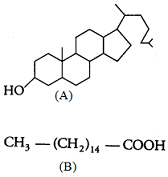
Which of the following is correct for the compounds A and B?
-
0%
a) A – Precursor for biosynthesis of steroid hormone, B – Palmitic acid.
-
100%
b) A – Sterol, B – Unsaturated fatty acid.
-
0%
c) A – Benzene derivative, B – Major component of palm oil.
-
0%
d) A – Most abundant steroid in animal tissue, B – Stearic acid.
Q.6.
ame the enzymes that catalyze removal of roups from substrates by mechanism other than hydrolysis leaving double bonds
-
0%
a) Transferases
-
0%
b) Lyases
-
0%
c) Isomerases
-
100%
d) Ligases
Q.7.
Phosphodiester bond is present in
-
100%
a) ATP
-
0%
b) ADP
-
0%
c) cAMP
-
0%
d) None of these
Q.8.
Which of the following is a homopolysaccharide?
-
0%
a) Heparin
-
100%
b) Inulin
-
0%
c) Pectin
-
0%
d) Hyaluronic acid
Q.9.
All the macromolecules are the result of the process of polymerisation, a process in which repeating subunits termed monomers are bound into chains of different lengths except:
-
100%
a) Proteins
-
0%
b) Lipids
-
0%
c) Carbohydrates
-
0%
d) Nucleic acids
Q.10.
Most essential fatty acid is
-
0%
a) Linolenic acid
-
0%
b) Stearic acid
-
0%
c) Linoleic acid
-
100%
d) Arachidonic acid
Q.11.
Sulpha drugs control bacterial pathogens by
-
100%
a) They are competitive inhibitors of folic acid synthesis in bacteria
-
0%
b) They control the bacterial pathogens by feedback inhibition
-
0%
c) Non-competitive inhibition
-
0%
d) Allosteric modulation
Q.12.
How many of the following statements are false: (i) Haemoglobin is a conjugated protein. (ii) At Vmax, all enzymes are saturated with substrate. (iii) In non competitive inhibition, substrate and inhibitor are structurally dissimilar. (iv) In non competitive inhibition, substrate and inhibitor bind to active site. (v) In competitive inhibition, inhibitor bind mostly site other than active site.
-
100%
a) One
-
0%
b) Two
-
0%
c) Three
-
0%
d) Four
Q.13.
Which of the following statement is incorrect?
-
0%
a) Easily separable non – protein organic cofactors are termed as co-enzymes.
-
0%
b) Enzyme which catalyses the rearrangement of molecular structure to form isomer are included in isomerases.
-
100%
c) The protein part of the holoenzyme is apoenzyme.
-
0%
d) Km value is property of the substrate.
Q.14.
Maurice Wilkins and Rosalind Franklin determine structure of DNA using technique called
-
100%
a) X-ray Diffraction
-
0%
b) X-ray Refraction
-
0%
c) X-ray Reflection
-
0%
d) Y-ray Refraction
Q.15.
An enzyme which is devoid of its either prosthetic group or co-enzyme is designates as
-
0%
a) holoenzyme
-
0%
b) apoenzyme
-
100%
c) substrate
-
0%
d) coenzyme
Q.16.
_________ is the most abundant protein in animal world and _______ is the most abundant protein in the whole biosphere.
-
0%
a) Insulin, PEP – case.
-
100%
b) Insulin, RuBisco.
-
0%
c) Collagen, PEP – case.
-
0%
d) Collagen, RuBisco.
Q.17.
Match the column:
| Column A | Column B |
| a. Transferase | Kinase |
| b. Lyase | Aldolase |
| c. Ligase | RNA ligase |
| d. Hydrolase | Lipase |
-
0%
a) a= 1 b = 2 c = 3 d = 4
-
100%
b) a= 2 b = 1 c = 4 d = 3
-
0%
c) a= 1 b = 3 c = 2 d = 4
-
0%
d) a= 4 b = 3 c = 1 d = 2
Q.18.
On losing the carboxyl group as carbon dioxide amino acids form biologically active
-
0%
a) Amine such as histamine
-
0%
b) Glucose
-
100%
c) N-base
-
0%
d) Alcohol
Q.19.
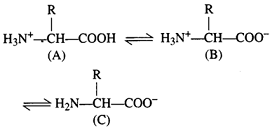
The given amino acid is a neutral amino acid, then A, B and C are formed respectively in:
-
100%
a) Acidic, basic and neutral medium.
-
0%
b) Neutral, Acidic and basic medium.
-
0%
c) Basic, neutral and acidic medium.
-
0%
d) Acidic, neutral and basic medium.
Q.20.
Two chains of amino acids in an insulin molecule are held together by
-
0%
a) sulphide bridges
-
0%
b) disulphide bridges
-
100%
c) peptide bond
-
0%
d) covalent linkage
Q.21.
Select the number of false statements regarding Watson and Crick’s double helical model of DNA: (i) Proposed in 1953 and got Nobel Prize in (ii) Made up of two polynucleotide chains. (iii) They are complementary and antiparallel. (iv) Backbone is sugar and phosphate linked by 3’ – 5’ phosphodiester bond. (v) Nitrogen bases are projecting inside. (vi) Diameter is 20 Å. (vii) Pitch is 34Å. (viii) At each step of ascent the strand turns 32°.
-
100%
a) 1
-
0%
b) 2
-
0%
c) 3
-
0%
d) 4
Q.22.
Cellulose, the most important constituent of plant cell wall is made of
-
0%
a) unbranched chain of glucose molecules linked by α 1, 4-glycosidic bond
-
0%
b) branched chain of glucose molecules linked by β 1, 4-glycosidic bond in straight chain and α 1,6 –glycosidic bond at the site of branching
-
100%
c) unbranched chain of glucose linked by β 1, 4-glycosidic bond
-
0%
d) branched chain of glucose molecules linked by α 1,6-glycosidic bond at the site of branching
Q.23.
Identify the amino acid with hydroxymethyl as its R group
-
0%
a) Glycine
-
0%
b) Alanine
-
0%
c) Serine
-
100%
d) Phenylalanine
Q.24.
Which of the following vitamins is a coenzyme for amino acid and fatty acid metabolism
-
0%
a) Vitamin B6
-
100%
b) Vitamin B12
-
0%
c) Vitamin B1
-
0%
d) Vitamin B2
Q.25.
Nickel contributes to the formation of one of the following
-
100%
a) urease
-
0%
b) dehydrogenase
-
0%
c) Rubisco protein
-
0%
d) nitrate reductase
Q.26.
Which of the following elements is present in higher proportion (% weight of the total) in earth’s crust with respect to the average composition of a human body
-
100%
a) Carbon
-
0%
b) Nitrogen
-
0%
c) Sulfur
-
0%
d) Magnesium
Q.27.
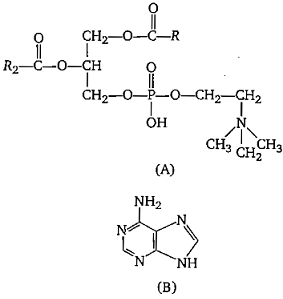
Which one of the following structural formulae of two organic compounds is correctly identified along with its related function?
-
100%
a) A – Triglyceride-major --- source of energy
-
0%
b) B – Uracil – a component of DNA
-
0%
c) A – Lecithin – a component of cell membrane
-
0%
d) B – Adenine – a cucleotide that makes up nucleic acid
Q.28.
Heating may cause denaturion of enzyme or protein mainly by damaging its
-
0%
a) physical configuration
-
0%
b) chemical structure
-
0%
c) both physical configuration as well as chemical structure
-
100%
d) other properties
Q.29.
Nickel contributes to the formation of one of the following
-
0%
a) urease
-
100%
b) dehydrogenase
-
0%
c) Rubisco protein
-
0%
d) nitrate reductase
Q.30.
Hilum the centre of starch grain is made up of
-
0%
a) Fat
-
0%
b) Carbohydrate
-
100%
c) Nitrogen
-
0%
d) Protein
Q.31.
Cheese is a ____________.
-
0%
a) Conjugated protein
-
0%
b) Denatured protein
-
0%
c) Globular protein
-
100%
d) All of these
Q.32.
In the modern system of nomenclature, which one of the following occupies 1st position?
-
0%
a) Oxido reductase.
-
100%
b) Transferase.
-
0%
c) Hydrolase.
-
0%
d) Ligase.
Q.33.
A large and important group of compound which can be made by repetition of simple isoprenoid units, is called
-
0%
a) Terpenoids
-
0%
b) steroids
-
100%
c) Carotenoids
-
0%
d) terpenses
Q.34.
About 98% of the mass of every living organism is composed of just six elements including carbon, hydrogen, nitrogen oxygen and
-
100%
a) phosphorus and sulphur
-
0%
b) sulphur and magnesium
-
0%
c) magnesium and sodium
-
0%
d) calcium and phosphorus
Q.35.
NAD, NADH and NADP are
-
0%
a) not a participant in any catalytic reaction
-
0%
b) participants as cofactors in non-catalytic reaction
-
0%
c) participants as cofactor in enzyme catalysed reactions
-
100%
d) participants as cofactor in both non-catalytic and enzyme catalysed reactions
Q.36.
From the following groups, select the one which has only secondary metabolites?
-
0%
a) Arbrin, cellulose, arginine, tyrosine
-
0%
b) Glycine, gums, serine, diterpenes
-
100%
c) Carotenoids, phenylalanine, curcumin, rubber
-
0%
d) Conclavin-A, morphine, codeine, vinblastin
Q.37.
Glucose is also called
-
0%
a) Grape sugar
-
0%
b) Corn sugar
-
0%
c) Dextrose
-
100%
d) All of these
Q.38.
Keratin have larger amount of
-
100%
a) Magnesium
-
0%
b) Calcium
-
0%
c) Phosphorous
-
0%
d) Sulphur
Q.39.
Cyanide kills an animal by:
-
0%
a) Competitive inhibitor of enzyme cytochrome oxidise
-
0%
b) Killing brain cells
-
100%
c) Killing the cells of cardiac muscles
-
0%
d) Inhibiting cytochrome oxidise, a mitochondrial enzyme essential for cellular respiration by non-competitive inhibition
Q.40.
Which of the following are homopolymers? (i) Inulin. (ii) Insulin. (iii) Chitin. (iv) Cellulose. (v) GLUT – (vi) Glycogen.
-
0%
a) (i), (iii) and (v).
-
0%
b) (i), (iii), (iv) and (vi).
-
100%
c) (i), (ii) and (iv).
-
0%
d) (iii) and (iv).
Q.41.
Most of glycogens upon mixing with iodine gives a color which is
-
100%
a) blue
-
0%
b) red
-
0%
c) green
-
0%
d) pink
Q.42.
Most simpler sugars which are sweet and highly soluble in water are called
-
0%
a) Polysaccharides
-
0%
b) Monosaccharide's
-
0%
c) Disaccharides
-
100%
d) Oligosaccharides
Q.43.
Molecular structure of amylopectin is
-
100%
a) Longer than amylose
-
0%
b) Shorter than amylose
-
0%
c) Unbranched
-
0%
d) Formed through 1,2 linkages
Q.44.
Which of the following elements is present in higher proportion [% weigh of the total] in Earth’s crust with respect to the average composition of a human body?
-
0%
a) Carbon
-
100%
b) Nitrogen
-
0%
c) Sulfur
-
0%
d) Magnesium
Q.45.
The linkage that joins two adjacent nucleotides in RNA is
-
0%
a) phosphate ester
-
0%
b) phosphodiester
-
0%
c) phosphate anhydride
-
100%
d) N-glycoside
Q.46.
Which of the following options consist of non-essential amino acids only?
-
0%
a) Valine, leucine, glycine, alanine
-
0%
b) Glycine, seine, proline, glutamic acid
-
100%
c) Proline, aspartic acid, glutamic acid methionine
-
0%
d) Cysteine, tyrosine, alanine, isoleucine
Q.47.
Insulin is a primary structure of an amino acid which has two chains containing
-
0%
a) 51 amino acids
-
0%
b) 40 amino acids
-
0%
c) 50 amino acids
-
100%
d) 30 amino acids
Q.48.
Excess carbohydrates and proteins are stored in the body as
-
100%
a) amino acids
-
0%
b) fats
-
0%
c) starch
-
0%
d) monosaccharides
Q.49.
Which one of the following is correct sequence of carbohydrates in increasing order of complexity of chemical structure?
-
0%
a) Oligosaccharides, Triose, starch, sucrose, maltose
-
100%
b) Sucrose, starch, oligosaccharides, maltose, trioses
-
0%
c) Triose, glucose, maltose, oligosaccharide starch
-
0%
d) Triose, glucose, maltose, oligosaccharide, starch
Q.50.
The low melting area of DNA is due to:
-
0%
a) A - U base pairs
-
0%
b) G - C base pairs
-
100%
c) A - T base pairs
-
0%
d) Both (b) and (c)