Q.1.
Which among the following is an essential fatty acid in mammals?
-
0%
a) Stearic acid.
-
0%
b) Palmitic acid
-
0%
c) Acetic acid
-
0%
d) Gamma Linoleic acid
Q.2.
The loss of tertiary and quaternary structure of an enzyme brings out:
-
0%
a) Loss of its catalytic activity.
-
100%
b) Thermo stability.
-
0%
c) Increase in water solubility.
-
0%
d) Loss in lipid solubility.
Q.3.
If one amino acid in each beta chain of haemoglobin, out of 574 amino acids do not occupy normal place it can lead to
-
0%
a) paralysis
-
0%
b) death
-
0%
c) cramp
-
0%
d) fits
Q.4.
A polymer that is formed by glycosidic linkage of many monosaccharide units is called as
-
0%
a) Monosaccharides
-
0%
b) Polymer
-
0%
c) Polysaccharides
-
0%
d) Disaccharides
Q.5.
The vitamin Niacin functions as coenzyme in
-
50%
a) Nucleoprotein synthesis
-
50%
b) Hydrogen transport
-
0%
c) Fatty acid synthesis
-
0%
d) RBC production
Q.6.
Which of the following is a purine nucleoside?
-
0%
a) Uracil
-
0%
b) Cytidine
-
0%
c) Thymidine
-
0%
d) Adenosine
Q.7.
In the average composition of a cell, the maximum % of total cellular mass [after water and protein] is constituted by
-
0%
a) Carbohydrates
-
0%
b) Lipid
-
0%
c) Nucleic acids
-
0%
d) Ions
Q.8.
Jute fibres deteriorate quickly because
-
0%
a) cellulose content is high
-
0%
b) lignin content is high
-
0%
c) cellulose content is low
-
0%
d) lignin content is low
Q.9.
Nitrogen bases do not contain:
-
0%
a) Carbon.
-
0%
b) Phosphorus
-
0%
c) Hydrogen
-
0%
d) Nitrogen
Q.10.
The number of monosaccharide units in a polysaccharide is
-
0%
a) 4
-
0%
b) 6
-
0%
c) 10
-
0%
d) More than 10
Q.11.
A specific low molecular weight substance such as the product of another enzyme in the chain reaction which binds with a specific site of the enzyme different from its substrate binding site is called as
-
0%
a) Irreversible inhibitor
-
0%
b) Competitive inhibitor
-
0%
c) Allosteric modulator
-
0%
d) Non-competitive inhibitor
Q.12.
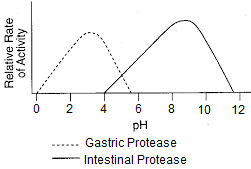
statement best describes the information shown in the graph below:
-
0%
a) The action of enzymes varies with pH.
-
0%
b) A pH of 7 provides an optimum medium for digestive enzymes.
-
0%
c) Gastric juices is active at a pH ranging from 0 to 14.
-
0%
d) Acids have a pH greater than 7.
Q.13.
Find out the number of trioses, tetroses, pentoses, hexoses and heptoses from the following monosaccharides: Glyceraldehyde, Dihydroxy acetone, Erythrose, Erythrulose, Ribose, Ribulose, Xylulose, Arabinose, Deoxyribose, Glucose, Fructose, Galactose, Mannose, Rhamnose, Sedoheptose.
-
0%
a) Trioses= 1; Tetroses= 3; Pentoses= 6; Hexoses= 3; Heptoses= 2
-
0%
b) Trioses= 3; Tetroses= 2; Pentoses= 4; Hexoses= 5; Heptoses= 1
-
0%
c) Trioses= 2; Tetroses= 2; Pentoses= 5; Hexoses= 5; Heptoses= 1
-
0%
d) Trioses= 5; Tetroses= 2; Pentoses= 1; Hexoses= 2; Heptoses= 5
Q.14.
Which statement is true?
-
0%
a) Adenine has 4 nitrogen atoms
-
0%
b) Cytosine has 3 nitrogen atoms
-
0%
c) Guanosine has 3 nitrogen atoms
-
0%
d) Uracil has 5 nitrogen atoms
Q.15.
Glucose is
-
0%
a) Ketose hexose sugar
-
0%
b) Aldose hexose sugar
-
0%
c) Furanose pentose sugar
-
0%
d) Pyranose pentose sugar
Q.16.
Most of the blood proteins in our body are
-
0%
a) Acidic
-
0%
b) Basic
-
0%
c) Neutral
-
0%
d) None of there
Q.17.
In the DNA molecule
-
0%
a) the total amount of purine nucleotides anad pyrimidine nucleotides is not always equal
-
0%
b) there are two strands which run parallel in the 5’ → 3’ direction
-
100%
c) the proportion of adenine in relation to thymine varies with the organism
-
0%
d) there are two strands which run antiparallel one 5’ → 3’ direction and other in 3’ → 5’
Q.18.
What is the term used for a protein molecule that assists in the proper folding of other proteins?
-
0%
a) ubiquitin
-
0%
b) chaperonin
-
0%
c) vimentins
-
0%
d) cyclins
Q.19.
Heating may cause denaturation of enzyme or protein mainly by damaging its
-
0%
a) physical configuration
-
0%
b) chemical structure
-
100%
c) both physical configuration as well as chemical structure
-
0%
d) other properties
Q.20.
Match column – I with Column – II and select the correct option from codes given below
| Column – I | Column – II |
| A. Pigments | (i) Abrin, ricin |
| B. Toxins | (ii) Concanavalin A |
| C. Alkaloids | (iii) Carotenoids |
| D. Lectins | (iv) Morphine, codeine |
-
0%
a) A = (iv) ; B = (iii) ; C = (i) ; D = (ii)
-
0%
b) A = (ii) ; B = (iv) ; C = (i) ; D = (iii)
-
0%
c) A = (iii) ; B = (i) ; C = (iv) ; D = (ii)
-
0%
d) A = (i) ; B = (ii) ; C = (iii) ; D = (iv)
Q.21.
How many ester bonds are present in a simple triglyceride?
-
0%
a) One
-
0%
b) Two
-
0%
c) Three
-
0%
d) Four
Q.22.
A compound which is responsible for structure of membranes of cell and its organelles is a
-
0%
a) lipid
-
0%
b) proteins
-
0%
c) fats, glucose, starch
-
0%
d) waxes
Q.23.
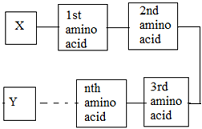
Identify X and Y in the newly synthesised polypeptide chain given below:
-
0%
a) X = – NH3, Y = – COOR.
-
0%
b) X = – NH2, Y = – COOH.
-
0%
c) X = – COOH, Y – NH2.
-
0%
d) X = – COOR, Y – NH2
Q.24.
The unique properties of each amino acid are determined by its particular
-
0%
a) R group
-
0%
b) Amino group
-
0%
c) Kinds of peptide bonds
-
0%
d) Number of bonds to other amino acids
Q.25.
If Oligosaccharides is hydrolyzed, it will yield up to two to ten
-
0%
a) monosaccharides
-
0%
b) disaccharides
-
0%
c) oligosaccharides
-
0%
d) polysaccharides
Q.26.
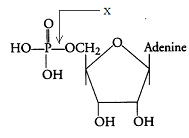
What type of bond is indicated by X in the diagram given below?
-
0%
a) Phosphodiester bond.
-
0%
b) Ionic bond.
-
0%
c) Glycosidic bond.
-
0%
d) Ester bond.
Q.27.
Inhibitors blocking active site by making covalent bonds are specifically known as
-
0%
a) reversible inhibitors
-
0%
b) irreversible inhibitor
-
0%
c) competitive inhibitors
-
0%
d) non-competitive inhibitors
Q.28.
Amylose is formed by condensation between
-
0%
a) α-glucose molecules
-
0%
b) β-fructose molecules
-
0%
c) between α-glucose and β-fructose molecules
-
0%
d) None of above
Q.29.
The enzyme code of enzyme 2.7.1.1 refers to the following main groups:
-
0%
a) Ligase.
-
0%
b) Hydrolase.
-
0%
c) Transferase.
-
0%
d) Lyase.
Q.30.
β - pleated structure of protein is present in silk fibres, the protein is
-
0%
a) Collagen
-
0%
b) Keratin
-
0%
c) Rayon
-
0%
d) Fibroin
Q.31.
Antiparallel strands of a DNA molecule means that
-
0%
a) the phosphate group of two DNA strands, at their endsm share the same position
-
0%
b) the phosphate groups at the start of two DNA strands are in opposite position (pole)
-
0%
c) one strand turns clockwise
-
0%
d) one strand turns anti-clockwise
Q.32.
Locomotion is a very important feature in animals. Considering the frequent need for locomotion in animals, an animal would obtain the greatest benefit from storing its energy as
-
0%
a) Fats
-
0%
b) Proteins
-
0%
c) Minerals
-
0%
d) Carbohydrates
Q.33.
Match the tissues/ molecules mentioned in column I with those of their degrading enzymes mentioned in column II and select the correct option from the given codes
| Column I | Column II |
| A. Cell wall | (i) Proteases |
| B. RNA | (ii) Pectinases |
| C. Histone | (iii) Ribonucleases |
| D. Pectin | (iv) Cellulase |
-
0%
a) A = (iv); B = (iii) ; C – (i); D – (ii)
-
0%
b) A = (ii); B = (i) ; C – (iv); D – (iii)
-
0%
c) A = (i); B = (ii) ; C – (iii); D – (iv)
-
0%
d) A = (iii); B = (iv) ; C – (ii); D – (i)
Q.34.
The inorganic compounds like phosphate, sulphate, etc which becomes available in the filtrate after grinding the living tissue in trichloroacetic acid represents:
-
0%
a) Acid – insoluble pool.
-
0%
b) Acid – soluble pool.
-
0%
c) Water – pool.
-
0%
d) Gaseous pool.
Q.35.
Both in cells and extracellular fluids dibasic phosphate (HPO4-) and monobasic phosphate (H2PO4-) act as acid base buffers to maintain-
-
0%
a) K+ concentration of extracellular fluid
-
0%
b) Na+ concentration of extracellular fluid
-
0%
c) Na+ concentration of cellular fluid
-
0%
d) H+ concentration of cellular fluid
Q.36.
Which of the following is phospholipids?
-
0%
a) Oleic acid
-
0%
b) Sphingomyelin
-
0%
c) Prostaglandin
-
0%
d) Glycerol
Q.37.
Match the following:
| Column I | Column II |
| Class 1 | I. Ligases |
| Class 2 | II. Isomerases |
| Class 3 | III. Lyases |
| Class 4 | IV. Hydrolases |
| Class 5 | V. Transferases |
| Class 6 | VI. Oxido-reductase or dehydrogenase or redox enzyme. |
-
0%
a) 1 – I, 2 – II, 3 – III, 4 – IV, 5 – V, 6 – VI.
-
0%
b) 1 – I, 2 – III, 3 – V, 4 – II, 5 – IV, 6 – VI.
-
0%
c) 1 – VI, 2 – V, 3 – IV, 4 – III, 5 – II, 6 – I.
-
0%
d) 1 – II, 2 – IV, 3 – VI, 4 – I, 5 – III, 6 – V.
Q.38.
The feedback effect in enzymatic action refers to
-
0%
a) The effect of enzyme concentration on its rate of action
-
0%
b) The effect of substrate on the rate of enzyme action
-
0%
c) The effect of an external compound on the rate of enzymatic action
-
0%
d) The effect of end products on the rate of enzymatic action
Q.39.
Which of the following is incorrect?
-
0%
a) Nitrogenous base :Adenine Nucleoside :Adenosine Nucleotide:Adenylic acid
-
0%
b) Nitrogenous base :Uracil Nucleoside :Uridine Nucleotide:Uridylic acid.
-
0%
c) Nitrogenous base :Thymine Nucleoside :Thymosine Nucleotide:Thymonylic acid
-
0%
d) Nitrogenous base :Cytosine Nucleoside :Cytidine Nucleotide: Cytidylic acid
Q.40.
In amylose chain, glucose molecules are linked through
-
0%
a) 1 → 3 bond
-
0%
b) 1 → 4 bond
-
0%
c) 2 → 2 bond
-
0%
d) 2 → 4 bond
Q.41.
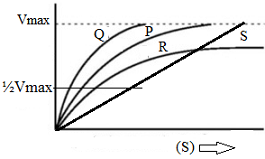
Analyse the figure given below. The Km values for the curves of four different enzymes and their substrates (P, Q, R and S) are 1.72, 0.25, 3.40 and 5.75 respectively. Select the correct order about their enzyme – substrate affinity?
-
0%
a) P > Q > R > S.
-
0%
b) Q > P > R > S.
-
0%
c) R > P > Q > S.
-
0%
d) S > R > Q > P.
Q.42.
Which one of the following correct average composition of cells with respect to the percentage of total cellular mass?
| H2O | Proteins | Carbohydrates | lipid | Nucleic acids | Ions | |
| (A) | 70 – 90 | 10 – 15 | 3 | 2 | 5 – 7 | 1 |
| (B) | 70 – 90 | 3 | 10 – 15 | 2 | 5 – 7 | 1 |
| (C) | 70 – 90 | 10 – 15 | 2 | 3 | 1 | 5 – 7 |
| (D) | 70 – 90 | 3 | 10 – 15 | 2 | 5 – 7 | 1 |
-
0%
a) A
-
0%
b) B
-
0%
c) C
-
0%
d) D
Q.43.
Vitamin nicotinamide and the plant hormone indole-3-acetic acid are formed from
-
0%
a) Alanine
-
0%
b) Serine
-
0%
c) Tryptophan
-
0%
d) Glutamic acid
Q.44.
Which one of the following is saturated fatty acid?
-
0%
a) Linolenic acid
-
0%
b) Oleic acid
-
0%
c) Stearic acid
-
0%
d) Linoleic acid.
Q.45.
Chitin is the second most abundant organic substance present in the exoskeleton of insects and crustaceans. It is a
-
0%
a) Lipid
-
0%
b) Protein and CaCO3 deposits in it
-
0%
c) Polysaccharide and the basis unit is N-acetyl glucosamine
-
0%
d) Protein
Q.46.
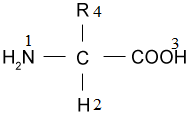
An amino has the following structure. Which two groups combine to form the peptide linkage?
-
0%
a) 1 – 3.
-
0%
b) 2 – 3.
-
0%
c) 1 – 4.
-
0%
d) 1 – 2.
Q.47.
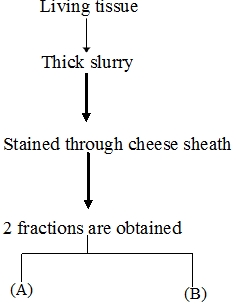
Consider the following flow chart where A represents Filtrate/Acid soluble pool and B represents Retentate/Acid insoluble fraction pellet: (i) Molecular weight ranging from 18 to 800daltons (Da) approximately. (ii) Has four types of organic compounds – proteins, nucleic acids, polysaccharides and lipids. (iii) Contains chemicals that have molecular weight more than 10,000Da. (iv) Has monomers. (v) Has generally polymers. (vi) Represent rough chemical composition of cytosol. (vii) Represent the framework of cytoplasm and cell organelles. Which of the following is the correct statement (i) –(vii) for A and B?
-
0%
a) A – (i), (ii) and (iii); B – (iv), (v), (vi) and (vii).
-
0%
b) A – (ii), (iv) and (vi); B – (i), (iii), (v) and (vii).
-
0%
c) A – (i), (iv) and (vi); B – (ii), (iii), (v) and (vii).
-
0%
d) A – (i), (iii) and (v); B – (ii), (iv), (vi) and (vii).
Q.48.
Find the basic amino acids?
-
0%
a) Glutamic acid and aspartic acid
-
0%
b) Histidine and proline
-
0%
c) Lysine and arginine
-
0%
d) Glycine and alanine
Q.49.
Which of the following is used to ice creams, cosmetics and medicines to emulsify and give a smooth texture?
-
0%
a) Carboxy methylcellulose
-
0%
b) Cellulose nitrate
-
0%
c) Cellulose acetate
-
0%
d) Cellulose
Q.50.
In non-competitive inhibition
-
0%
a) the substrate and inhibitor cannot bind to the enzyme at the same time
-
0%
b) the inhibitor binds only to the substrate-enzyme complex
-
0%
c) the inhibitor can bind to the enzyme at the same time as the enzyme’s substrate
-
0%
d) the binding of the inhibitor to the enzyme reduces it activity but does not affect the binding of substrate