Q.1.
The genetic defect adenosine deaminase (ADA) deficiency may be cured permanently by ...[ CBSE 2009]
-
88%
a) Introducing bone marrow cells producing (ADA) into cells at an early embryonic stages
-
0%
b) Administrating adenosine deaminase activators
-
12%
c) Periodic infusion of genetically engineered lymphocytes having functional ADA cDNA
-
0%
d) Enzyme replacement therapy
Q.2.
Bt toxin is ... [ MHTCET 2010]
-
75%
a) Protein
-
0%
b) Carbohydrate
-
0%
c) Lipid
-
25%
d) Enzyme
Q.3.
What are correctly matched .... [ BHU 2008] Ligase - Joins short segments of DNA together DNA polymerase - cuts DNA at specific site Helicase - breaks hydrogen bond between complementary pair during DNA replication
-
50%
a) 1,2, 3 correct
-
17%
b) 1, 2 correct
-
17%
c) 2,3 correct
-
17%
d) 1,3 correct
Q.4.
Melting of DNA at 70°C is due to breakdown of ... [ AMU 2012]
-
29%
a) Phosphodiester bounds
-
43%
b) Hydrogen bonds
-
14%
c) Glycosidic bonds
-
14%
d) Disulphide bonds
Q.5.
Giant Mouse has been produced through ...[ CBSE 2000]
-
0%
a) Tissue culture
-
17%
b) Gene differentiation
-
67%
c) Gene manipulation
-
17%
d) All the above
Q.6.
Which technique made it possible to genetically engineering living organisms ... [ CBSE 2011]
-
83%
a) Recombinant DNA techniques
-
17%
b) Heavy isotope labeling
-
0%
c) X-ray diffraction
-
0%
d) Hybridization
Q.7.
GAATTC is recognition site of restriction endonuclease ...[ Odisha 2010]
-
0%
a) Hind III
-
83%
b) EcoRI
-
0%
c) Bam I
-
17%
d) Hae III
Q.8.
Statement a: Agrobacterium tumefaciens causes crown gall in dicots Statement b: Agrobacterium tumefaciens enters host through wound and injuries
-
20%
a) b is correct, a is wrong
-
80%
b) both a and b are correct
-
0%
c) both a and b are wrong
-
0%
d) a is correct, b is wrong
Q.9.
First genetically modified plant commercially released in India is .... [ WB 2010]
-
17%
a) Golden Rice
-
33%
b) Bt Bringal
-
17%
c) Slow ripening Tomato
-
33%
d) Bt cotton
Q.10.
Main objective of production of herbicide resistant GGM crops is to ... [ CBSE 2008] Explanation is provided please click on
-
17%
a) Encourage eco friendly herbicides
-
33%
b) Reduce herbicide accumulation in food articles for health safety
-
33%
c) Eliminate weeds from fields without the use of manual labour
-
17%
d) Eliminate weeds from fields without the use of herbicides
Q.11.
Which one of the following is used in genetic engineering? [ MPPMT 2000 ]
-
50%
a) Restriction endonuclease
-
17%
b) RNA polymerase
-
33%
c) DNA polymerase
-
0%
d) Nuclease
Q.12.
Thermostable enzymes 'Taq and Pfu' isolated from thermophilic bacteria are ... [ AMU 2011]
-
33%
a) RNA polymerases
-
33%
b) DNA polymerases
-
0%
c) DNA ligases
-
33%
d) Restriction endonucleases
Q.13.
What is true of Bt toxin? [ CNSE 2009]
-
0%
a) The concerned bacillus has antitoxins
-
100%
b) The inactive protoxin get converted into active form in the insect gut
-
0%
c) Bt protein exists as active toxin in bacillus
-
0%
d) The activated toxin enters the ovaries of the pest to sterilize it an thus prevents its multiplication
Q.14.
Recombinant DNA or rDNA technology as discovered by ....[ Kerala 2007]
-
0%
a) Khorana
-
0%
b) Bateson and de Vries
-
20%
c) Sutton and Avery
-
80%
d) Cohen and Boyer
Q.15.
han one correct options Q215) In genetics engineering which is used for transfer of genes from one cell to another ...[ RPMT 2002]
-
40%
a) Vector
-
20%
b) Probe
-
40%
c) Plasmid
-
0%
d) Virus
Q.16.
Bollworm attacks ...[ MHTCET 2010]
-
0%
a) Tomato
-
20%
b) Bacillus thuringiensis
-
60%
c) Cotton
-
20%
d) Bt cotton
Q.17.
Which of the following is commonly used as a vector for introducing a DNA fragment in human lymphocytes ?[NEET 2018]
-
60%
a) Retrovirus
-
20%
b) Ti plasmid
-
20%
c) λ phage
-
0%
d) pBR 322
Q.18.
In India, the organisation responsible for assessing the safety of introducing genetically modified organisms for public use is ... .... [ NEET 2018] Explanation is provided, please click on
-
20%
a) Indian Council of Medical Research (ICMR)
-
0%
b) Council for Scientific and Industrial Research (CSIR)
-
0%
c) Research Committee on Genetic Manipulation (RCGM)
-
80%
d) Genetic Engineering Appraisal Committee (GEAC)
Q.19.
A 'new variety of rice was patented by a foreign company though such varieties have been present in India for a long time. This is related to ... ... [NEET 2018]
-
0%
a) Co-667
-
0%
b) Sharbati Sonora
-
0%
c) Lerma Rojo
-
100%
d) Basmati
Q.20.
Use of bioresources by multinational companies and organisations without authorisation from the concerned country and its peoople is called ... ... [ NEET 2018]
-
0%
a) Bio-infringement
-
80%
b) Biopiracy
-
0%
c) Biodegradation
-
20%
d) Bioexploitation
Q.21.
The correct order of steps in Polymerase Chain Reaction (PCR) is B39
-
0%
a) Extension, Denaturation, Annealing
-
0%
b) Annealing, Extension, Denaturation
-
20%
c) Denaturation, Extension, Annealing
-
80%
d) Denaturation, Annealing, Extension
Q.22.
Stirred tank bioreactor has been designed for: {submitted by Adhithyan js}
-
20%
a) Ensuring anaerobic conditions in the culture vessel.
-
60%
b)Availability of oxygen throughout the process.
-
20%
c) Addition of preservatives to the product
-
0%
d) Purification of the product.
Q.23.
Name the factors or steps indicated by numbers 1- {submitted by Adhithyan js}
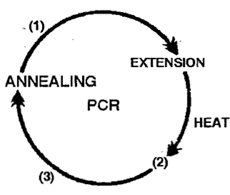
-
20%
a) 1-Taq polymerase, 2-denaturation, 3-primer.
-
20%
b) 1-Denaturation, 2-Taq polymerase, 3-primer.
-
60%
c) 1-Primer, 2-denaturation, 3-Taq polymerase.
-
0%
d) 1-Taq polymerase, 2-Extension, 3-ligation.
Q.24.
If recombinant DNA is inserted within the coding sequence of enzyme galactosidase, which of the following will occur in case of non-recombinants? {submitted by Adhithyan js}
-
0%
a) Insertional inactivation.
-
0%
b) Colonies do not produce any colour.
-
80%
c) Chromogenic substrate will give blue colour.
-
20%
d) Inactivation of enzyme galactosidase.
Q.25.
on 172 Technology which uses living components for the welfare of human being is.....
-
20%
a) Biology
-
0%
b) Botany
-
40%
c) Bioinformatics
-
40%
d) Biotechnology
Q.26.
etic engineering, the ‘probe’ refers to: {submitted by Adhithyan js}
-
60%
a) A radioactive labelled single stranded DNA molecule.
-
20%
b)A radioactive labelled double stranded DNA molecule.
-
20%
c) A radioactive labelled single stranded RNA molecule.
-
0%
d) A radioactive labelled double stranded RNA molecule.
Q.27.
Which of the following should be chosen for best yield if one were to produce a recombinant protein in large amounts? {submitted by Adhithyan js}
-
75%
a) A stirred tank bioreactor without in-lets and out-lets.
-
0%
b) Laboratory flask of largest capacity
-
25%
c) A continuous culture system
-
0%
d) Any of the above
Q.28.
A mixture of DNA fragments, A, B, C and D with molecular weights A+B=C, A>B and D>C, was subjected to agarose gel electrophoresis. The position of these fragments from cathode to anode sides of gel should be: {submitted by Adhithyan js}
-
50%
a) B, A, C, D
-
50%
b) A, B, C, D
-
0%
c) C, B, A, D
-
0%
d) B, A, D, C.
Q.29.
The colonies of recombinant bacteria appear white in contrast to blue colonies of non-recombinant bacteria because of: {submitted by Adhithyan js}
-
67%
a) Insertional inactivation of α galactosidase in the non–recombinant bacteria.
-
33%
b) Insertional inactivation of α galactosidase in the recombinant bacteria.
-
0%
c) Inactivation of glycosidase enzyme in recombinant bacteria
-
0%
d) Non-recombinant bacteria containing β galactosidase.
Q.30.
The role of DNA ligase in the construction of a recombinant DNA molecule is: {submitted by Adhithyan js}
-
20%
a) Formation of hydrogen bonds between the sticky ends of DNA fragment.
-
40%
b) Formation of phosphodiester bond between the DNA fragments.
-
20%
c) Ligation of purines with pyramidine bases.
-
20%
d) Formation of disulphide bonds between the nitrogen bases.
Q.31.
Electroporation procedure involves: {submitted by Adhithyan js}
-
33%
a) Fast passage of food through sieve pores in phloem elements with the help of electric stimulation
-
0%
b) Opening of stomata pores during night by artificial light
-
33%
c) Making transient pores in the cell membrane to introduce gene constructs
-
33%
d) Purification of saline water with the help of a membrane system.
Q.32.
Which of the following ions are required for the activity of Type II endonuclease: {submitted by Adhithyan js}
-
33%
a) Ca2+
-
67%
b) Mg2+
-
0%
c) Cl-
-
0%
d) Mn2+
Q.33.
Primers are: {submitted by Adhithyan js}
-
25%
a) Small chemically synthesised oligonucleotides of about 10-18 nucleotides that are complementary to the region of template DNA.
-
0%
b)Chemically synthesised oligonucleotides of about 10-18 nucleotides that are not complementary to the region of template DNA.
-
0%
c) The double stranded DNA that need to be amplified.
-
75%
d) Specific sequence present on recombinant DNA.
Q.34.
The specific DNA sequence in a chromosome, responsible for initiating replication: {submitted by Adhithyan js}
-
0%
a) Recognition sequence
-
0%
b) Replication fork
-
0%
c) Origin of replication.
-
100%
d) Selectable marker.
Q.35.
How many of the following statements are true about Hind II? {submitted by Adhithyan js} (i) The first restriction endonuclease discovered. (ii) It cuts DNA molecules at a particular point by recognizing a specific sequence of three base pairs. (iii) It was isolated from Haemophilus influenzae. (iv) It produces sticky ends. (v) Its recognition sequence is: 5’ – GTCGAC – 3’; 3’ – CAGCTG – 5’.
-
0%
a) 2
-
0%
b) 3
-
100%
c) 4
-
0%
d) 5
Q.36.
Which of the following is wrong regarding the convention of naming restriction enzyme EcoRI?{submitted by Adhithyan js}
-
100%
a) The first letter of the name comes from the genus and second two letters from the species of the eukaryotic cell.
-
0%
b) R represents the name of the strain.
-
0%
c) Roman numeral indicates the order in which the enzymes were isolated.
-
0%
d) EcoRI comes from Escherichia coli RY 13.
Q.37.
Which of the following is false regarding downstream processing:{submitted by Adhithyan js}
-
50%
a) The process involves separation and purification.
-
50%
b) The product has to be formulated with suitable preservatives.
-
0%
c) Strict quality control testing for each product produced is also required.
-
0%
d) The downstream processing and quality control testing is the same for all products.
Q.38.
Identify the parts labeled A –D in the diagram of E. Coli cloning vector pBR322 {submitted by Adhithyan js}
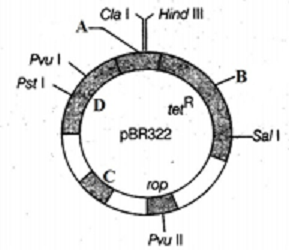
-
33%
a) A-EcoRI, B - Bam HI, C- Ori, D-ampR
-
67%
b) A-ampR, B-Ori, C-Bam HI, D-EcoRI.
-
0%
c) A-Ori, B-Bam HI, C-EcoRI, D- ampR.
-
0%
d) A-Bam HI, B-EcoRI, C-ampR, D-Ori. (Ans: (A))
Q.39.
Which vector can clone only a small fragment of DNA?{submitted by Adhithyan js}
-
0%
a) BAC
-
0%
b) YAC
-
0%
c) Plasmid
-
100%
d) Cosmid
Q.40.
Continuous addition of sugars in Fed batch fermentation is done to:{submitted by Adhithyan js}
-
0%
a) Degrade sewage.
-
0%
b) Produce methane.
-
0%
c) Obtain antibiotics
-
100%
d) Purify enzyme
Q.41.
Restriction enzymes are present in several microorganisms cut foreign DNA at specific sites and destroy them. The enzymes do not destroy the cellular DNA because: {submitted by Adhithyan js}
-
0%
a) the cellular DNA does not have specific sites.
-
0%
b) the susceptible specific sites are masked by proteins.
-
0%
c) the restriction enzyme susceptible sites are modified by cellular enzymes.
-
100%
d) the restriction enzymes and DNA occupy different compartments.
Q.42.
Plasmids are suitable vectors for gene cloning because: {submitted by Adhithyan js}
-
25%
a) these are small circular DNA molecules which can integrate with host chromosomal DNA.
-
50%
b) these are small circular DNA molecules with their own Ori sequence.
-
0%
c) these can shuttle between prokaryotic and eukaryotic cells.
-
25%
d) these often carry antibiotic resistance.
Q.43.
Study the given figure carefully and choose the wrong statement regarding this: {submitted by Adhithyan js}
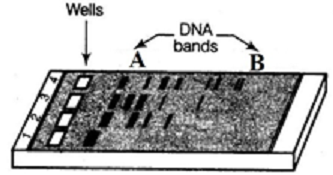
-
50%
a) It represents typical agarose gel electrophoresis showing differential migration of DNA fragments
-
0%
b) Lane 1 contains undigested DNA fragments.
-
50%
c) Lane 2 to 4 contains digested DNA fragments.
-
0%
d) Smallest DNA bands are present at A position and largest DNA bands are present at B position.
Q.44.
Choose the right combination of components required to set up a polymerase chain reaction (PCR) from the following:{submitted by Adhithyan js}
-
0%
a) template DNA, two primers, dNTPs and DNA ligase.
-
0%
b) template DNA, one primer, dNTPs and DNA ligase.
-
100%
c) template DNA, two primers, dNTPs and Taq DNA polymerase.
-
0%
d) template DNA, one primer, dNTPs and Taq DNA polymerase.
Q.45.
The introduction of T-DNA into plants involve: {submitted by Adhithyan js}
-
0%
a) Exposing the plants to cold for a brief period.
-
0%
b) Allowing the plant roots to stand in water.
-
100%
c) Infection of the plant by Agrobacterium tumefaciens.
-
0%
d) Altering the pH of the soil, then heat shocking the plants.
Q.46.
Choose the correct option; (1) In elution, the separated bands of DNA are cut out from agarose gel and extracted from the gel piece. (2) E. coli cloning vector pBR322 shows several restriction sequences, Ori, antibiotic resistance gene and Rop. (3) The downstream processing and quality control testing vary from product to product. (4) Competent bacterial cell cannot be taken up by the plasmid. {submitted by Adhithyan js}
-
0%
a) All are correct.
-
0%
b) All except (3) is correct.
-
0%
c) All except (4) is correct.
-
100%
d) Only (3) and (4) are wrong.
Q.47.
Consider the given statements with respect to gel electrophoresis: (i) DNA can be separated by forcing them to move towards cathode under an electric field. (ii) DNA fragments separate according to their size through sieving effect provided by the agarose gel. (iii) The used matrix in this technique is agarose which is an artificial polymer. Which of the following statements is/are correct: {submitted by Adhithyan js}
-
0%
a) (i) and (ii)
-
0%
b) (ii) only
-
0%
c) (ii) and (iii) only.
-
100%
d) All are correct.
Q.48.
Which of the following statements is not correct: {submitted by Adhithyan js}
-
100%
a) T-DNA transform normal plant cells into a tumour.
-
0%
b) Retroviruses in animals have the ability to transform normal cells into cancerous cells.
-
0%
c) Ti plasmids of Agrobacterium tumefaciens is modified into cloning vector which is more pathogenic to plants.
-
0%
d) Retroviruses have also been disarmed and now are used to deliver desirable genes into animal cells.
Q.49.
Which is incorrect: {submitted by Adhithyan js}
-
0%
a) In PCR, two primers are used.
-
0%
b) Taq DNA polymerase is needed for PCR.
-
100%
c) Taq DNA polymerase is not thermo stable.
-
0%
d) Multiple copies of gene can be synthesized in PCR.
Q.50.
For a plasmid to be a cloning vector, the minimum numbers of elements required are:{submitted by Adhithyan js}
-
0%
a) origin of replication, multiple cloning sites, selectable marker.
-
100%
b)origin of replication, multiple cloning sites, selectable marker, promoter.
-
0%
c) origin of replication, multiple cloning site, selectable marker, translational site
-
0%
d) origin of replication, multiple cloning site, promoter.