Q.1.
When synapsis is complete all along the chromosome, the cell is said to have a stage called
-
0%
a) diplotene
-
50%
b) diakinesis
-
50%
c) zygotene
-
0%
d) pachytene
Q.2.
What is the correct sequence of the steps given here? Also work out the process depicted in the steps I) Homologous chromosomes move toward opposite poles of the cell; chromatids do not separate II) Chromosomes gather to gather at the two poles of the cell and the nuclear membranes form III) Homologous chromosomes pair and exchange segments IV) Homologous chromosomes align on a central plate V) The haploid cells separate completely
-
50%
a) The correct sequence is III →IV → I →II→V and the process is meiosis I
-
50%
b) The correct sequence is II →I → V →IV →II and the process is mitosis
-
0%
c) The correct sequence is IV →I → III →II→V and the process is meiosis I
-
0%
d) The correct sequence is II →V → IV →I →II and the process is mitosis
Q.3.
Identify the meiotic stage in which the homologous chromosomes separate while the sister chromatids remain attached to the centromeres.
-
0%
a) Anaphase I.
-
50%
b) Metaphase I.
-
50%
c) Anaphase II.
-
0%
d) Metaphase II.
Q.4.
Which of the following ions are necessary for assembly of microtubules?
-
50%
a) Na+ and Ca2+
-
0%
b) Na+ and K+
-
50%
c) Ca+ and Mg2+
-
0%
d) Ca2+and Cl-
Q.5.
Prophase is marked by:
-
0%
a) Initiation of condensation of chromosomal materials.
-
0%
b) Alignment of chromosome at equatorial plate.
-
50%
c) Completion of assembly of mitotic spindle.
-
50%
d) Complete disintegration of nuclear envelope.
Q.6.
In a dipole cell, at which stage of cell cycle, the amount of DNA is doubled
-
50%
a) G0
-
0%
b) S phase
-
50%
c) S, G2 and M phase
-
0%
d) G1 and G2
Q.7.
Find correct match:
| Column I | Column II |
| Spireme stage. | a) Diplotene |
| Antephase | b) Prophase |
| Congression | c) Post mitotic phase. |
| Chiasmata counting | d) Metaphase stage |
-
50%
a) 1 - b ; 2 - c ; 3 - a ; 4 - d
-
0%
b) 1 - b ; 2 - d ; 3 - c ; 4 - a
-
50%
c) 1 - b ; 2 - c ; 3 - d ; 4 - a
-
0%
d) 1 - c ; 2 - b ; 3 - d ; 4 - a
Q.8.
Meiosis I :
-
50%
a) is sometimes followed by interphase
-
50%
b) is followed by a period of interkinesis
-
0%
c) is not followed by any period of rest
-
0%
d) is always followed by interphase
Q.9.
Which is the most common mechanism of genetic variation in the population of a sexually reproducing organism?
-
0%
a) Transduction.
-
0%
b) Genetic drift.
-
100%
c) Chromosomal aberration.
-
0%
d) Recombination.
Q.10.
The beginning of diplotene is recognized by
-
50%
a) Crossing over
-
0%
b) Dissolution of synaptonemal complex
-
0%
c) Appearance of chiasmata
-
50%
d) Appearance of recombination nodules
Q.11.
Given below is a schematic break-up of the phases/stages of cell cycle Which one of the following is the correct indication of the stage/phase in the cycle
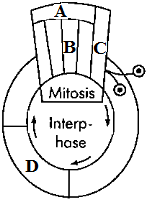
-
0%
a) A-Cytokinesis
-
50%
b) B-Metaphase
-
50%
c) C – Karyokinesis
-
0%
d) D – Synthetic pahse
Q.12.
Microtubule depolymerizing drug such as colchicine is expected to
-
0%
a) allow mitosis beyond metaphase
-
0%
b) induce formation of multiple contractile rings
-
100%
c) inhibit spindle formation during mitosis
-
0%
d) inhibit cytokinesis
Q.13.
The key features of meiosis are given below. Identify the incorrect statement:
-
0%
a) Diplotene stage is characterised by X shaped structure called bouquet.
-
50%
b) Meiosis involves two sequential cycles of nuclear and cell division called Meiosis I and Meiosis II but only a single cycle of DNA replication.
-
50%
c) Pachytene stage is characterised by the appearance of recombination nodules.
-
0%
d) Zygotene stage is characterised by Synapsis, accompanied by the formation of synaptonemal complex.
Q.14.
Assertion (A) : Phase of cell division is also known as dividing phase. Reason (R) : In mitotic phase new cells are produced from pre-existing cells through meiosis division.
-
50%
a) Both A and R are true and R is the correct explanation of A.
-
50%
b) Both A and R are true but the R is not the correct explanation of A.
-
0%
c) A is true statement but R is false.
-
0%
d) Both A and R are false.
Q.15.
The time period between meiotic I and meiotic II cell division is called :
-
0%
a) interphase
-
50%
b) 1st gap
-
0%
c) interkinesis
-
50%
d) growth phase
Q.16.
he nuclear membrane disintegrates and spindle appears at :
-
0%
a) Late prophase
-
0%
b) Prometaphase
-
50%
c) Late telophase
-
50%
d) Early prophase
Q.17.
Meiosis – II is :
-
0%
a) Reduction division
-
100%
b) Commonly cell elongation
-
0%
c) Mitotic division
-
0%
d) Cell division
Q.18.
Statement – P : In ‘S’ stage centrosome is duplicated Statement – Q : In the prophase centrioles separate from each other and move towards the opposite poles.
-
0%
a) Statement P and Q both are correct
-
100%
b) Statement P is correct statement Q is wrong
-
0%
c) Statement P is wrong and statement Q is correct
-
0%
d) Statement P and Q both are wrong
Q.19.
In the given diagram “a” and “b”, which stage of mitosis is indicated
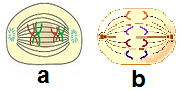
-
0%
a) a = Early prophase b = Anaphase
-
100%
b) a = Late prophase b = Anaphase
-
0%
c) a = Telophase b = Telophase
-
0%
d) a = Metaphase b = Telophase
Q.20.
During mitosis ER and nucleolus begin to disappear at
-
0%
a) early metaphase
-
100%
b) early prophase
-
0%
c) late prophase
-
0%
d) late metaphase
Q.21.
Beads on string like structures of A are seen in B, which further condense to form chromosomes in C stage of cell division
-
100%
a) A – Chromonema,, B – Chromatin C –Metaphase
-
0%
b) A- Chromonema B – Chromatid C – Anaphase
-
0%
c) A – Chromatin , B – Chromatid C – Metaphase
-
0%
d) A- Chromonema B – Chromosome C – Anaphase
Q.22.
Assertion: In meiosis, one haploid cell produces two diploid cells. Reason: The daughter cell in meiosis receives maternal and paternal chromosomes of homologous pairs.
-
100%
a) Both Assertion and Reason are true and Reason is the correct explanation of Assertion.
-
0%
b) Both Assertion and Reason are true but Reason is NOT the correct explanation of Assertion.
-
0%
c) Assertion is true but Reason is false.
-
0%
d) Both Assertion and Reason are false.
Q.23.
Which of the following statements is incorrect about G0 phase
-
0%
a) Cell volume keeps on increasing during this phase
-
0%
b) Mitosis occurs after G0 phase
-
0%
c) Cell metabolism occurs continuously in G0 phase
-
100%
d) Biocatalysts can be used to exit G0 phase
Q.24.
At what stage of the cell cycle are histone proteins synthesized in a eukaryotic cell:
-
0%
d) During the G1 phase.
-
100%
a) During the entire prophase.
-
0%
b) During G2 phase.
-
0%
c) During the S phase.
Q.25.
Calcium dependent kinases can control
-
0%
a) Cell surface receptors
-
0%
b) membrane structure
-
0%
c) DNA replication
-
100%
d) Cell cycle activities
Q.26.
Colchicine prevents the mitosis of cell at:
-
0%
a) Telophase stage.
-
0%
b) Prophase stage.
-
0%
c) Metaphase stage.
-
100%
d) Anaphase stage.
Q.27.
Identify the correct matched pair
-
0%
a) Exchange of genetic material – Diakinesis
-
0%
b) Anaphase II of meiosis – Centromeric division
-
100%
c) Segregation – Metaphase II
-
0%
d) Significance of meiosis – Production of genetically similar cells
Q.28.
Repulsion of homologous chromosomes takes place in:
-
100%
a) Pachytene.
-
0%
b) Zygotene.
-
0%
c) Leptotene.
-
0%
d) Diakinesis.
Q.29.
How many chromatids will be there in a cell having 12 chromosomes when it passes through mitotic metaphase and metaphase II?
-
0%
a) 12 and 12.
-
100%
b) 12 and 24.
-
0%
c) 24 and 12.
-
0%
d) 24 and 24.
Q.30.
The significance of meiosis lies in:
-
0%
a) Production of genetic variability in the population of species.
-
100%
b) Reduction of diploid number of chromosomes into haploid.
-
0%
c) Maintaining constancy in the number of chromosomes in an organism.
-
0%
d) All of the above.