Q.1.
DNA replication in bacteria occurs ….[NEET- 2017]
-
50%
a) During S-phase
-
50%
b) Within nucleolus
-
0%
c) Prior to fission
-
0%
d) Just before transcription
Q.2.
Arrange the following events of meiosis in correct sequence : [ ReAIPMT 2015] (a) Crossing over (b) Synapsis (c) Terminalisation of chaismata (d) Disappearance of nucleolus
-
14%
a) (b), (c), (d), (a)
-
43%
b) (b), (a), (d), (c)
-
14%
c) (b), (a), (c), (d)
-
29%
d) (a), (b), (c), (d)
Q.3.
Satellite DNA is important because it : [ ReAIPMT 2015]
-
20%
a) Codes for enzymes needed for DNA replication
-
20%
b) Codes for proteins needed in cell cycle
-
40%
c) Shows high degree of polymorphism in population and also the same degree of polymorphism in an individual, which is heritable from parents to children
-
20%
d) Does not code for proteins and is same in all members of the population
Q.4.
Offsets are produced by ..[ NEET 2018]
-
17%
a) Meiotic divisions
-
33%
b) Mitotic divisions
-
50%
c) Parthenocarpy
-
0%
d) Parthenogenesis
Q.5.
The stage during which separation of the paired homologous chromosomes begins is
-
0%
a) Pachytene
-
20%
b) Diplotene
-
20%
c) Diakinesis
-
60%
d) Zygotene
Q.6.
Select the incorrect match [ NEET 2018]
-
25%
a) Lampbrush – Diplotene bivalents chromosomes
-
0%
b) Allosomes – Sex chromosomes
-
50%
c) Submetacentric – L-shaped chromososmes chromosomes
-
25%
d) Polytene – Oocytes of amphibians chromosomes
Q.7.
When Synapsis is complete all along the chromosome, the cell is said to have entered the stage called:
-
25%
a) Diplotene
-
0%
b) Zygotene.
-
75%
c) Diakinesis.
-
0%
d) Pachytene.
Q.8.
In salivary glands, chromosomes somehow or other the original chromonemata go on dividing longitudinally repeatedly so that they show not 2 or 4 chromonemata as in normal chromosomes but a large number of them. This is termed as Polyteny. Such repeated division of chromonemata threads without actual cell division may be termed as:
-
33%
a) Free cell formation.
-
33%
b) Amitosis.
-
33%
c) Endomitosis.
-
0%
d) Brachymeiosis.
Q.9.
Assertion: Chromosomal mutation may take place due to non-disjunction in Meiosis – I. Reason: Meiosis I reduces the chromosome number to half.
-
50%
a) Both Assertion and Reason are true and Reason is the correct explanation of Assertion.
-
50%
b) Both Assertion and Reason are true but Reason is NOT the correct explanation of Assertion.
-
0%
c) Assertion is true but Reason is false.
-
0%
d) Both Assertion and Reason are false.
Q.10.
Phragmoplast:
-
50%
a) Help in plant cytokinesis.
-
50%
b) Helps in cell enlargement.
-
0%
c) Formation occur during cytokinesis of bacterial cell.
-
0%
d) Formation occur during mitotic anaphase.
Q.11.
Recombination nodules are formed in:
-
0%
a) Zygotene.
-
50%
b) Diplotene.
-
0%
c) Leptotene.
-
50%
d) Pachytene.
Q.12.
Colchicine prevents the mitosis of cells at which phase of karyokinesis:
-
0%
a) Metaphase.
-
33%
b) Anaphase.
-
67%
c) Prophase.
-
0%
d) Interphase.
Q.13.
Consider the given two statements i) During G1 phase the cell is metabolically active and continuously grows but does not replicate its DNA ii) During G2pahse,proteinsare synthesized in preparation for mitosis while cell growth continues Of the two statements
-
0%
a) Only i is correct
-
0%
b) Only ii is correct
-
0%
c) Both I and ii correct
-
0%
d) Both I and ii are incorrect
Q.14.
Match the following:
| Column I | Column II |
| Karyokinesis. | a) Zygotic meiosis |
| Cell plate | b) Cytoplasmic division. |
| Diplontic cycle | c) Plant cells. |
| Haplontic cycle | d) Nuclear division |
| Cytokinesis | e) Gamete meiosis. |
-
0%
a) 1 -d ; 2 -c ; 3 - b ; 4 -e ; 5 - a
-
0%
b) 1 -d ; 2 -c ; 3 - a ; 4 -e ; 5 - b
-
0%
c) 1 -d ; 2 -c ; 3 - e ; 4 -a ; 5 - b
-
0%
d) 1 -c ; 2 -d ; 3 - e ; 4 -a ; 5 - b
Q.15.
he exchange of segments of non-sister chromatids between chromosomes of a homologous pair termed as
-
0%
a) crossing over
-
0%
b) chromosomal aberration
-
0%
c) transformation
-
0%
d) translocation
Q.16.
Crossing over that results in genetic recombination in higher organisms occur between:
-
0%
a) Two different bivalents.
-
0%
b) Sister chromatids of a bivalent.
-
0%
c) Non-sister chromatids of a bivalent.
-
0%
d) Two daughter nuclei.
Q.17.
How many of the following events are not related with mitosis? (i) Sister chromatids are separated. (ii) Pairing between homologous chromosomes. (iii) Spindle fibres attach to the kinetochores of chromosomes. (iv) Crossing over between homologous chromosomes. (v) Formation of synaptonemal complex. (vi) Assembly of nuclear envelope.
-
0%
a) One.
-
0%
b) Two.
-
0%
c) Three.
-
0%
d) Four.
Q.18.
Synapsis occurs between
-
0%
a) spindle fibres and centromere
-
0%
b) two homologous chromosomes
-
0%
c) a male and a female gamete
-
0%
d) mRNA and ribosomes
Q.19.
Given below is the representation of a certain event at a particular stage of a type of cell division. Which is this stage
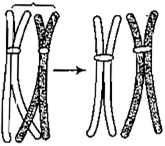
-
0%
a) Both prophase and metaphase of mitosis
-
0%
b) Prophase-I during meiosis
-
0%
c) Prophase-II during meiosis
-
0%
d) Prophase of mitosis
Q.20.
Chromosomal behaviour occurring during different substages of Prophase I of meiosis is given below; Select the statement which is suited to Diplotene:
-
0%
a) Chromosomes starts pairing together.
-
0%
b) Bivalents/ tetrads are clearly visible.
-
0%
c) Dissolution of the synaptonemal complex and the tendency of recombined homologous chromosomes of the bivalents to separate from each other except at the sites of crossovers.
-
0%
d) Terminalisation of Chiasmata.
Q.21.
The cell which exist in G0 phase.
-
0%
a) Meristem.
-
0%
b) Osteocytes.
-
0%
c) liver cell.
-
0%
d) Heart cell.
Q.22.
Which stage of cell division dothe following figures A and B represent respectively?
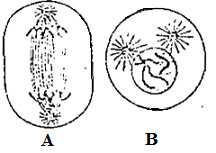
-
0%
a) A – Metaphase B- Telophase
-
0%
b) A - Telophase B- Metaphase
-
0%
c) A - Late anaphase B – Prophase
-
0%
d) A - Prophase B – Anaphase
Q.23.
Assertion: Meiosis II is similar to mitosis. Reason: Meiosis I cannot occur in haploid cells.
-
0%
a) Both Assertion and Reason are true and Reason is the correct explanation of Assertion.
-
0%
b) Both Assertion and Reason are true but Reason is NOT the correct explanation of Assertion.
-
0%
c) Assertion is true but Reason is false.
-
0%
d) Both Assertion and Reason are false.
Q.24.
The centromeres is present very close to one end of the chromosome in:
-
0%
a) Sub-metacentric chromosome.
-
0%
b) Acrocentric chromosomes.
-
0%
c) Telocentric chromosomes.
-
0%
d) Metacentric chromosomes.
Q.25.
Select the correct option with respect to mitosisChromatids start moving towards opposite poles in telophase
-
0%
a) Chromosomes move to the spindle equator and get aligned along equatorial plate in metaphase
-
0%
b) Golgi complex and endoplasmic reticulum are still visible at the end of prophase
-
0%
c) Chromatids start moving towards opposite poles in telophase
-
0%
d) Chromatids separate but remains in the centre of the cell in anaphase
Q.26.
Barr body is found in the cytoplasm during
-
0%
a) prophase in cell of male mammal
-
0%
b) interphase in cell of male mammal
-
0%
c) interphase in cell of female mammal
-
0%
d) prophase in cell of female mammal
Q.27.
The events of cell division are:
-
0%
a) Genetically controlled.
-
0%
b) Chemically controlled.
-
0%
c) Neural regulated.
-
0%
d) Hormone regulated.
Q.28.
The cell shown in the given diagram is in

-
0%
a) Metaphase
-
0%
b) Telophase
-
0%
c) Late prophase
-
0%
d) Early prophase
Q.29.
A cell at telophase stage is observed by a student in a plant brought from filed. He tells his teacher that this cell is not like other cells at telophase stage. There is no formation of cell plate and thus the cell is containing more number of chromosomes as compared to other dividing cells. This would result in
-
0%
a) aneuploidy
-
0%
b) somaclonal variation
-
0%
c) polyploidy
-
0%
d) polyteny
Q.30.
Identify the stage of cell cycle represented by the key events: (i) Chromosome cluster at opposite spindle poles and their identity is lost as discrete elements. (ii) Nuclear envelope assembles around the chromosome clusters. (iii) Nucleolus, golgi complex and ER reforms.
-
0%
a) Telophase.
-
0%
b) Anaphase.
-
0%
c) Metaphase.
-
0%
d) Prophase.