Q.1.
Protoplasm is ... .... [ MPPMT 1999 ]
-
7%
a) Emulsion
-
64%
b) Complex colloidal solution
-
14%
c) Molecular solution
-
14%
d) Suspension
Q.2.
Which is not true of active transport ... .... [ Odisha 2012 ]
-
31%
a) It is chemical process
-
23%
b) Energy is obtained from ATP
-
31%
c) Occurs through carrier molecules
-
15%
d) Not modified by enzymes
Q.3.
Ingestion of solid or liquid substances into cell is referred to as ... ..... [ DPMT 2011 ]
-
73%
a) Endocytosis
-
9%
b) Diffusion
-
9%
c) Osmosis
-
9%
d) Exocytosis
Q.4.
Fluid mosaic model of cell membrane was put forward by ... .... [ AIIMS 1992 ]
-
44%
a) Danielli and Davson
-
56%
b) Singer and Nicolson
-
0%
c) garner and Allard
-
0%
d) Watson and Crick
Q.5.
Match the following ... .. [ kerala 2006 ]
| (a) bacteria | (1.) Synthesis and storage of lipids |
| (b) Sphaerosomes | (2.) Idiogram |
| (c) Chloroplasts | (3.) Glycocalyx |
| (d) Karyotype | (4.) Thylakoids |
-
75%
a) a - 3, b - 1, c- 4, d - 2
-
12%
b) a - 3, b - 1, c- 2, d - 4
-
12%
c) a - 4, b - 3, c- 2, d - 1
-
0%
d) a - 1, b - 2, c- 3, d - 4
Q.6.
A nucleotide is formed of ... ... [ BHU 2001 ]
-
11%
a) Purine, pyrimidine and phosphate
-
11%
b) purine, sugar and phosphate
-
67%
c) Nitrogen base, sugar and phosphate
-
11%
d) Pyrimidine, sugar and phosphate
Q.7.
Flat membranous bag are characteristic of ... .... [ RPMT 1998 ]
-
22%
a) Peroxisomes
-
0%
b) Mitochondria
-
44%
c) Lysosomes
-
33%
d) Golgi bodies
Q.8.
The one located inside a vacuole is ... ... [ Manipal 2005 ]
-
22%
a) Tonoplast
-
11%
b) Matrix
-
33%
c) Ergastic substances
-
33%
d) Cell sap
Q.9.
The term sarcode was used for living substance of cell by ... ... [CPMT 2000 ]
-
0%
a) Hooke
-
67%
b) Dujardin
-
33%
c) Purkinje
-
0%
d) Brown
Q.10.
Electron microscope has revealed the presence of ... ... [ AFMC 1996 ]
-
55%
a) Ribosomes
-
0%
b) Chromosomes
-
36%
c) Chloroplast
-
9%
d) Leucoplast
Q.11.
Consider the following statements A) In prokaryotic cell, an outgrowth of plasma membrane into cell is called polysome B) SER is major site for glycoprotein synthesis C) RuBisCO is most abundant protein of biosphere D) Mitochondria, chloroplasts and peroxisomes are not part of endomembrane system. Of the above statement ... [ Kerala 2012 ]
-
57%
a) C and D alone are correct
-
14%
b) A and B alone are correct
-
14%
c) B and C alone are correct
-
14%
d) B and D alone are correct
Q.12.
Which of the following statement regarding mitochondria membrane is not correct? ... ... [ CBSE 2006 ]
-
33%
a) Outer membrane resembles a sieve
-
0%
b) Outer membrane is permeable to all kinds of molecules
-
50%
c) Enzymes of electron transport chain are embedded in outer membrane
-
17%
d) Inner membrane is highly convoluted forming a series of infoldings.
Q.13.
Protoplasm is ... ... [ AMU 2000 ]
-
29%
a) Nonliving matter
-
29%
b) Bearer of hereditary characters
-
14%
c) Living matter without function
-
29%
d) Physical basis of life
Q.14.
Which is wrong ... ... [ CBSE 2007 ]
-
57%
a) Both chloroplast and mitochondrion have an internal compartment or thylakoid space bounded by thylakoid membrane
-
14%
b) Both contain DNA
-
29%
c) Chloroplast is generally larger
-
0%
d) Both are covered by double membrane
Q.15.
E.R. is more developed in ... .... [ MPPMT 1999 ]
-
17%
a) Green cells
-
17%
b) Young cells
-
67%
c) Mature cells
-
0%
d) Bacteriophage
Q.16.
DNA is present in both ... .... [ AFMC 2011 ]
-
0%
a) Centriole and mitochondria
-
29%
b) Ribosomes and plastids
-
57%
c) Chloroplasts and mitochondria
-
14%
d) Chloroplasts and Golgi apparatus
Q.17.
Ribosomes are made up of ... ... [ MPPMT 1995 ]
-
17%
a) DNA and protein
-
0%
b) DNA alone
-
50%
c) RNA and proteins
-
33%
d) DNA and RNA
Q.18.
Secretory function of cell is carried out by ... .. [ CPMT 2000 ]
-
0%
a) Peroxisomes
-
75%
b) Golgi apparatus
-
12%
c) Lysosomes
-
12%
d) Sphaerosomes
Q.19.
Peroxisomes occur in ... ... [ Odisha 2005 ]
-
0%
a) Bundle sheath
-
33%
b) Vascular bundles
-
67%
c) Mesophyll cells
-
0%
d) Endosperm
Q.20.
An oxidative organelle is ... ... [ CET Chd 2011 ]
-
17%
a) Ribosome
-
33%
b) Golgi body
-
33%
c) Peroxisome
-
17%
d) ER
Q.21.
Schleiden and Schwann proposed cell theory in .. ... [ Har PMT 2002 ]
-
33%
a) 1836 - 37
-
33%
b) 1838 - 39
-
0%
c) 1901 -02
-
33%
d) 1938 -39
Q.22.
Assembly of 60 S and 40 S subunits of ribosome produces .... ... [ kerala 2003 ]
-
60%
a) 80 S
-
20%
b) 70 S
-
20%
c) 50 S
-
0%
d) 100 S
Q.23.
in chloroplasts the chlorophyll is located in .... ... [ CBSE 2005 ]
-
40%
a) Stroma
-
60%
b) Grana
-
0%
c) Pyrenoid
-
0%
d) Both A and B
Q.24.
Which was purines? ... ... [ RPMT 2006 ]
-
33%
a) Adenine and Guanine
-
50%
b) Adenine and Thymine
-
17%
c) Cytosine and Thymine
-
0%
d) Cytosine and Guanine
Q.25.
GERL is associated with ... ... [ AIIMS 1997 ]
-
40%
a) Peroxisomes
-
20%
b) Golgi body
-
40%
c) Mitochondrion
-
0%
d) Lomasome
Q.26.
ion Q15) Balbiani rings are parts of:
-
17%
a) Ribosome.
-
17%
b) Plasma membrane.
-
67%
c) Giant chromosome.
-
0%
d) Microtubule.
Q.27.
Which is correct .... ... [CPMT 2010 ]
-
0%
a) Oil storage - Rhodoplast
-
50%
b) Protein storage - Amyloplast
-
25%
c) Starch storage - Aleuroplasts
-
25%
d) Fat storage - Elaioplast
Q.28.
Cell vacuole contains ... ... [ CPMT 1991 ]
-
17%
a) Water
-
17%
b) Metabolic gases
-
50%
c) Water and dissolved substances
-
17%
d) Cytoplasm
Q.29.
Consider the statements regarding facilitated transport 1) Requires ATP energy 2) Transport saturates 3) Highly selective 4) Requires special membrane properties 5) Uphill transport Of the above statements ... ... [ kerala 2012 ]
-
75%
a) 1, 2, 3 are relevant, 4 and 5 are irrelevant
-
0%
b) 2, 3, 5 are relevant, 1 and 4 are irrelevant
-
25%
c) 2, 3, 4 are relevant, 1 and 5 are irrelevant
-
0%
d) 3, 4, 5 are relevant, 1 and 2 are irrelevant
Q.30.
Cell saps occurs in organelle ... .. [ MPPMT 2002 ]
-
20%
a) Nucleolus
-
40%
b) Vacuole
-
0%
c) Endoplasmic reticulum
-
40%
d) Golgi bodies
Q.31.
Which organelle occurs both in plants and animals ... ... [ Odisha 2007 ]
-
0%
a) Cell wall
-
50%
b) Mitochondria
-
50%
c) Centriole
-
0%
d) Chloroplast
Q.32.
Mitochondria are related to ... ... [ MPPMT 1999 ]
-
0%
a) Viruses
-
25%
b) Plasmids
-
25%
c) Plastids
-
50%
d) Procaryotes
Q.33.
Which of the following show selective permeability? ... ... [ Odisha 2005 ]
-
75%
a) Cell membrane
-
25%
b) Cell wall
-
0%
c) Cytoplasm
-
0%
d) Protoplasm
Q.34.
An individual has a number of different types of cells was first stated by ... ... [ Har PMT 2002 ]
-
0%
a) Dujardin
-
50%
b) Robert Brown
-
0%
c) Dutrochet
-
50%
d) Schleiden and Schwann
Q.35.
Histones are rich in amino acids ... ... [ RPMT 2011 ]
-
0%
a) Arginine and lysine
-
33%
b) Lysine and histidine
-
33%
c) Valine and histidine
-
33%
d) Arginine and histidine
Q.36.
Robert Hook coined the term cell in ... ... [ BHU 2008 ]
-
0%
a) 1650
-
50%
b) 1665
-
50%
c) 1865
-
0%
d) 1960
Q.37.
Lysosome enzymes are active at pH ... .. [ MPPMT 2002 ]
-
50%
a) 5
-
0%
b) 7
-
25%
c) 8
-
25%
d) Variable
Q.38.
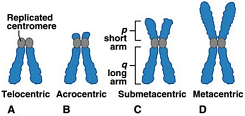
Chromosome having terminal centromere capped by telomere is ... ... [ HPPMT 2007 ]
-
0%
a) Metacentric
-
0%
b) Submetacentric
-
75%
c) Acrocentric
-
25%
d) Telocentric
Explanation
Q.39.
Stack of lamellae found inside a plastid is ... ... [ Odisha 2004 ]
-
25%
a) Thylakoid
-
0%
b) Stroma
-
50%
c) Granum
-
25%
d) Oxysome
Q.40.
Double membrane is absent in ... ... [ CPMT 1995 ]
-
0%
a) Mitochondria
-
0%
b) Chloroplast
-
25%
c) Nucleus
-
75%
d) Lysosomes
Q.41.
Tonoplast, a differentially permeable membrane surrounds ... ... [ AMU 1991 ]
-
50%
a) vacuole
-
0%
b) Nucleus
-
25%
c) Cytoplasm
-
25%
d) Lysosome
Q.42.
Structural element of chromatin is ... ... [ WB 2011 ]
-
25%
a) Histone
-
0%
b) Acid protein and DNA
-
50%
c) Nucleosome
-
25%
d) Nuclear matrix
Q.43.
Match the columns: ... ... [ kerala 2005 ]
| Column I | Column II |
| (a) Endoplasmic reticulum | (i) Cellular respiration |
| (b) Free ribosome | (ii) Osmoregulation and excretion |
| (c) Mitochondrion | (iii) Synthesis of lipids |
| (d) Contratile | (iv) Synthesis of non-secretory proteins |
-
0%
a) a - i, b - ii, c - iv, d - iii
-
100%
b) a - iii, b - iv, c - i, d - ii
-
0%
c) a - iii, b - iv, c - ii, d - i
-
0%
d) a - ii, b - i, c - iii, d - iv
Q.44.
Callus is ... ... [ JKCMEE 2002 ]
-
25%
a) Material used in healing in phloem
-
0%
b) Secondary tissue developed by woody plants
-
50%
c) An undifferentiated mass of cells
-
25%
d) All the above
Q.45.
Nucleus was discovered by ... ... [ AFMC 2003 ]
-
0%
a) Purkinje
-
0%
b) Nageli
-
67%
c) Brown
-
33%
d) Hofmeister
Q.46.
In active transport. ATP energy is used by carrier proteins to transport materials ... ... [ AIIMS 2011 ]
-
25%
a) Against concentration gradient across cell membrane
-
25%
b) Against concentration gradient across cell wall
-
25%
c) Along concentration gradient across cell wall
-
25%
d) Along concentration gradient across cell membrane
Q.47.
In 1831, Robert Brown discovered ... ... [ Odisha 2007 ]
-
0%
a) Cell
-
33%
b) Dictyosome
-
33%
c) Nucleus
-
33%
d) Nucleolus
Q.48.
Nucleosome contains ... ... [ MPPMT 1999 ]
-
25%
a) Nucleolus
-
25%
b) Genes
-
25%
c) Microfilaments
-
25%
d) Histones
Q.49.
The discoverer of lysosome is ... ... [ BHU 1991 ]
-
0%
a) Palade
-
0%
b) de Duve
-
33%
c) Porter
-
67%
d) Golgi
Q.50.
identify correct option A) Chromoplasts - Contain pigments other than chlorophyll B) Leucoplasts - Devoid of any pigment C) Amyloplasts - Store proteins D) Aleuroplasts - Store oils and fats E) Elaioplasts - Store carbohydrates
-
50%
a) B and C correct
-
25%
b) C and D correct
-
0%
c) D and E correct
-
25%
d) A and B correct