Q.1.
ion Q85) Which assertion is false ?
-
55%
a) Suicidal bag possess double layer structure
-
27%
b) Mitochondria are self-replicating organelles
-
9%
c) Virchow give the final shape of the cell theory
-
9%
d) Active transport occurs against the concentration gradient
Q.2.
ion Q86) Which of the cell organelle is associated with the given characters? (i) They are membrane bound vesicular structures formed by the packing in the golgi apparatus. (ii) They are rich in hydrolytic enzymes. (iii) Their enzymes active at acidic pH. (iv) These enzymes are capable of digesting carbohydrate, protein, lipids and nucleic acids.
-
50%
a) Lysosomes.
-
33%
b) vacuole.
-
17%
c) Peroxisomes.
-
0%
d) Glyoxysomes.
Q.3.
ion Q87) Cyclosis movements are responsible for:
-
0%
a) Microtubules.
-
25%
b) Microfilaments.
-
25%
c) Intermediate filaments.
-
50%
d) All of these.
Q.4.
ion Q88) student was given cell samples (A and B) to identify parts which are highlighted. He observed the samples under the microscope and list down the function of the part of cell sample. The information collected by the student is listed in the table below, on the basis of which the student infers that the samples contain the organelles. Explain why the samples were belonged to eukaryotic cell and not prokaryotic cell? Because,
| Sample A | Sample B |
| Make energy available for cellular metabolism | Generates ATP and synthesizes sugar |
| Absent in cell that carry oxygen throughout the body | Present in plant cell |
| Called the energy currency of cell | Source of all the food energy |
-
50%
a) Eukaryotic cells have membrane bound organelles.
-
50%
b) Eukaryotic cell have non - membrane bound organelles.
-
0%
c) Eukaryotic cell are smaller and multiply more rapidly than prokaryotic cells.
-
0%
d) Eukaryotic cell are larger and multiply more rapidly than prokaryotic cells.
Q.5.
ion Q89) Which function is carried out by the cell organelle 'X'?
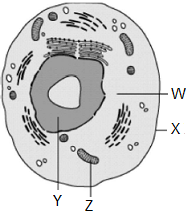
-
25%
a) Helps control the movement of substance in and out of the cell
-
0%
b) Passes information from the parent cell to newly formed cell
-
75%
c) Maintains the proper shape of the cell and serves as a protective barrier
-
0%
d) Helps the cell to make food with the help of chlorophyll and sunlight.
Q.6.
ion Q90) Which of the following pair are correctly matched? (i) Microtubules - Structural components of cilia (ii) Centrioles - Store hydrolytic enzymes. (iii) Amyloplasts - Store oil protein and starch in plants.
-
0%
a) (i), (ii) and (iii).
-
0%
b) (i) and (ii).
-
80%
c) (i) only.
-
20%
d) (i) and (iii).
Q.7.
ion Q91) Smooth endoplasmic reticulum takes part in synthesis of:
-
0%
a) DNA.
-
0%
b) Proteins.
-
60%
c) Lipids and steroids.
-
40%
d) Sugars.
Q.8.
ion Q92) (A) Aleuroplasts stores proteins. (R)Amyloplasts stores starch
-
25%
a) Assertion (A) and Reason (R) both are true and reason (B) is correct explanation of the assertion A.
-
75%
b) Assertion (A) and Reason (R) both are true but reason B is not a correct explanation of the assertion (A)
-
0%
c) Assertion (A) is true but Reason (B) is false.
-
0%
d) Assertion (A) is false but Reason B is true.
Q.9.
ion Q93) Microtubules are the constituents of:
-
0%
a) Centrioles, spindle fibres, chromatin.
-
0%
b) Centrosome, nucleosome, centrioles.
-
50%
c) Cilia, flagella, peroxisomes.
-
50%
d) Spindle fibres, centrioles, cilia.
Q.10.
ion Q94) Both the membranes of mitochondrion are:
-
0%
a) Structurally different but functionally similar.
-
67%
b) Structurally as well as functionally different.
-
0%
c) Structurally similar but functionally different.
-
33%
d) Structurally different but functionally similar.
Q.11.
ion Q95) Which of the following statements are incorrect ? (i) Plant cells have centrioles which are absent in almost all animal cells. (ii) Ribosomes are the site of protein synthesis. (iii) The middle lamella is a layer mainly of calcium carbonate which holds the different neighbouring cells together. (iv) In animal cell, steroidal hormones are synthesized by smooth endoplasmic reticulum. Of the above statements
-
67%
a) (i) and (iii).
-
33%
b) (iii) and (iv).
-
0%
c) (ii) and (iv).
-
0%
d) (i) and (iv).
Q.12.
ion Q96) Which among the following represent a mesokaryotic cell?
-
0%
a) Desmids.
-
0%
b) Desmocapsa.
-
50%
c) Slime moulds.
-
50%
d) Mycoplasma.
Q.13.
ion Q97) Vesicular body containing undigested food materials are:
-
0%
a) Telolysosome.
-
0%
b) Cytolysosome.
-
50%
c) Phagolysosome.
-
50%
d) Heterophagosome.
Q.14.
ion Q98) Mitochondrial Cristae are sites of:
-
0%
a) Breakdown of macromolecules.
-
0%
b) Protein synthesis.
-
33%
c) Phosphorylation of flavoproteins.
-
67%
d) Oxidation and reduction reaction.
Q.15.
ion Q99) Identify the cytoskeleton present in skin:
-
33%
a) Microtubule.
-
0%
b) Microfilaments.
-
67%
c) Intermediate filaments.
-
0%
d) All of these.
Q.16.
Assertion: Transmembrane proteins penetrate through the lipid bilayer. Reason: Extrinsic proteins are loosely bound to lipid bilayer.
-
0%
a) Both Assertion and Reason are true and Reason is the correct explanation of Assertion.
-
50%
b) Both Assertion and Reason are true but Reason is NOT the correct explanation of Assertion.
-
50%
c) Assertion is true but Reason is false.
-
0%
d) Both Assertion and Reason are false.
Q.17.
on Q101) Which of the following is a part of eukaryotic flagella?
-
0%
a) Nexin bridges.
-
50%
b) Protein hub.
-
0%
c) Massulae.
-
50%
d) Astral rays.
Q.18.
Chondriosome refers to:
-
0%
a) Total number of ribosomes in a cell.
-
0%
b) Total number of mitochondria in a cell.
-
100%
c) Broken membranes of ER and golgi bodies.
-
0%
d) Depression in secondary wall.
Q.19.
on Q104) Assertion: Chloroplast is a cell organelle. Reason: An organelle is a distinct part of a cell which has a particular structure and function.
-
100%
a) Both Assertion and Reason are true and Reason is the correct explanation of Assertion.
-
0%
b) Both Assertion and Reason are true but Reason is NOT the correct explanation of Assertion.
-
0%
c) Assertion is true but Reason is false.
-
0%
d) Both Assertion and Reason are false.
Q.20.
on Q105) Desmin and Vimentin are examples of:
-
0%
a) Neurofilaments.
-
0%
b) Cilial filaments.
-
0%
c) Heterogeneous filaments.
-
100%
d) Keratin filaments.
Q.21.
on Q106) Axoneme is present in:
-
50%
a) Centrioles.
-
0%
b) Nucleolus.
-
50%
c) Flagella.
-
0%
d) Mitochondria.
Q.22.
on Q111) Assertion: The fimbriae are elongated tubular structures made of special proteins. Reason: The pili are small bristle like fibres sprouting out of the cell.
-
0%
a) Both Assertion and Reason are true and Reason is the correct explanation of Assertion.
-
100%
b) Both Assertion and Reason are true but Reason is NOT the correct explanation of Assertion.
-
0%
c) Assertion is true but Reason is false.
-
0%
d) Both Assertion and Reason are false.
Q.23.
on Q112) Which of the following statement is correct regarding vacuole?
-
0%
a) It is membrane-bound and contains storage proteins and lipids.
-
50%
b) It is membrane-bound and contains water and excretory substances.
-
50%
c) It lacks membrane and contains air.
-
0%
d) It lacks membrane and contains water and excretory substances.
Q.24.
on Q113) Which of the following statements are correct? (i) In prokaryotic cells, a special membranous structure formed by the extension of the plasma membrane into the cell is known as polysome. (ii) The smooth endoplasmic reticulum is the major site for synthesis of glycoproteins. (iii) RuBisco is the most abundant protein in the whole biosphere. (iv) Mitochondria, chloroplasts and peroxisomes are not considered as part of endomembrane system. Of the above statements:
-
0%
a) (iii) and (iv).
-
50%
b) (i) and (ii)
-
50%
c) (ii) and (iii)
-
0%
d) (i) and (iv).
Q.25.
on Q114) The solid linear cytoskeletal elements having a diameter of 6nm and made up of a single type of monomer are known as:
-
0%
a) Microtubules.
-
0%
b) Microfilaments.
-
50%
c) Intermediate filaments.
-
50%
d) Lamins.
Q.26.
on Q115) Which one of the following is incorrect statement?
-
0%
a) Organisms composed of single cell are unicellular.
-
0%
b) Organisms composed of many cells are multicellular.
-
0%
c) Organisms which are not composed of any cell are acellular.
-
100%
d) Organisms which are composed of single cell is acellular.
Q.27.
on Q116) Which of the following is true about chloroplast?
-
0%
a) One in Chlamydomonas.
-
0%
b) 20-40 in leaf mesophyll cell.
-
50%
c) Present in different shapes.
-
50%
d) All of these.
Q.28.
on Q117) Bacteria possess small DNA other than circular DNA which is called as...
-
0%
a) Cosmid
-
100%
b) Plasmid
-
0%
c) Plastid
-
0%
d) Starid
Q.29.
on Q118) What is the diameter of mitochondrion?
-
0%
a) 0.2-1.0 µm
-
50%
b) 1.0-4.1 µm
-
50%
c) 0.02-0.10 µm
-
0%
d) 1.5-2.5 µm
Q.30.
on Q119) (A)The blue green algae is a prokaryotic. (R)The blue green algae possess 70 s ribosomes.
-
50%
a) Assertion (A) and Reason (R) both are true and reason (B) is correct explanation of the assertion A.
-
50%
b) Assertion (A) and Reason (R) both are true but reason B is not a correct explanation of the assertion (A)
-
0%
c) Assertion (A) is true but Reason (B) is false.
-
0%
d) Assertion (A) is false but Reason B is true.
Q.31.
on Q120) Select the Correct option from Column-I and Column-II
| Column I | Column II |
| P Chloroplast | 1 Single layer structure |
| Q Lysosomes | 2 Double layered |
| R Nucleolus | 3 without membrane |
-
50%
a) (P - 3) (Q - 1) (R - 2)
-
0%
b) (P - 1) (Q - 2) (R - 3)
-
0%
c) (P - 2) (Q - 3) (R - 1)
-
50%
d) (P - 2) (Q - 1) (R - 3)
Q.32.
on Q121) Transformation and recycling of plasma membrane are the functions of:
-
0%
a) Golgi bodies.
-
0%
b) Lysosomes.
-
0%
c) Smooth endoplasmic reticulum.
-
100%
d) Rough endoplasmic reticulum.
Q.33.
on Q122) You are asked to examine a cell using a powerful light microscope. The image you see has a clearly defined nucleus and mitochondria. It also has a large central vacuole and chloroplasts. From what group of organisms did this cell most likely come?
-
0%
a) Bacteria.
-
0%
b) Protists.
-
50%
c) Fungi.
-
50%
d) Plants.
Q.34.
on Q123) Golgi apparatus is absent in:
-
0%
a) Higher plants.
-
0%
b) Yeast.
-
50%
c) Bacteria and blue-green algae.
-
50%
d) None of the above.
Q.35.
on Q124) The figure below shows the structure of a mitochondrion with its four parts labelled (A), (B), (C) and (D). Select the part correctly matched with its function.
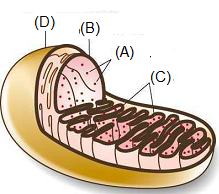
-
50%
a) Part (D): Outer membrane Gives rise to inner membrane by splitting.
-
50%
b) Part (B): Inner membrane Forms infoldings called Cristae.
-
0%
c) Part (C): Cristae Possess single circular DNA molecule and ribosomes.
-
0%
d) Part (A): Matrix Major site for respiratory chain enzymes.
Q.36.
on Q125) Balbiani rings are:
-
0%
a) Seen on lampbrush chromosome and are the site of r-RNA synthesis.
-
0%
b) Seen on polytene chromosomes and are the site of r - RNA and protein synthesis.
-
50%
c) Seen on salivary gland chromosomes and are the site of lipid and protein synthesis.
-
50%
d) Seen on both lampbrush and salivary gland chromosomes and are the site of protein synthesis.
Q.37.
on Q126) Pericentriolar matrix seen around centrioles is:
-
50%
a) Kinoplasm.
-
0%
b) Diplosome.
-
0%
c) Axoneme.
-
50%
d) Blepharoplast.
Q.38.
on Q127) Palade particles are:
-
50%
a) Ribosomes.
-
0%
b) Microbodies.
-
0%
c) Lysosomes.
-
50%
d) Dictyosomes.
Q.39.
on Q128) In which of the following would to expect to find Glyoxysomes?
-
0%
a) Endosperm of wheat.
-
50%
b) Root hairs.
-
0%
c) Endosperm of castor.
-
50%
d) Palisade cells of leaf.
Q.40.
on Q129) Assertion: Lysosomes are capable of digesting carbohydrates, proteins, lipids and nucleic acids. Reason: Lysosomes are rich in hydrolytic enzymes like carbohydrases, proteases, lipases and nucleases.
-
100%
a) Both Assertion and Reason are true and Reason is the correct explanation of Assertion.
-
0%
b) Both Assertion and Reason are true but Reason is NOT the correct explanation of Assertion.
-
0%
c) Assertion is true but Reason is false.
-
0%
d) Both Assertion and Reason are false.
Q.41.
on Q130) Cell structure of bacteria responsible for cellular respiration, DNA replication and cell wall formation is:
-
50%
a) Plasmid.
-
0%
b) Fimbriae.
-
50%
c) Chondroid.
-
0%
d) Chromatophores.
Q.42.
on Q131) Microtubules, motor proteins, and actin filaments are all part of the:
-
0%
a) Mechanism of photosynthesis that occurs in chloroplasts.
-
0%
b) Rough ER in prokaryotic cells.
-
50%
c) Cytoskeleton of eukaryotic cells.
-
50%
d) Process that moves small molecules across cell membranes.
Q.43.
on Q132) The following diagram shows some of the missing structures in a plant cell marked as A, B, C, D E. Choose the option with their correct names.
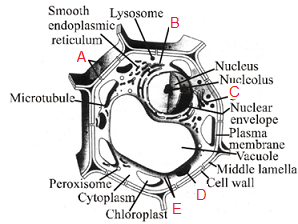
-
33%
a) A - Plasmodesmata, B - Rough endoplasmic reticulum, C - Golgi apparatus, D - Mitochondrion, E - Ribosomes
-
67%
b) A - Desmosomes, B - Rough endoplasmic reticulum, C - Golgi apparatus, D - Mitochondrion, E - Ribosomes
-
0%
c) A - Plasmodesmata, B - Smooth endoplasmic reticulum, C - Golgi apparatus, D - Mitochondrion, E - Ribosomes
-
0%
d) A - Tight junction, B - Rough endoplasmic reticulum, C - Golgi apparatus, D - Mitochondrion, E -Ribosomes
Q.44.
on Q133) Which of the following terms is not correctly matched with its feature?
-
0%
a) Osmosis Movement of water by diffusion.
-
0%
b) Nucleoplasm Site of active synthesis of ribosomal RNA.
-
50%
c) Mesosome Infolding of cell membrane and characteristics of eukaryotes.
-
50%
d) Pili Elongated tubular surface structures (made of special protein) of bacteria.
Q.45.
on Q134) Match column-I and column-II and select the correct answer
| Column I | Column II |
| A. Bacteria without walls | Lysosome |
| B. Small circular DNA | Mycoplasma cells |
| C. Flattened sacs in | Thylakoid a chloroplast |
| D. A vesicle in which | Plasmid hydrolytic enzymes are stored |
-
0%
a) A= 3 ; B = 4 ; C=2 ; D=1
-
100%
b) A= 2 ; B = 4 ; C=3 ; D=1
-
0%
c) A= 1 ; B = 2 ; C=3 ; D=4
-
0%
d) A= 4 ; B = 3 ; C=1; D=2
Q.46.
on Q135) Which of the following is true for lysosomes? (i) Polymorphic organelles. (ii) Single membrane bounded and different vitamins, testosterone and progesterone are the membrane labilizers that increase the chance of autolysis. (iii) Number of lysosomes are maximum and found in the flight muscles of birds. (iv) Hydrolytic enzymes actively functional at acidic pH 5.
-
0%
a) Both (i) and (iii)
-
50%
b) (iii) only.
-
0%
c) (i), (ii) and (iv).
-
50%
d) (iv) only.
Q.47.
on Q136) Many cells function properly and divide mitotically even though they do not have:
-
0%
a) Plasma membrane.
-
100%
b) Cytoskeleton.
-
0%
c) Mitochondria.
-
0%
d) Plastids.
Q.48.
on Q137) Which of the following is the fundamental characteristics of cell membrane?
-
0%
a) Amino acid regulation.
-
0%
b) Fat regulation.
-
0%
c) Glucose regulation.
-
100%
d) Ion regulation.
Q.49.
on Q138) In prokaryotes, Chromatophores are:
-
0%
a) Specialized granules responsible for colouration of cells.
-
0%
b) Structures responsible for organizing the shape of the organism.
-
0%
c) Inclusion bodies lying free inside the cells for carrying out various metabolic activities.
-
100%
d) Internal membrane system which becomes extensive and complex in photosynthetic bacteria.
Q.50.
on Q139) Which of the following statements is/are correct? (i) The shape of the cells may vary with the function they perform. (ii) Human RBC is about 7.0 µm in diameter. (iii) Cytoplasm is the main area of cellular activities. (iv) Various chemical reactions occur in cytoplasm to keep the cell in the living state.
-
100%
a) (i), (ii), (iii) and (iv).
-
0%
b) Only (i) and (ii).
-
0%
c) Only (iv).
-
0%
d) None of the above.