Q.1.
on Q343) Which one of the following combination is mismatched?
-
50%
a) Glycocalyx - May be capsule or slime layer.
-
0%
b) Pili - Reproduction.
-
50%
c) Cell wall - Protective, determines shape, prevents from bursting.
-
0%
d) Flagella, pili and fimbriae - Surface structures of bacterial cell.
Q.2.
on Q344) Point out the contribution of Singer and Nicolson:
-
0%
a) First explained that cells divide and new cells are formed from pre existing cells.
-
0%
b) Formulated the cell theory.
-
100%
c) Discovered nucleus.
-
0%
d) Proposed the fluid mosaic model of cell membrane.
Q.3.
on Q345) Which of the following statements regarding mitochondrial membrane is not correct?
-
50%
a) The inner membrane is highly convoluted forming a series of infoldings.
-
50%
b) The outer membrane resembles a sieve.
-
0%
c) The outer membrane is permeable to all kinds of molecules.
-
0%
d) The enzymes of the electron transport chain are embedded in the outer membrane.
Q.4.
on Q346) According to fluid mosaic model of cell membrane the quasi fluid nature of lipids:
-
0%
a) Enables lateral movement of proteins within the overall bilayer.
-
0%
b) Inhibits the lateral movement of proteins within the layer.
-
100%
c) Describes the arrangement of lipids in the membrane.
-
0%
d) Describes the arrangement of proteins in the membrane.
Q.5.
on Q347) Assertion: A cell membrane shows fluid behaviour. Reason: A membrane is a mosaic or composite of diverse lipids and proteins.
-
67%
a) Both Assertion and Reason are true and Reason is the correct explanation of Assertion.
-
0%
b) Both Assertion and Reason are true but Reason is NOT the correct explanation of Assertion.
-
0%
c) Assertion is true but Reason is false.
-
33%
d) Both Assertion and Reason are false.
Q.6.
on Q348) 80S ribosomes are seen in:
-
0%
a) Mitochondrial matrix.
-
0%
b) Membranes of ER.
-
0%
c) Stroma of chloroplast.
-
100%
d) Bacterial cytoplasm.
Q.7.
on Q349) Cell membranes possess lipids, proteins and carbohydrates. The ratio of proteins and lipids varies considerably in different cell types. In human beings, the membrane of the RBCs has approximately:
-
0%
a) 40% lipids and 52% carbohydrates.
-
50%
b) 40% proteins and 52% lipids.
-
0%
c) 40% lipids and 52% proteins.
-
50%
d) 40% carbohydrates and 52% lipids.
Q.8.
on Q350) Which of the following statements are true regarding mitochondria? (i) Reproduce by binary fission method. (ii) Mitochondria are stained by Janus green B. (iii) Largest cell organelle in animal cell. (iv) Mitochondrial matrix possesses enzymes for Kreb's cycle and protein synthesis.
-
0%
a) All except (i).
-
0%
b) All expect (iii).
-
100%
c) All except (iv).
-
0%
d) All are true.
Q.9.
on Q351) Consider the following statements: (i) Nucleonema is a part of nucleolus. (ii) Nucleus controls the activity of cytoplasm by sending enzymes, hormones, RNA and cAMP. (iii) Nucleolus is formed by secondary constriction. (iv) Chromatin is made up of nucleoprotein. Of the above statements:
-
0%
a) All except (iv) are false.
-
100%
b) All except (ii) are true.
-
0%
c) Only (iii) is false.
-
0%
d) (i) and (iv) are true but (ii) and (iii) are false.
Q.10.
on Q352) The telomeres of eukaryotic chromosomes consist of short sequences of:
-
0%
a) Cytosine rich repeats.
-
0%
b) Adenine rich repeats.
-
0%
c) Guanine rich repeats.
-
100%
d) Thymine rich repeats.
Q.11.
on Q353) How many of the following sentences are true? (i) Three membrane bound structures is related to chloroplast. (ii) ER acts as an exoskeleton and gives support to cytoplasm. (iii) Chondriosomes are the total number of mitochondria of a cell. (iv) H1 histone proteins are rich in arginine. (v) Hemicellulose is more abundant in primary wall.
-
100%
a) 2.
-
0%
b) 3.
-
0%
c) 4.
-
0%
d) 5.
Q.12.
on Q354) Outer and inner mitochondrial membrane are:
-
0%
a) Structurally and functionally similar.
-
0%
b) Structurally and functionally different.
-
0%
c) Structurally similar but functionally different.
-
100%
d) Structurally different but functionally similar.
Q.13.
on Q355) A cell organelle 'X' is divided into two types based on the presence or absence of another cell organelle 'Y' that helps in the protein synthesis. Identify 'X' and 'Y':
-
0%
a) Golgi complex and ribosomes.
-
100%
b) Lysosomes and ribosomes.
-
0%
c) Endoplasmic reticulum and ribosomes.
-
0%
d) Chloroplast and thylakoids.
Q.14.
on Q356) A Centriole-like structure, from which the cilium and the flagellum emerge, is the:
-
0%
a) Centrosome.
-
0%
b) Basal body.
-
0%
c) Axoneme.
-
100%
d) Vimentin.
Q.15.
on Q357) Chromatophores are:
-
0%
a) Present in lipo-polysaccharide layer of gram negative bacteria.
-
0%
b) Coloured pigments present in fluorescent bacteria.
-
0%
c) Vesicles that store pigments in prokaryotic cells.
-
100%
d) Extensions on membrane in cyanobacteria
Q.16.
on Q358) Which of the following lacks cell wall?
-
0%
a) Gametes.
-
0%
b) Amoeba.
-
100%
c) Mycoplasma.
-
0%
d) All of these.
Q.17.
on Q359) The given diagram shows the types of chromosomes (labelled as A, B, C & D) based on the position of Centromere. Which one is the correct option for the labelled chromosomes. A, B, C and D ?
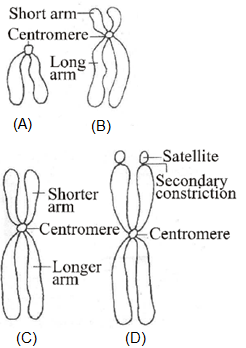
-
100%
a) A Telocentric chromosome, B Acrocentric chromosome, C Submetacentric chromosome, D Metacentric chromosome
-
0%
b) A Acrocentric chromosome, B Telocentric chromosome, C Metacentric chromosome, D Submetacentric chromosome
-
0%
c) A Submetacentric chromosome, B Metacentric chromosome, C Telocentric chromosome, D Acrocentric chromosome
-
0%
d) A Metacentric chromosome, B Submetacentric chromosome, C Acrocentric chromosome, D Telocentric chromosome.
Q.18.
on Q360) Basal bodies of eukaryotic cilia and flagella are derived from:
-
0%
a) Plasma membrane.
-
0%
b) Centrioles.
-
100%
c) Lysosomes.
-
0%
d) Golgi complex.
Q.19.
on Q361) Given below are some characters of a cell organelle. Identify the correct organelle which shows all the characters described below: (i) It is a membrane bound space found in the cytoplasm. (ii) It is bound by a single membrane called tonoplast. (iii) It contains water, sap, excretory products and other materials not useful to the cell. (iv) It has higher concentration of sap than the cytoplasm.
-
0%
a) Golgi apparatus.
-
100%
b) Lysosomes.
-
0%
c) Endoplasmic reticulum.
-
0%
d) Vacuoles.
Q.20.
on Q362) Which of the following is incorrect regarding centrioles?
-
0%
a) Both the centrioles in a Centrosome lie perpendicular to each other.
-
0%
b) Each Centriole has an organisation like that of cart wheel.
-
0%
c) Central proteinaceous hub is missing in a centriole.
-
0%
d) Centrosome usually contains two cylindrical centrioles.
Q.21.
on Q363) Indicate the increasing order of size:
-
0%
a) Lysosome, ribosome, mitochondria, chloroplast.
-
0%
b) Ribosome, lysosome, chloroplast, mitochondria.
-
0%
c) Ribosome, lysosome, mitochondria, chloroplast.
-
0%
d) Mitochondria, chloroplast, ribosome, lysosome.
Q.22.
on Q364) Consider the following statements: (i) Mesosomes are very prominent in gram +ve bacteria. (ii) Chromatophores are present only in photosynthetic prokaryotes. (iii) Fimbriae are arising from plasma membrane. (iv) During protein synthesis, ribosomes units are held together by manganese ions. (v) In golgi bodies, the cis face represents the concave surface of Cisternae.
-
0%
a) (i), (iii) and (iv) are false but (ii) and (v) are true.
-
0%
b) (iv) and (v) are false but (i), (ii) and (iii) are true.
-
0%
c) (iii) and (v) are true but (i), (ii) and (iv) are false.
-
0%
d) (iii), (iv) and (v) are false but (i) and (ii) are true.
Q.23.
on Q365) Find out the mismatched pair:
-
0%
a) Robert Brown - Nucleus.
-
0%
b) Dujardine - Sarcode.
-
0%
c) Purkinje - Protoplasm.
-
0%
d) Rudolf Virchow - Protoplasm theory.
Q.24.
on Q366) The hydrophilic part of plasma membrane is:
-
0%
a) Polar end.
-
0%
b) Non polar end.
-
0%
c) Globular end.
-
0%
d) Lipid layer.
Q.25.
on Q367) Consider the following statements regarding bacterial flagellum: (i) In bacteria, flagella are arising from plasma membrane. (ii) No definite arrangement of fibrils. (iii) Distal rings are absent in Gram +ve bacteria. (iv) Made of flagellin protein.
-
0%
a) Only (i) is false.
-
0%
b) Only (iii) is false.
-
0%
c) (i), (ii) and (iii) are false while (iv) is true.
-
0%
d) All the statements are true.
Q.26.
on Q368) Which cell organelle is considered as plant lysosome?
-
0%
a) Lysosomes.
-
0%
b) Peroxisomes.
-
0%
c) Sphaerosomes.
-
0%
d) Ribosomes.
Q.27.
on Q369) How many of the following statements are true regarding karyotype analysis? (i) Karyotype includes the number of chromosomes, relative size, position of centromere, length of the arms and secondary constrictions. (ii) Diagrammatic representation of karyotype is called idiogram. (iii) Suggests primitive or advanced features of an organism. (iv) The karyotype of different species are compared and similarities in them represent the evolutionary relationships. (v) Helpful in detection of chromosomal aberrations and polyploidy.
-
0%
a) One.
-
0%
b) Three.
-
0%
c) Four.
-
0%
d) Five.
Q.28.
on Q370) Assertion: In plants, cell wall is made up of cellulose, hemicellulose and pectin. Reason: A cell wall is impermeable.
-
0%
a) Both Assertion and Reason are true and Reason is the correct explanation of Assertion.
-
0%
b) Both Assertion and Reason are true but Reason is NOT the correct explanation of Assertion.
-
0%
c) Assertion is true but Reason is false.
-
0%
d) Both Assertion and Reason are false.
Q.29.
on Q371) Which sentence is correctly explained?
-
0%
a) Nucleolus is formed of secondary constricted region.
-
0%
b) DNA is a homopolymer.
-
0%
c) Giant chromosomes resulted by nuclear division without replication of DNA.
-
0%
d) Centrosomes are found in plants and lower animals.
Q.30.
on Q372) In mitochondria, it contains F-particles.
-
0%
a) Matrix
-
0%
b) Cristae
-
0%
c) Outer layer
-
0%
d) All of the above
Q.31.
on Q373) In some of Bacteria the outer-most layer is a loose sheath layer called as....
-
0%
a) Slime layer
-
0%
b) Capsule
-
0%
c) Cell membrane
-
0%
d) Glycocalyx
Q.32.
on Q374) Which plastids possess chlorophyll pigments?
-
0%
a) Chloroplast
-
0%
b) Xanthophyllous
-
0%
c) Anthocyanin
-
0%
d) Carotene
Q.33.
on Q375) (A) Cilia and Flagella possess 9+2 arrangement. (R)Centrosome possess 9+0 arrangement.
-
0%
a) Assertion (A) and Reason (R) both are true and reason (B) is correct explanation of the assertion A.
-
0%
b) Assertion (A) and Reason (R) both are true but reason B is not a correct explanation of the assertion (A)
-
0%
c) Assertion (A) is true but Reason (B) is false.
-
0%
d) Assertion (A) is false but Reason B is true.
Q.34.
on Q376) Select the Correct option from Cloumn-I and Column-II
| Column I | Column II |
| P Robert Hook | 1 Cell theory |
| Q Robert Brown | 2 Golgi apparats |
| R Schieiden | 3 Cell |
| S Camilo Golgi | 4 Nucleus |
-
0%
a) (P - 3) (Q - 4) (R - 1) (S - 2)
-
0%
b) (P - 1) (Q - 2) (R - 4) (S - 3)
-
0%
c) (P - 2) (Q - 1) (R - 3) (S - 4)
-
0%
d) (P - 4) (Q - 2) (R - 1) (S - 3)
Q.35.
on Q377) It directs formation of the bipolar spindle during cell division.
-
0%
a) Golgi body
-
0%
b) Centriole
-
0%
c) Ribosome
-
0%
d) Cilia
Q.36.
on Q378) Select the wrong statement from the following:
-
0%
a) Both chloroplasts and mitochondria contain an inner and an outer membrane.
-
0%
b) Both chloroplasts and mitochondria have an internal compartment, the thylakoid space bounded by the thylakoid membrane.
-
0%
c) Both chloroplasts and mitochondria contain DNA.
-
0%
d) The chloroplasts are generally much larger than mitochondria.
Q.37.
on Q379) Under which of the following conditions would you expect to find a cell with a predominance of free ribosomes?
-
0%
a) A cell that is secreting proteins.
-
0%
b) A cell that is producing cytoplasmic enzymes.
-
0%
c) A cell that is constructing its cell wall or extracellular matrix.
-
0%
d) A cell that is digesting food particles.
Q.38.
on Q380) Mesosomes in prokaryotes do not help in:
-
0%
a) Cell wall formation.
-
0%
b) DNA replication.
-
0%
c) Respiration.
-
0%
d) Photosynthesis.
Q.39.
on Q381) Which one of the following cellular part is correctly described?
-
0%
a) Ribosomes - Those on chloroplasts are larger (80S) while those in the cytoplasm are smaller (70S).
-
0%
b) Centrioles - Sites for active RNA synthesis.
-
0%
c) Lysosomes - Optimally active at a pH of about 8.5.
-
0%
d) Thylakoid - Flattened membranous sacs forming the grana of chloroplasts.
Q.40.
on Q382) With regard to plant cell wall, how many molecules of glucose are present in a single cellulose fibril?
-
0%
a) 250.
-
0%
b) 6000.
-
0%
c) 60000.
-
0%
d) 600.
Q.41.
on Q383) At which pH lysosomal enzymes remain active:
-
0%
a) pH - 5.
-
0%
b) pH - 7.
-
0%
c) pH - 8.
-
0%
d) pH - 10.
Q.42.
on Q384) The power house of cell:
-
0%
a) Is bound by a single membrane.
-
0%
b) Possess Cristae by a single membrane.
-
0%
c) Are sites for formation of energy currency of the cell.
-
0%
d) Is found in eukaryotic and prokaryotic cells.
Q.43.
on Q419) The diagram given below represents a fluid mosaic model of plasma membrane. Match the components marked as A, B, C, D and E in the diagram below from the list (i) to (vii). (i) Sugar. (ii) Protein. (iii) Lipid bilayer. (iv) Integral protein. (v) Cytoplasm. (vii) Cell wall. (viii) External protein.
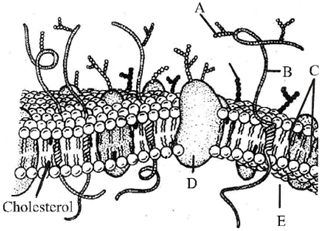
-
0%
a) A - (i), B - (ii), C - (iii), D - (iv), E - (v)
-
0%
b) A - (ii), B - (i), C - (iii), D - (iv), E - (v)
-
0%
c) A - (i), B - (ii), C - (iii), D - (iv), E - (vi)
-
0%
d) A - (i), B - (ii), C - (iii), D - (vii), E - (v).
Q.44.
on Q385) Some cellular structures are bound by single or double membrane while some others are without a membrane. Match the organelles in List I with the nature of membrane in List II and select the answer using the code from the list given below:
| Column I | Column II |
| a. Mitochondria | Without membranes |
| b. Lysosomes | Single membrane |
| c. Ribosomes | Double membrane |
| d. Nucleus | |
| e. Centrioles | |
| f. Golgi bodies | |
-
0%
a) a -1 ;b - 2 ; c - 3 ; d -2 ; e -1 ;f - 2
-
0%
b) a -3 ;b - 1 ; c - 2 ; d -1 ; e -2 ;f - 1
-
0%
c) a -3 ;b - 2 ; c - 1 ; d -3 ; e -1 ;f - 2
-
0%
d) a -2 ;b - 3 ; c - 1 ; d -3 ; e -1 ;f - 3
Q.45.
on Q386) Mitochondria and chloroplast are believed to be bacterial endosymbiont because: I. They have self nucleic acid i.e., circular ds, DNA and RNAs. II. 70s ribosomes. III. Their membrane resembles that of bacteria, having pore proteins. IV. ETS and ATP forming machinery is present.
-
0%
a) I and II.
-
0%
b) I, II and III.
-
0%
c) I and IV.
-
0%
d) All statements
Q.46.
on Q387) Which of the following are common to plant cell and animal cell? Peroxisomes, nucleolus, lysosome, plasmodesmata, microvilli, microtubule
-
0%
a) 6
-
0%
b) 5
-
0%
c) 4
-
0%
d) 3
Q.47.
on Q388) Vesicles from the ER fuse with the ........... of the golgi apparatus and move towards the .............
-
0%
a) trans face, cis face.
-
0%
b) Maturing face, cis face.
-
0%
c) Maturing face, trans face.
-
0%
d) cis face, maturing face.
Q.48.
on Q389) The membrane of Endoplasmic reticulum remains continuous with the membranes of:
-
0%
a) Plasma membrane and lysosome.
-
0%
b) Golgi complex and plastids.
-
0%
c) Nuclear membrane and cell membrane.
-
0%
d) Golgi complex and vacuoles.
Q.49.
on Q390) Find the mismatched pair:
-
0%
a) Suberin - Root endodermis.
-
0%
b) Callose - Lenticels of bark.
-
0%
c) Algin - Brown algae.
-
0%
d) Lignin - Xylem fibres.
Q.50.
on Q391) Assertion: Middle lamella is mainly made of magnesium pectate and minority of calcium pectate. Reason: Middle lamella is absent in collenchymatous tissue.
-
0%
a) Both Assertion and Reason are true and Reason is the correct explanation of Assertion.
-
0%
b) Both Assertion and Reason are true but Reason is NOT the correct explanation of Assertion.
-
0%
c) Assertion is true but Reason is false.
-
0%
d) Both Assertion and Reason are false.