Q.1.
In relation to Gross primary productivity and Net primary productivity of an ecosystem, which one of the following statements is correct? [NEET 2020]
-
17%
a) Gross primary productivity and Net primary productivity are one and same
-
13%
b) There is no relationship between Gross primary productivity and Net primary productivity
-
22%
c) Gross primary productivity is always less than net primary productivity
-
48%
d) Gross primary productivity is always more than net primary productivity
Q.2.
Which of the following is the most important cause for animals and plants being driven to extinction? [NEET 2019]
-
56%
a) Habitat loss and fragmentation
-
13%
b) Drought and floods
-
20%
c) Economic exploitation
-
11%
d) Alien species invasion
Q.3.
Which of the following ecological pyramids is generally inverted? [NEET 2019]
-
17%
a) Pyramid of numbers in grassland
-
22%
b) Pyramid of energy
-
25%
c) Pyramid of biomass in a forest
-
35%
d) Pyramid of biomass in a sea
Explanation
Q.4.
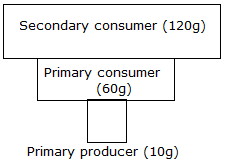
What type of ecological pyramid would be obtained with the following data ? Secondary consumer : 120 g Primary consumer : 60 g Primary producer : 10 g [NEET 2018]
-
18%
a) Upright pyramid of numbers
-
22%
b) Pyramid of energy
-
47%
c) Inverted pyramid of biomass
-
13%
d) Upright pyramid of biomass
Explanation
Q.5.
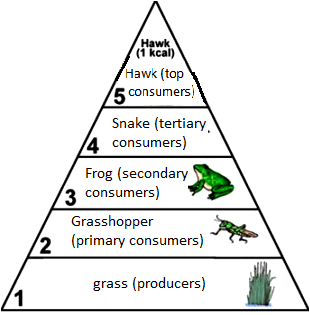
Which one is the correct food chain? .... .... [A.I.I.M.S.1996]
-
9%
a) Eagle → snake → grasshopper → grass → frog
-
8%
b) Frog → snake → eagle → grasshopper → grass
-
7%
c) Grasshopper → grass → snake → frog → eagle
-
75%
d) Grass → grasshopper → frog → snake → eagle
Explanation
Q.6.
Match the trophic levels with their correct species examples in grassland ecosystem. .... .. [NEET 2020] Select the correct option
| (a) Fourth trophic level | (i) Crow |
| (b) Second trophic level | (ii) Vulture |
| (c) First trophic level | (iii) Rabbit |
| (d) Third trophic level | (iv) Grass |
-
23%
a) a → iv; b → iii; c → ii; d → i;
-
19%
b) a → i; b → ii; c → iii; d → iv;
-
52%
c) a → ii; b → iii; c → iv; d → i;
-
6%
d) a → iii; b → ii; c → i; d → iv;
Q.7.
Wildlife is destroyed most when .... .... [C.B.S. E. 1994]
-
8%
a) There is lack of proper care
-
26%
b) Mass scale hunting for foreign trade
-
54%
c) Its natural habitat is destroyed
-
12%
d) Natural calamity
Q.8.
Maximum human population can be supported if all the humans are .... .... [C.P.M.T.1981]
-
20%
a) Carnivores
-
25%
b) Pure vegetarian
-
22%
c) Vegetarian along with use of milk
-
33%
d) Vegetarian alongwith use of milk and eggs
Q.9.
ASSERTION: A network of food chains existing together in an ecosystem is known as a food web. REASON: An animal like kite cannot be part of a food web` A.I.I.M.S.2006
-
16%
a) Both Assertion and Reason are true and Reason is the correct explanation of Assertion
-
31%
b) The Assertion and Reason are true but Reason is not correct explanation of Assertion
-
45%
c) Assertion is true but, Reason is false
-
8%
d) Assertion is false but, Reason is true
Q.10.
Dominant plants of cold desert are .... .... [Guj .C.E.T. 2007]
-
20%
a) Tall trees and herbaceous plants
-
23%
b) Low stature shrubs and herbaceous plants
-
43%
c) Shrubs and small trees
-
14%
d) Low stature shrubs and perennial grasses
Q.11.
If all the plants are to die, all the animals will also die due to deficiency of .... .... [A.F.M.C.1989]
-
41%
a) Food
-
12%
b) Carbon dioxide
-
46%
c) Oxygen
-
1%
d) Timber
Q.12.
Each successive trophic level has .... ..... [B.H.U.2002]
-
60%
a) Less total energy
-
20%
b) More total energy
-
17%
c) Increased total energy
-
3%
d) Non- estimated energy contents
Q.13.
Sunderbans contain mainly .... .... [Har.PM.T. 2005]
-
17%
a) Alpine trees
-
65%
b) Mangrove plants
-
11%
c) Grass
-
7%
d) Fir forests
Q.14.
It is not a protected forest .... .... [C.B.S.E. 2008]
-
13%
a) Reserve forest
-
15%
b)Sanctuary
-
24%
c) Core of biosphere
-
49%
d) Orchard
Q.15.
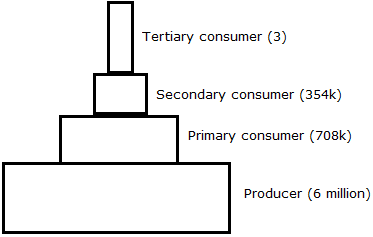
In grassland ecosystem, the number of primary producers is about 6 million. The number of top carnivore supported by it would be .... ..... [A.M.U.2009]
-
16%
a) 60 million
-
23%
b) 30 million
-
20%
c) 6 million
-
41%
d) 3
Explanation
Q.16.
Energy transfer from organisms to organism in a natural community develops .... .... [M.P.P.M.T.1999]
-
11%
a) Biological control
-
69%
b) Food chain
-
5%
c) Natural barriers
-
15%
d) Food web
Q.17.
Biomass produced by plants in oceans accounts for .... .... [A.M.U. 1992]
-
19%
a) 85%
-
36%
b) 75%
-
19%
c) 65%
-
26%
d) 55%
Q.18.
Phytoplankton are dominant in .... .... [D.P.M.T.2007]
-
23%
a) Limnetic zone
-
25%
b) Profundal zone
-
21%
c) Littoral zone
-
31%
d) Benthic zone
Q.19.
Antimalarial drug quinine is got from Manipur 2009
-
66%
a) Bark of Cinchona
-
15%
b) Root of Cycas
-
12%
c) Stem of Mango
-
7%
d) None
Q.20.
Forest which is never leafless .... .... [Guj.C.E.T. 2010]
-
33%
a) Tropical deciduous forest
-
52%
b) Tropical forest
-
9%
c) Temperate deciduous forest
-
7%
d) Temperate forest
Q.21.
An organisms contains carbon molecules which have passed through three levels of ecosystem, the organisms is .... .... [Odisha 2008]
-
12%
a) Priamry consumer
-
12%
b) Secondary consumer
-
31%
c) Producer
-
44%
d) Tertiary consumer
Explanation
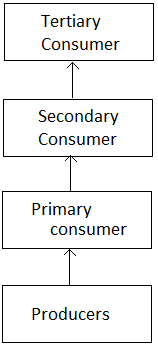
Q.22.
Ecological efficiency is .... .... [Kerala 2009]
-
18%
a) Food primary assimilated/food energy ingested × 100
-
18%
b) Gross primary productivity/ incident total solar radiation × 100
-
28%
c) Volume of CO2 evolved/volume of O2 consumed
-
38%
d) Energy in biomass production at a trophic level/energy in biomass production at previous trophic level × 100
Q.23.
Lime is added to soil which is .... .... [D.P.M.T. 2009]
-
10%
a) Sandy
-
36%
b) Alkaline
-
50%
c) Acidic
-
5%
d) Salty
Q.24.
Land mass occupied by forest is about .... .... [C.B.S.E. 1999]
-
19%
a) 11%
-
29%
b) 22%
-
29%
c) 30%
-
24%
d) 60%
Q.25.
In nitrification ammonia is first oxidized to nitrite by .... .... [H.P.P.M.T. 2010]
-
29%
a) Nitrosomonas and nitrosococcus
-
53%
b) Nitrosomonas and nitrobacter
-
12%
c) Pseudomonas and nitrosococus
-
6%
d) Pseudomonas and thiobacillus
Q.26.
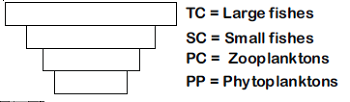
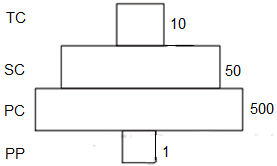
In the pyramid of numbers find out the correct possibilities .... .... [C.B.S.E. 2012]
-
24%
a) Level PC is rat and level SC is cats
-
24%
b) Level PP is pipal tree and level SC is sheep
-
19%
c) Level PP is phytoplankton in sea and level Tc is Whale
-
32%
d) Level PC is insects and level SC is small insectivorous birds
Q.27.
Decomposers of an ecosystem include .... .... [Kerala 2004]
-
8%
a) Microscopic animals
-
17%
b) Bacteria and fungi
-
53%
c) Both A and B
-
22%
d) Bacteria, fungi and macroscopic animals
Q.28.
Fertility of soil is measured by its ability to .... .... [ C.B.S.E. 1992]
-
29%
a) Retain nutrients
-
32%
b) Hold organic materials
-
18%
c) Hold water
-
21%
d) Support life
Q.29.
Which of the following is present in maximum amount in atmosphere? .... .... [D.P.M.T.2002]
-
14%
a) Oxygen
-
61%
b) Nitrogen
-
19%
c) Carbon dioxide
-
6%
d) Hydrogen
Q.30.
Jhoom cultivation refers to ..... ..... [Pb P.M.T. 1998]
-
14%
a) Cultivation of Jamun trees
-
32%
b)Cultivation of medicinal plants by tribes
-
45%
c) Tribal method of shifting cultivation
-
9%
d) Cultivation of terraces