Q.1.
Which of the following process helps in nutrient conservation?
-
25%
a) Mineralisation
-
25%
b) Immobilisation
-
0%
c) Leaching
-
50%
d) Nitrification
Q.2.
Given below is a simplified model of phosphorus cycling in a terrestrial ecosystem with four blanks (A-D). Identify the blanks.... [AIPMT 2014]
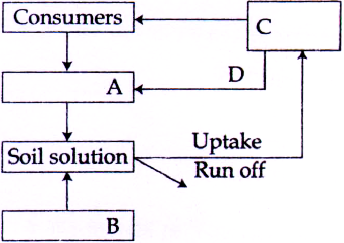
-
20%
a) A: Detritus; B: Rock minerals; C: Producer; D: Litter fall
-
60%
b) A:Producers; B: Litter fall C: Rock minerals; D:Detritus
-
20%
c) A: Rock minerals; B:Detritus; C: Litter fall; D:Producers
-
0%
d) A:Litter fall; B: Producers; C:Rock minerals; D:Detritus
Q.3.
In an ecosystem the rate of production of organic matter during photosynthesis is termed as : …[AIPMT 2015]
-
17%
a) Net productivity
-
17%
b) Net primary productivity
-
50%
c) Gross primary productivity
-
17%
d) Secondary productivity
Q.4.
Secondary Succession takes place on/in : …[AIPMT 2015]
-
40%
a) Newly cooled lava
-
0%
b) Bare rock
-
40%
c) Degraded forest
-
20%
d) Newly created pond
Q.5.
The mass of living material at a trophic level at a particular time is called : …[AIPMT 2015]
-
33%
a) Standing crop
-
17%
b) Gross primary productivity
-
17%
c) Standing state
-
33%
d) Net primary productivity
Q.6.
A system of rotating crops with legume or grass pasture to improve soil structure and fertility is called:- …[AIPMT-2016]
-
0%
a) Ley farming
-
40%
b) Contour farming
-
0%
c) Strip farming
-
60%
d) Shifting agriculture
Q.7.
Which of the following is a characteristic feature of cropland ecosystem ? …[AIPMT-2016]
-
40%
a) Absence of soil organisms
-
0%
b) Least genetic diversity
-
40%
c) Absence of weeds
-
20%
d) Ecological succession
Q.8.
The term ecosystem was coined by …[AIPMT-2016]
-
20%
a) E.P. Odum
-
40%
b) A.G. Tansley
-
20%
c) E. Haeckel
-
20%
d) E. Warming
Q.9.
Which of the following would appear as the pioneer organisms on bare rocks? …[AIPMT-2016]
-
40%
a) Lichens
-
20%
b) Liverworts
-
40%
c) Mosses
-
0%
d) Green algae
Q.10.
Natural reservoir of phosphorus is …[NEET 2013]
-
25%
a) Sea water
-
25%
b) Animal bones
-
25%
c) Rock
-
25%
d) Fossils
Q.11.
Which one of the following processes during decomposition is correctly described?... [NEET 2013]
-
33%
a) Fragmentation - Carried out by organisms such as earthworm
-
67%
b) Humification - Leads to the accumulation of a dark coloured substance humus which undergoes microbial action at a very fast rate
-
0%
c) Catabolism - Last step in the decomposition under fully anaerobic condition
-
0%
d) Leaching - Water soluble inorganic nutrients rise to the top layers of soil
Q.12.
The primary producers of the deep-sea hydrothermal vent ecosystem are ...
-
67%
a) Blue-green algae
-
33%
b) Coral reefs
-
0%
c) Green algae
-
0%
d) Chemosynthetic bacteria
Q.13.
Which ecosystem has the maximum biomass? ….[NEET- 2017]
-
67%
a) Forest ecosystem
-
33%
b) Grassland ecosystem
-
0%
c) Pond ecosystem
-
0%
d) Lake ecosystem
Q.14.
Presence of plants arranged into well defined vertical layers depending on their height can be seen best in : ….[NEET- 2017]
-
0%
a) Tropical Savannah
-
67%
b) Tropical Rain Forest
-
0%
c) Grassland
-
33%
d) Temperate Forest
Q.15.
ost animals that live in deep oceanic waters are... [ ReAIPMT 2015]
-
33%
a) Detritivores
-
33%
b) Primary consumers
-
33%
c) Secondary consumers
-
0%
d) Tertiary consumers
Q.16.
An association of individuals of different species living in the same habitat and having functional interactions is... [ ReAIPMT 2015]
-
100%
a) Population
-
0%
b) Ecological niche
-
0%
c) Biotic community
-
0%
d) Ecosystem
Q.17.
In which of the following both pairs have correct combination ... [ ReAIPMT 2015]
-
67%
a) Gaseous nutrient cycle → Sulphur and Phosphorus Sedimentary nutrient cycle → Carbon and Nitrogen
-
0%
b) Gaseous nutrient cycle → Carbon and Nitrogen Sedimentary nutrient cycle → Sulphur and Phosphorus
-
33%
c) Gaseous nutrient cycle → Carbon and sulphur Sedimentary nutrient cycle → Nitrogen and phosphorus
-
0%
d) Gaseous nutrient cycle → Nitrogen and sulphur Sedimentary nutrient cycle → Carbon and Phosphorus
Q.18.
During ecological succession ...[ ReAIPMT 2015]
-
100%
a) the changes lead to a community that is in near equilibrium with the environment and is called pioneer community
-
0%
b) the gradual and predictable change in species composition occurs in a given area
-
0%
c) the establishment of a new biotic community is very fast in its primary phase
-
0%
d) the number and types of animals remain constant
Q.19.
Natality refers to ... ... [NEET 2018]
-
67%
a) Death rate
-
33%
b) Birth rate
-
0%
c) Number of individuals leaving the habitat
-
0%
d) Number of individuals entering a habitat
Q.20.
What type of ecological pyramid would obtained with the following data ? [NEET 2018] Secondary consumer : 120 g Primary consumer : 60 g Primary producer : 10 g
-
33%
a) Inverted pyramid of biomass
-
0%
b) Pyramid of energy
-
67%
c) Upright pyramid of numbers
-
0%
d) Upright pyramid of biomass