Q.1.
Deforestation does not lead to .... .... [C.B.S.E. 1994]
-
33%
a) Quick nutrient cycling
-
17%
b) Soil erosion
-
17%
c) Alternation of local weather conditions
-
33%
d) Destruction of natural habitat of wild animals
Q.2.
Ecosystem having the highest primary productivity is .... .... [B.H.U.2012]
-
10%
a) Pond
-
20%
b) Ocean
-
60%
c) Forest
-
10%
d) Desert
Q.3.
Which is dominant in desert? ..... ..... [B.H.U.1997]
-
50%
a) Hyla
-
17%
b) Leopard
-
0%
c) Tiger
-
33%
d) Lizard
Q.4.
Trophic levels in ecosystem are formed by .... .... [W.B. 2009]
-
17%
a) Only bacteria
-
0%
b) Only herbivores
-
83%
c) Organisms linked in food chain
-
0%
d) Only plants
Q.5.
Energy flow in an ecosystem is ..... ..... [B.H.U. 2012]
-
75%
a) Unidirectional
-
0%
b) Bidirectional
-
12%
c) Multidirectional
-
12%
d) Stable
Q.6.
Nitrogen content of biosphere remains constant due to .... .... [A.F.M.C.2001]
-
57%
a) Nitrogen fixation
-
29%
b) Nitrogen cycle
-
14%
c) Industrial pollution
-
0%
d) Absorption of nitrogen
Q.7.
Rate of conversion of light energy into chemical energy of organic molecules in an ecosystem is .... .... [C.B.S.E.1998]
-
80%
a) Gross primary productivity
-
20%
b) Net primary productivity
-
0%
c) Net secondary productivity
-
0%
d) Gross secondary productivity
Q.8.
Pyramid of numbers in a forest ecosystem is .... .... [M.P.P.M.T.1993]
-
50%
a) Upright
-
25%
b) Inverted
-
12%
c) Irregular
-
12%
d) Linear
Q.9.
Domestic cooking gas cylinder contains .... .... [M.P.P.M.T. 1998]
-
50%
a) Coal gas
-
50%
b) Liquid petroleum gas
-
0%
c) Non-conventional process
-
0%
d) All the above
Q.10.
Which is not correct? .... .... [Kerala 2007]
-
33%
a) In most ecosystems, the pyramids of number and biomass are upright
-
0%
b) In tree dominated ecosystem, the pyramid of numbers is inverted
-
33%
c) In deep water ecosystem, the pyramid of biomass is upright
-
33%
d) Pyramid of energy expresses mainly the rate of energy production
Q.11.
Food level of an ecosystem are known as .... .... [M.P.P.M.T.1996]
-
33%
a) Producers
-
0%
b) Herbivore levels
-
17%
c) Consumer levels
-
50%
d) Trophic levels
Q.12.
An association which fixes nitrogen through non-nodulation is .... .... [B.H.U.2002]
-
20%
a) Maize roots with spirllium notatium
-
20%
b) Digitaria roots with spirllium notatium
-
0%
c) Coralloid roots of cycas with anabaena
-
60%
d) All the above
Q.13.
Biomass available for consumption to herbivores and decomposers is called .... .... [C.B.S.E.2010]
-
12%
a) Secondary productivity
-
25%
b) standing crop
-
12%
c) Gross primary productivity
-
50%
d) net primary productivity
Q.14.
Vegetation of Rajasthan is .... .... [C.P.M.T.1996]
-
83%
a) Xerophytic
-
17%
b) Alpine
-
0%
c) Arctic
-
0%
d) Deciduous
Q.15.
The pyramid of biomass in sea is .... .... [H.P.P.M.T. 2012]
-
0%
a) Upright
-
0%
b) Slanting
-
12%
c) Horizontal
-
88%
d) Inverted
Q.16.
The term biocoenosis was given by ..... ..... [K.C.E.T.2001]
-
25%
a) Warming
-
0%
b) Carl Mobius
-
50%
c) Tansley
-
25%
d) Odum
Q.17.
Which one has maximum biomass? .... .... [C.E.T..P.M.T.1997]
-
17%
a) Pond ecosystem
-
0%
b) Lake ecosystem
-
17%
c) Grassland ecosystem
-
67%
d) Forest ecosystem
Q.18.
Savannahs are .... ..... [M.P.P.M.T.2002]
-
20%
a) Tropical rain forests
-
0%
b) Desert scrubs
-
20%
c) Grassland with scattered trees
-
60%
d) Dense forests with closed canopy
Q.19.
The term " ecosystem development" to ecological succession was given by .... .... [Har.P.M.T. 2007]
-
50%
a) Odum
-
0%
b) Clements
-
33%
c) Mishra
-
17%
d) Blackman
Q.20.
At what height in Himalayas are Taiga forest located .... .... [Guj .C.E.T. 2011]
-
40%
a) 1000 - 1500 m
-
40%
b) 2000 - 3000 m
-
20%
c) 500 - 1000 m
-
0%
d) 1000 - 1200 m
Q.21.
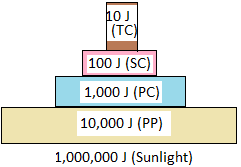
Which receives the maximum energy .... .... [C.P.M.T.1994]
-
83%
a) Producers
-
0%
b) Decomposers
-
0%
c) Secondary consumers
-
17%
d) Primary consumers
Explanation
Q.22.
Which is correct? .... .... [Har.P.M.T..1994]
-
40%
a) Least productive ecosystem is desert and deep lake
-
0%
b) Sugarcane is the most productive agro-ecosystem
-
20%
c) Most productive is coral reef system
-
40%
d) All the above
Q.23.
The factor that destroys plant biodiversity is .... ..... [C.E.T. Chd 2002]
-
17%
a) Biosphere reserves
-
0%
b) Vulnerable ecosystems
-
67%
c) Inaccessibility of habitats
-
17%
d) Destruction of habitats.
Q.24.
A food chain begins with .... .... [M.P.P.M.T.1995]
-
67%
a) Photosynthetic organisms
-
0%
b) Nitrogen fixing organisms
-
17%
c) Decomposers
-
17%
d) Consumers
Q.25.
Detritus food chain begins with .... .... [J.K.C.E.T. 2012]
-
14%
a) Primary producers
-
14%
b) Primary consumers
-
14%
c) Secondary consumers
-
57%
d) Dead organic matter
Q.26.
Which one depicts nitrogen fixation? .... .... [D.P.M.T.1999]
-
60%
a) N2 + 3H2 → 2NH3
-
0%
b) 2NH3 → N2 + 3H2
-
20%
c) 2N2 + Glucose → 2 animo acids
-
20%
d) 2NH4 + 2O2 → 8e- → N2 + 4H2O
Q.27.
Which one is biotic in origin? ..... .... [C.P.M.T. 1987]
-
17%
a) Texture and porosity of soil
-
33%
b) Rainfall
-
17%
c) Carbon dioxide content of soil
-
33%
d) Light intensity
Q.28.
Total energy fixed by an ecosystem is .... .... [C.P.M.T.1991]
-
50%
a) Primary production
-
33%
b) Gross production
-
17%
c) Net production
-
0%
d) Secondary production
Q.29.
Crop residue allowed to decay and decompose in farm land is called .... .... [C.O.M.E.D.-K’s 2007]
-
17%
a) Mulching
-
17%
b) Strip cropping
-
33%
c) Contour farming
-
33%
d) Terracing
Q.30.
Mangrove forests occurs in .... .... [Odisha 2003]
-
20%
a) Laterite soil
-
40%
b) Estuaries
-
20%
c) Arid areas
-
20%
d) Hilly areas