Q.1.
Ecological pyramids are of types .... .... [M.P.P.M.T.1997]
-
14%
a) Two
-
57%
b) Three
-
29%
c) Four
-
0%
d) Five
Q.2.
Energy enters a food chain through ..... ..... [C.P.M.T.2003]
-
100%
a) Producers
-
0%
b) Decomposer
-
0%
c) Herbivores
-
0%
d) Carnivores
Q.3.
Decreased rainfall in northern areas is due to ..... .... [D.P.M.T. 1996]
-
20%
a) Changes in sun
-
20%
b) Global phenomenon
-
20%
c) Deforestation in catchment areas
-
40%
d) Deforestation in evaporating area near equator
Q.4.
Transfer of energy is different trophic levels of an ecosystem is .... .... C.E.T.Chd.1997
-
29%
a) Bioenergetics
-
43%
b) Biosystem
-
14%
c) Geobiocoenosis
-
14%
d) Holocoenosis
Q.5.
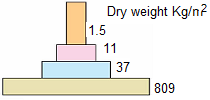
In a pyramid of biomass, primary producers have a dry biomas of 809 kg/m2.The biomass at tertiary consumer level would be .... .... [ A.M.U. 2012]
-
33%
a) 37 kg/m2
-
33%
b) 11 kg/m2
-
33%
c) 5 kg/m2
-
0%
d) 1.5 kg/m2
Explanation
Q.6.
Ecosystem is .... ..... [Odisha 2005]
-
40%
a) Always open
-
0%
b) Always closed
-
20%
c) Both open and closed depending upon community
-
40%
d) Both open and closed depending upon biomass
Q.7.
Which one is non renewable energy source? .... .... [H.P.P.M. 2005]
-
0%
a) Hydropower
-
40%
b) Tidal power
-
20%
c) Geothermal power
-
40%
d) Nuclear energy
Q.8.
Tropical forests are denser due to .... .... [C.P.M.T.2002]
-
0%
a) wild animals
-
0%
b) High temperature and less rainfall
-
0%
c) Low temperature and excess rain
-
100%
d) High temperature and high rainfall
Q.9.
Most economical and effective method of control of soil pH is application of .... .... [A.M.U. 2011]
-
25%
a) CaCO3
-
25%
b) Ca(OH)2
-
50%
c) CaCl2
-
0%
d) Ca(NO3)2
Q.10.
Which occupies more than one trophic level in the same ecosystem at the same time ... .... [C.B.S.E.2011]
-
80%
a) Sparrow
-
0%
b) Goat
-
20%
c) Frog
-
0%
d) Lion
Q.11.
In a food chain, herbivores/deer/grasshoppers are .... .... [M.P.P.M.T.2002]
-
60%
a) Primary producers
-
40%
b) Primary consumers
-
0%
c) Secondary consumers
-
0%
d) Decomposers
Q.12.
Detritus food chain begins with .... .... [Odisha 2007]
-
83%
a) Bacteria
-
0%
b) Viruses
-
0%
c) Algae
-
17%
d) Protozoa
Q.13.
An ammonifying bacteria is .... ..... [A.M.U.2002]
-
33%
a) Clostridium
-
33%
b) Azotobacter
-
33%
c) Nitrosococcus
-
0%
d) Bacillus ramosus
Q.14.
The most stable ecosystem is .... .... [B.H.U.2002]
-
80%
a) Forest
-
0%
b) Moutain
-
20%
c) Desert
-
0%
d) Ocean
Q.15.
Which is not functional unit of an ecosystem .... .... [C.B.S.E. 2012]
-
0%
a) Productivity
-
17%
b) Decomposition
-
0%
c) Energy flow
-
83%
d) Stratification
Q.16.
Nitrogen is a critical element of the ecosystem because it is .... ..... [B.H.U.1996]
-
20%
a) Essential element
-
40%
b) Abundant in atmosphere
-
0%
c) Labile
-
40%
d) Fixed by microbes
Q.17.
Clove oil is got from .... .... [Odisha 2009]
-
33%
a) Crocus sativa
-
0%
b) Zingiber officinale
-
67%
c) Curcuma
-
0%
d) Syzygium aromaticum
Q.18.
In a biotic community, the most important factor for survival of an animals is .... .... [R.P.M.T.2006]
-
0%
a) Day length
-
17%
b) Soil moisture
-
67%
c) Green food
-
17%
d) Predators
Q.19.
During summer khas khas mats used for cooling air are prepared from roots of .... .... [M.P.P.M.T. 2010]
-
67%
a) Saccharum munja
-
33%
b) Bambusa nana
-
0%
c) Vetiveria zizanioides
-
0%
d) Setaria pumila
Q.20.
Standing crop is .... .... [J.K.C.M.E.E. 2011]
-
0%
a) All photosynthetic living forms of an area
-
100%
b) Amount of living matter in a component of population at any time
-
0%
c) All living forms
-
0%
d) All crops plants in an area
Q.21.
Nepenthes belongs to the category of .... .... [C.P.M.T.1990]
-
25%
a) Primary consumer
-
0%
b) Producer
-
25%
c) secondary consumer
-
50%
d) Both B and C
Q.22.
Controlling factor in ecosystem is .... ..... [C.E.T.Chd2000]
-
0%
a) Soil moisture
-
40%
b) Food
-
40%
c) Predation
-
20%
d) Temperature
Q.23.
Which one is nature's cleaner? .... ..... [Pb.PM.T.1997]
-
20%
a) Consumers
-
0%
b) Producers
-
80%
c) Decomposers and scavengers
-
0%
d) Symbionts
Q.24.
Major communities of the world are .... ..... [B.H.U.1996]
-
0%
a) Scrubs, jungles and gardens
-
0%
b) Ocean, fresh water and forest communities
-
20%
c) Grassland and desert communities
-
80%
d) Both B and C
Q.25.
Deforestation will decrease ..... ..... [C.B.S.E. 1990[
-
0%
a) Soil erosion
-
20%
b) Land slides
-
0%
c) Soil fertility
-
80%
d) Rainfall
Q.26.
The importance of ecosystem lies in .... ..... [C.P.M.T. 1990]
-
20%
a) Cycling of materials
-
0%
b) Flow of energy
-
60%
c) Both A and B
-
20%
d) Its biomass
Q.27.
Broad-leaves oaks are found in .... .... [A.F.M.C.2004]
-
67%
a) Tropical evergreen forest
-
33%
b) Temperate deciduous forest
-
0%
c) North coniferous forest
-
0%
d) Tropical deciduous forest
Q.28.
Carnivores represent .... ..... [M.P.P.M.T.1993]
-
0%
a) Primary consumers
-
80%
b) Secondary and tertiary consumers
-
0%
c) Secondary consumers
-
20%
d) Reducers
Q.29.
Animals like Mice, Lizards and Cockroach share their habitat with human dwellings. They are .... .... [Kerala 2001]
-
20%
a) Inquilines
-
20%
b) Cultigens
-
20%
c) Transplants
-
40%
d) Humus
Q.30.
Moderate rain during summer produces .... .... [A.I.I.M.S.1998]
-
20%
a) Desert
-
20%
b) Grassland
-
20%
c) Scrub forest
-
40%
d) Deciduous forest