Q.1.
During respiration of cockroach when it is at rest:
-
25%
a) All spiracles remain open all times.
-
50%
b) Only thoracic spiracles remain open all the times.
-
0%
c) Last three pairs of abdominal spiracles remain open all the times.
-
25%
d) 1st and 3rd pairs of spiracles remain open all the times.
Q.2.
The function of the phallic glands in Periplanata is to secrete:
-
25%
a) a secretion that helps the sperm in the spermatophores to stick together.
-
25%
b) the innermost layer of the wall of the spermatophores.
-
25%
c) the middle layer of the wall of the spermatophores.
-
25%
d) the outermost layer of the wall of the spermatophores.
Q.3.
Chloragogen cells are found in:
-
0%
a) Blood of earthworm.
-
25%
b) Blood of cockroach.
-
25%
c) Haemocoel of cockroach
-
50%
d) Coelomic fluid of earthworm.
Q.4.
Which of the following blood vessel in earthworm is the largest and possess valves?
-
40%
a) Supraoesophagial blood vessel.
-
0%
b) Ventral blood vessel.
-
40%
c) Subneural blood vessel.
-
20%
d) Dorsal blood vessel.
Q.5.
Which of the following statement(s) is/are correct about the nervous system of cockroach? (i) It consists of series of segmentally arranged ganglia joined by paired longitudinal connectives to the ventral side. (ii) There are six ganglia lie in the thorax and three in the abdomen. (iii) The brain is represented by sub-oesophageal ganglion which supplies nerves to antenna and eyes. (iv) Each eye consists of 2000 hexagonal ommatidia. (v) Head holds a bit of the nervous system while the rest is situated along the dorsal side of its body parts.
-
50%
a) (i), (iii) and (iv).
-
50%
b) (i), (ii) and (v).
-
0%
c) (i) and (iv) only.
-
0%
d) (iii) and (v) only.
Q.6.
In Pheretima, nerve ring or brain ring is seen:
-
75%
a) in the anterior region between 3rd and 4th segments.
-
25%
b) in the anterior region between 8th and 9th segments.
-
0%
c) in the pre-typhlosolar region between 12th and 13th segments.
-
0%
d) in the clitellar region between 15th and 16th segments.
Q.7.
Read the following statements about Periplanata americana: (i) Cockroach is uricotelic. (ii) The number of heart chambers seen in cockroach is (iii) Collateral glands present in female help in excretion. (iv) Eggs of cockroach are centrolecithal. (v) The development of nymph is called paurometaboly. Of the above statements:
-
33%
a) Four are true.
-
0%
b) All are true.
-
0%
c) Only two are true.
-
67%
d) Only three are true
Q.8.
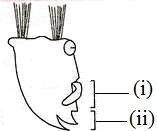
The given structure represents the mandibles of cockroach. Identify the parts labelled (i) and (ii).
-
0%
a) (i) Incising region, (ii) Grinding region.
-
0%
b) (i) Grinding region, (ii) Incising region.
-
0%
c) (i) Cutting region, (ii) Biting region.
-
100%
d) (i) Chewing region, (ii) Cutting region.
Q.9.
Identify the incorrect statement regarding septum in earthworm:
-
67%
a) Septae are absent from 1 to 4 segments.
-
33%
b) Oblique septum is found in the 8th segment.
-
0%
c) Complete septum are absent from 14 to last segment.
-
0%
d) Septae from 14 to last segment are porous.
Q.10.
Forest of nephridia in clitellar region is due to the presence of:
-
0%
a) Septal nephridia.
-
0%
b) Integumentary nephridia.
-
50%
c) Pharyngeal nephridia.
-
50%
d) All of these.
Q.11.
The main function of ocelli or simple eyes are:
-
67%
a) Formation of image.
-
33%
b) Perceiving multiple images.
-
0%
c) Light gathering.
-
0%
d) Functionless and vestigial.
Q.12.
Which of the following is incorrect regarding the various walls of spermatophores of cockroach:
-
67%
a) It consists of a bundle of sperms enclosed within three walls.
-
0%
b) Inner wall is secreted by utriculi majoris.
-
33%
c) Middle wall is secreted by congoblate glands.
-
0%
d) Outer layer is secreted by phallic gland.
Q.13.
The part of alimentary canal of cockroach not lined by cuticle in its inner wall:
-
0%
a) Fore gut.
-
0%
b) Mid gut.
-
50%
c) Hind gut.
-
50%
d) Gizzard.
Q.14.
Most digestion of food particles in cockroach occurs in:
-
0%
a) Crop.
-
50%
b) Gizzard.
-
50%
c) Stomodium.
-
0%
d) Mesenteron.
Q.15.
Spiral thickenings of cuticle in trachea of cockroach which prevents its collapse is:
-
0%
a) Intima.
-
50%
b) Ocelli.
-
50%
c) Tentorium.
-
0%
d) Apodemes.
Q.16.
Which of the following is not a function of Chloragogen cells in earthworm?
-
50%
a) Storage of reserve food.
-
0%
b) Deamination of proteins.
-
50%
c) Formation of uric acid.
-
0%
d) Excretion.
Q.17.
Consider the following statements: (i) Dorsal side of pharynx contains salivary glands which secrete saliva. (ii) Stomach contains calciferous glands which neutralize humic acid. (iii) Intestinal caecae secretes enzymes which aid in protein digestion. (iv) Typhlosole is avascular and non glandular villus like structures which helps in absorption. (v) Roof of pharynx contains pharyngeal glands containing chromaphil cells which secrete mucous and proteases enzymes. Which of the following statements are false regarding the alimentary canal of earthworm?
-
50%
a) (i) and (iv).
-
50%
b) (ii) and (iii).
-
0%
c) (iii) and (iv).
-
0%
d) (iii), (iv) and (v).
Q.18.
Large irregular cells which secrete wax in the cuticle of cockroach:
-
50%
a) Chromaphil cells.
-
50%
b) Trichogen cells.
-
0%
c) Oenocytes cells.
-
0%
d) Trophocyte cells.
Q.19.
Which of the following cells of fat body of cockroach contains symbiotic bacteria that helps in synthesis of amino acids, vitamins, etc?
-
50%
a) Trophocytes.
-
50%
b) Mycetocytes.
-
0%
c) Oenocytes.
-
0%
d) Urate cells.
Q.20.
The main feature that distinguishes Blatta orientalis from Periplanata americana is:
-
0%
a) Absence of spiracles.
-
50%
b) Absence of hind wings.
-
50%
c) Presence of uricose gland.
-
0%
d) Presence of reduced labrum and labium.
Q.21.
Which of the following is not a sense organ in cockroach?
-
0%
a) Antenna.
-
50%
b) Maxillary palp.
-
0%
c) Labial palp.
-
50%
d) Spiracles.
Q.22.
Nephridia are present in all the segments of earthworm, except:
-
50%
a) First 3 segments.
-
0%
b) First 2 segments.
-
50%
c) Lasts segment.
-
0%
d) First and last segment.
Q.23.
In cockroach, the position of heart is:
-
50%
a) Ventral.
-
50%
b) Dorsal.
-
0%
c) Lateral.
-
0%
d) Central.
Q.24.
Among the various mouth parts of cockroach, which of the following are paired?
-
0%
a) Mandibles only.
-
50%
b) Labrum only.
-
0%
c) Maxilla only.
-
50%
d) Mandibles and maxilla only.
Q.25.
Number of spiracles present on the body of Periplanata:
-
0%
a) 10
-
0%
b) 4
-
50%
c) 20
-
50%
d) 14
Q.26.
The structure present in the labium of cockroach is:
-
0%
a) Cardo.
-
100%
b) Lacinia.
-
0%
c) Galea.
-
0%
d) Paraglossa.
Q.27.
The excretory organs in cockroach are Malpighian tubules and its number is about:
-
50%
a) 6 to 8.
-
0%
b) 100 to 150.
-
50%
c) 8 to 10.
-
0%
d) 90 to 100.
Q.28.
Consider the following statements: (i) Blood vascular system of cockroach is of open type. (ii) Blood vessels are poorly developed and open into Haemocoel. (iii) Visceral organs are located in the Haemocoel and are bathed in blood. (iv) Heart of cockroach consists of elongated muscular tube lying along the mid dorsal line of thorax and abdomen. (v) The respiratory system consists of network of trachea that opens through 2 pairs of small spiracles present on the lateral side of the body.
-
0%
a) (i) is false, others are true.
-
50%
b) (ii) and (iii) are true, others are false.
-
0%
c) (iv) is false, others are true.
-
50%
d) (v) is false, others are true.
Q.29.
Read the following statements about earthworm: (i) If skin dry; the earthworm dies due to Asphyxia. (ii) Blood cells are phagocytic in nature. (iii) In earthworm gizzard is internally lined by cuticle and is present in the pretyphlosolar region. (iv) Two intestinal caecae arise from the 26th segment. (v) The red blood in earthworm is due to the respiratory pigment haemoglobin present in blood cells. (vi) Septal nephridia are exonephric nephridia whereas Integumentary nephridia are enteronephric nephridia. Of the above statements:
-
0%
a) Two are false.
-
50%
b) Three are false.
-
50%
c) Four are false.
-
0%
d) One is false.
Q.30.
What is true regarding female frog?
-
50%
a) Ureters transport gametes and urine.
-
0%
b) Ureters open into the urinary bladder.
-
0%
c) Ureters join oviduct.
-
50%
d) Ureters and oviduct open separately into the cloaca.