Q.1.
Assertion: In Arachis hypogea the fruit is shizocarpic. Reason: Fruit of Arachis hypogea is geocarpic.
-
50%
a) Both Assertion and Reason are true and Reason is the correct explanation of Assertion.
-
0%
b) Both Assertion and Reason are true but Reason is NOT the correct explanation of Assertion.
-
50%
c) Assertion is true but Reason is false.
-
0%
d) Both Assertion and Reason are false.
Q.2.
Match column-I with column-II and choose the correct option.
| Column I | Column II |
| A. Gram, sem, moong, soyabean | I. Medicine |
| B. Soyabean, groundnut | II Ornamental |
| C. Indigofera | III. Fodder |
| D. Sunhemp | IV. Fibres |
| E. Sesbania, Trifolium | V. Dye |
| F. Lupin, sweet potato | VI. Edible oil |
| G. Mulethi | VII. Pulses |
-
0%
a) A - I, B - II, C - III, D - IV, E - V, F - VI, G - VII
-
100%
b) A - VII, B - VI, C - V, D - IV, E - III, F - II, G - I
-
0%
c) A - II, B - IV, C - VI, D - I, E - III, F - V, G - VII
-
0%
d) A - I, B - III, C - V, D - VII, E - II, F - IV, G - VI
Q.3.
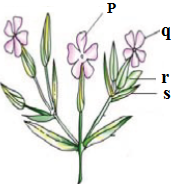
Give the name in following
-
67%
a) P-terminal bud , q-old flower r-floral bud, s-leaf
-
0%
b) P- terminal bud, q- floral bud, r- old flower, s- leaf
-
0%
c) P- old flower, q- terminal bud r- leaf s-floral bud
-
33%
d) P- leaf, q- floral bud, r- old flower, s- terminal bud
Q.4.
Select the correct pair
| Colum I | Colum II | Colum III |
| (a)Unilocular Ovary | (p) Five Chamber | I Petuna |
| (b) Bilocular Ovary | (q) Three Chamber | II Asparagus |
| (c) Trilocular Ovary | (r) One Chamber | III Hibiscus |
| (d) Pentalocular Ovary | (s) Two Chamber | IV Sunflower |
-
0%
a) (a)- (r)- IV, (b)-(s)-III ,(c)- (p)-II, (d)- (q) -I
-
100%
b) (a)- (r)- IV, (b)- (s)-I, (c)- (q)- II, (d)- (p)-III
-
0%
c) (a)- (s) -I, (b)- (r)- II,(c)- (q)- IV, (d)- (p)-III
-
0%
d) (a) -(q)-II, (b)- (r)-I (c)- (s)- III, (d)- (p)-IV
Q.5.
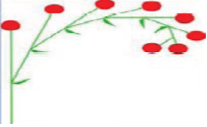
Identify the inflorescence
-
67%
a) Raceme
-
33%
b) Spike
-
0%
c) Helicoid
-
0%
d) Scorpioid
Q.6.
When the margins of sepals or petals overlap one another without any particular direction, the condition is termed as:
-
33%
a) Imbricate.
-
67%
b) Twisted.
-
0%
c) Valvate.
-
0%
d) Vexillary.
Q.7.
Coleorhizae is a cap like covering over:
-
100%
a) Radicle in dicots.
-
0%
b) Plumule in dicots.
-
0%
c) Plumule in monocots.
-
0%
d) Radicle in monocots.
Q.8.
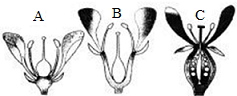
Given figures (A, B and C) shows the position of floral parts on thalamus. (given as I, II and III) Select the correct combination. I. Hypogynous flower ; II. Perigynous flower ; III. Epigynous flower
-
50%
a) A-I, B-II, C-III
-
0%
b) A-I, B-III, C-II
-
50%
c) A-III, B-II, C-I
-
0%
d) A-III, B-I, C-II
Q.9.
During the post-fertilization period, the ovules develops into ___A____ and the ovary matures into a ___B ____.
-
50%
a) A - seeds; B - fruit
-
50%
b) A - fruit; B - seeds
-
0%
c) A - flower; B - seed
-
0%
d) A - seeds; B - flower
Q.10.
When a flower has both Androecium and gynoecium, it is known as__________.
-
0%
a) asexual
-
100%
b) bisexual
-
0%
c) unisexual
-
0%
d) multisexual
Q.11.
Which one contain most reduced form of stem?
-
0%
a) Bulb
-
0%
b) Rhizome
-
100%
c) Tuber
-
0%
d) Twinner
Q.12.
Which of the following statements are true: (i) Thorns are modifications of stem. (ii) The pattern of arrangement of leaves on the stem or branch is called phyllotaxy. (iii) In Pinnately compound leaves, a number of leaflets are present on a common axis, the rachis, which represents the midrib of the leaf as in Neem. (iv) In opposite type of phyllotaxy, a single leaf arises at each node in alternate manner as in China rose.
-
0%
a) (i) and (ii).
-
50%
b) (ii), (iii) and (iv).
-
50%
c) (ii) and (iii) only.
-
0%
d) (i), (ii) and (iii).
Q.13.
Four sepals arranged in two whorls are characteristics of the family:
-
50%
a) Solanaceae.
-
0%
b) Fabaceae.
-
0%
c) Lilliaceae.
-
50%
d) Brassicaceae.
Q.14.
Fruits that develop from a single flower with a syncarpous pistil are:
-
0%
a) Aggregate.
-
50%
b) Pseudocarp.
-
0%
c) Multiple.
-
50%
d) Simple.
Q.15.
Replum is present in the ovary of the flower of:
-
50%
a) Lemon.
-
0%
b) Mustard.
-
50%
c) Sunflower.
-
0%
d) Pea.
Q.16.
Tetradynamous condition is found in:
-
0%
a) Hibiscus rosa-sinesis
-
0%
b) Ocimum sanctum
-
0%
c) Helianthus annuus
-
100%
d) Brassica campestris.
Q.17.
In plants like bitter gourd – Momordica charantia, which possess stem tendrils, develop from axillary buds, the roots have swollen regions at frequent intervals, such roots are called:
-
50%
a) Tuberous.
-
50%
b) Beaded/Moniliform.
-
0%
c) Conical.
-
0%
d) Fusiform.
Q.18.
Buds are typically found:
-
50%
a) At the apex or axil of leaves.
-
0%
b) At the tips of the branches.
-
0%
c) At the base of the leaves only.
-
50%
d) Both at the tips of branches and leaf base.
Q.19.
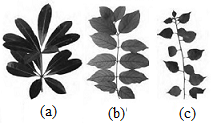
Which of the following types of phyllotaxy (a – c) represent sunflower, Alstonia and Calotropis respectively:
-
50%
a) (a), (b) and (c).
-
50%
b) (c), (a) and (b).
-
0%
c) (c), (b) and (a).
-
0%
d) (a), (c) and (b).
Q.20.
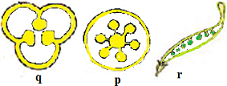
Choose the correct option by given placentation
-
0%
a) P-free central-Dianthus, q- parietal-Tomato, r-Marginal -Bean
-
0%
b)P- parietal-Tomato, q- Marginal -sunflower ,r- free central- Bean
-
0%
c) P-parietal-Argemone, q- free central- Bean, r- Marginal -sunflower
-
100%
d) P-free central-Dianthus, q- parietal-Argemone, r-Marginal –Bean
Q.21.
What is/are true about Aloe?
-
0%
a) Succulent.
-
0%
b) Trimerous flowers.
-
0%
c) Offset.
-
100%
d) All of these.
Q.22.
Juicy hair like structure observed in the lemon fruit developed from:
-
0%
a) Exocarp.
-
50%
b) Endocarp.
-
0%
c) Pericarp.
-
50%
d) Mesocarp.
Q.23.
Which of the following is wrong about tap root?
-
0%
a) Always remain underground.
-
0%
b) It may be surface feeder or deep feeder.
-
100%
c) Consists of single primary root.
-
0%
d) Primary root is not persistent
Q.24.
Radical leaves are found in:
-
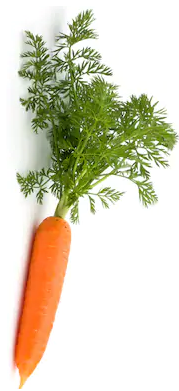
100%
a) Radish, turnip and carrots.
-
0%
b) Brassica, Iberis and Allysum.
-
0%
c) Sugarcane, bamboos and cane.
-
0%
d) Cynodon, Maize and wheat.
Explanation
Q.25.
Which of the following is correct with reference to floral character of family solanaceae?
-
100%
a) Axillary, bisexual, actinomorphic, epipetalous
-
0%
b) Racemose, zygomorphic, unisexual, floral characters
-
0%
c) Racemose, zygomorphic, bisexual, polypetalous
-
0%
d) Axillary, zygomorphic, bisexual, epipetalous.
Q.26.
Match the column I with column II and choose the option which shows their correct match.
| Column I | Column II |
| A. Placentation | (i) Arrangement of flowers on the rachis |
| B. Aestivation | (ii) Modified shoot for sexual reproduction |
| C. Inflorescence | (iii) Arrangement of various whorls in the bud |
| D. Flower | (iv) Arrangement of ovules within an ovary |
-
0%
a) A - (i), B - (ii), C - (iii), D - (iv)
-
0%
b) A - (iii), B - (i), C - (ii), D - (iv)
-
0%
c) A - (iii), B - (i), C - (iv), D - (ii)
-
100%
d) A - (iv), B - (iii), C - (i), D - (ii)
Q.27.
Which one of the following characteristics is not related to gynoecium?
-
0%
a) It is the female reproductive part of the flower.
-
100%
b) It is composed of stamens.
-
0%
c) Stigma is usually at the tip of the style and is the receptive surface for pollen grains.
-
0%
d) Each ovary bears one or more ovules attached to a flattened, cushion like placenta.
Q.28.
The primary roots and its branches constitute the
-
0%
a) fibrous root system.
-
100%
b) tap root system.
-
0%
c) adventitious root system.
-
0%
d) all of the above
Q.29.
Given below are the following plants. Aswagandha, Trifolium, Indigofera, Tobacco, Belladonna, Tulip, Aloe, Asparagus, Tomato. How many of the plants bear axile placentation and swollen placenta?
-
0%
a) 3
-
100%
b) 4
-
0%
c) 5
-
0%
d) 6
Q.30.
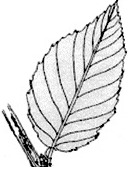
Identify the type of venation and select the wrong statement regarding this:
-
0%
a) The arrangement of veins and veinlets in the lamina of leaf is termed as venation.
-
0%
b) When the veinlets form a network, the venation is termed as reticulate.
-
0%
c) The above venation is the characteristics of a dicotyledonous plant.
-
100%
d) In this the veins run parallel to each other with the lamina.
Q.31.
In which of the following is a multiple root cap found?
-
0%
a) Maize.
-
0%
b) Mango.
-
0%
c) Gram.
-
100%
d) Pandamus.
Q.32.
The inflorescence in which receptacle becomes cup shaped and consists single naked female flower surrounded by many female flowers is found in:
-
0%
a) Poinsettia.
-
0%
b) Fig.
-
0%
c) Indian basil.
-
100%
d) Sunflower.
Q.33.
The aquatic plant Limnophila has leaves of more than one shape. The condition is described as
-
100%
a) polyphylly
-
0%
b) Heterophylly
-
0%
c) amphiphyly
-
0%
d) biphylly.
Q.34.
Sheathing leaf base is a characteristic of:
-
0%
a) Sugarcane.
-
0%
b) Maize.
-
0%
c) Banana.
-
100%
d) All of these.
Q.35.
The axillary buds of stem develop into woody, straight and pointed structures, they are called:
-
100%
a) Thorns.
-
0%
b) Hooks.
-
0%
c) Spines.
-
0%
d) Prickles.
Q.36.
Point out the mismatch among the following:
-
0%
a) Modified underground stem – Zaminkand.
-
0%
b) Thorn – Citrus.
-
100%
c) Tendrils – Rhizophora.
-
0%
d) Stem modified to flattened – Opuntia.
Q.37.
The presence of sheathing leaf base and a lingual is a characteristic of:
-
0%
a) Fern leaf.
-
0%
b) Banana leaf.
-
0%
c) Grass leaf.
-
100%
d) Cycas leaf.
Q.38.
A pome fruit is said to be false because: (CPMT 2000)
-
0%
a) The pericarp is inconspicuous
-
0%
b) The endocarp is cartilaginous
-
100%
c) The fruit is present in fleshy edible thalamus
-
0%
d) The fruit is derived from inferior ovary
Q.39.
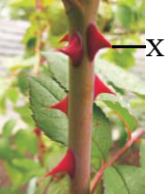
Name the labeled ‘x’ in plant
-
100%
a) Thorn
-
0%
b) Hook
-
0%
c) Prickles
-
0%
d) Stipules
Q.40.
Epiphytic roots are found in :
-
0%
a) Indian rubber
-
0%
b) Orchid
-
100%
c) Tinospora
-
0%
d) Cuscuta
Q.41.
Winged petiole is found in;
-
0%
a) citrus
-
100%
b) acacia
-
0%
c) radish
-
0%
d) peepal
Q.42.
Choose correct option
| Colum 1 | Colum2 |
| (p) polyadelphous | I china rose |
| (q) monadelphous | II pea |
| (r) diadelphous | III citrus |
-
100%
a) P- III, q-I, r-II
-
0%
b) P- III q-II, r- I
-
0%
c) P-I, q- III ,r-II
-
0%
d) P-II, q- III ,r-I
Q.43.
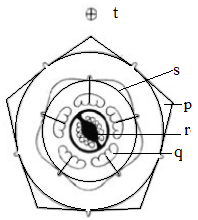
Name in given floral diagram:
-
0%
a) P-Calyx, q-Corolla, r-Androecium, s- Gynoecium, t- Mother axis
-
100%
b) P-Calyx, q-Androecium, r- Gynoecium, s-Corolla, t-Mother axis
-
0%
c) P- Corolla, q- Calyx, r-Androecium, s- Gynoecium, t- Mother axis
-
0%
d) P- Corolla , q- Calyx ,r- Gynoecium , s Androecium -t- mother axis
Q.44.
Which one of the following is not a characteristic feature of Fabaceae?
-
100%
a) Fruit is a berry.
-
0%
b) Stamens are ten.
-
0%
c) Sepals are five, gamosepalous and imbricate aestivation.
-
0%
d) Ovary superior, monocarpellary and unilocular with many ovules.
Q.45.
How many plants in the list given below have marginal placentation? Mustard, Gram, Tulip, Asparagus, Arhar, Sunhemp, Chilli, Colchicine, Onion, Moong, Pea, Tobacco, Lupin.
-
0%
a) Four
-
0%
b) Five
-
100%
c) Six
-
0%
d) Three
Q.46.
Most prominent function of inflorescence is
-
0%
a) dispersal of seeds.
-
0%
b) formation of more fruits.
-
100%
c) formation of pollen grains.
-
0%
d) dispersal of pollens.
Q.47.
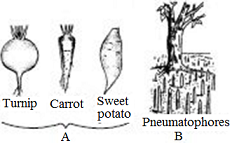
The given figures (A and B) show the modification of roots. Which of the following statements regarding the figures is correct?
-
0%
a) Tap roots of carrot, turnip and adventitious root of sweet potato, get swollen and store food.
-
50%
b) Pneumatophores conducts water, minerals & photosynthesis
-
50%
c) Pneumatophores is found in the plants that grow in sandy soil.
-
0%
d) Turnip & carrot shows adventitious roots and sweet potato shows tap root.
Q.48.
Which of the following statement(s) is /are correct?Many plants belong to family Fabaceae are good ornamentals (Tulip, Gloriosa), source of medicine (Aloe) and vegetables (Asparagus).The plumule and radicle are enclosed in sheaths which are called Coleorhiza and coleoptile respectively.A flower having either only stamens or only carpels is unisexual.Basal, alternate, linear, exstipulate with parallel venation types of leaves is found in the family lilliaceae.
-
0%
a) Only (i)
-
0%
b) Both (i) and (ii)
-
0%
c) Both (iii) and (iv)
-
100%
d) All of these
Q.49.
Read the following statements and answer the question.It is the pattern of arrangement of leaves on the stem or branch.It is usually of three types - alternate, opposite and whorled.It is meant for getting maximum amount of light. Which condition of plants is being described by the above statements?
-
100%
a) Phyllotaxy
-
0%
b) Venation
-
0%
c) Inflorescence
-
0%
d) Aestivation
Q.50.
Which one of the following statement is correct?
-
0%
a) Bulb of Allium cepa is a modified stem.
-
100%
b) Cloves of Allium sativum are fleshy scale leaves.
-
0%
c) Corm of Colacasia is a modified root.
-
0%
d) Tendril in Vitis vinifera is a modified axillary bud.