Q.1.
Fibrous root system is found in
-
0%
a) monocotyledonous plants.
-
50%
b) dicotyledonous plants.
-
50%
c) bryophytes.
-
0%
d) gymnosperm
Q.2.
Pappus helps in dispersal of pollen in
-
0%
a) Asteraceae
-
50%
b) Brassicaceae
-
0%
c) Malvaceae
-
50%
d) Solanaceae
Q.3.
In pea, the flowers are:
-
50%
a) Zygomorphic, Perigynous and Valvate aestivation.
-
50%
b) Zygomorphic, hypogynous and twisted aestivation.
-
0%
c) Zygomorphic, Perigynous and descending imbricate aestivation.
-
0%
d) Zygomorphic, Perigynous and ascending imbricate aestivation.
Q.4.
Which of these is an example for zygomorphic flower with imbricate aestivation?
-
0%
a) Canna.
-
100%
b) Cassia.
-
0%
c) Cucumber.
-
0%
d) Calotropis.
Q.5.
Tendrils of Passiflona develop from:
-
100%
a) Apical bud.
-
0%
b) Apical root.
-
0%
c) Terminal buds.
-
0%
d) Axillary buds.
Q.6.
Consider the following statements: (i) In leguminous plants, leaf base is becomes swollen called Pulvinus. (ii) The fleshy leaves of onion and garlic store food. (iii) The buds in Australian acacia become green and synthesise food. (iv) In Alstonia, leaves show alternate phyllotaxy. Choose the correct option:
-
0%
a) (ii) and (iv).
-
0%
b) (i) and (iii).
-
100%
c) (i) and (ii).
-
0%
d) (i) and (iv).
Q.7.
Select the mismatched pair out of the following.
-
0%
a) Rhizome - Dryopteris, Nelumbo nucifera.
-
0%
b) Corm - Crocus sativus, Amorphophallous.
-
100%
c) Sucker - Curcuma domestica, Zingiber officinale.
-
0%
d) Tuber - Helianthus tuberosus, Solanum tuberosum.
Q.8.
The technical term used for the Androecium in a flower of China rose (Hibiscus rosa sinensis) is
-
0%
a) monadelphous
-
33%
b) diadelphous
-
0%
c) polyandrous
-
67%
d) Polyadelphous
Q.9.
Consider the following statements: (i) When ovules are borne on central axis and septa are absent, as in Dianthus and Primrose, the placentation is free central. (ii) In some seeds, such as castor, the endosperm formed as a result of double fertilization, is a food storing tissue. (iii) Monocotyledonous seeds are endospermic but some as in orchids are non – endospermic. (iv) The plumule and radicle are enclosed in sheaths which are called coleoptile and Coleorhiza respectively.
-
50%
a) (i) and (ii) are correct while (iii) and (iv) are wrong.
-
50%
b) (i) only is correct while others are wrong.
-
0%
c) (i), (ii) and (iii) are correct while only (iii) is wrong.
-
0%
d) All are correct.
Q.10.
Study the following statements and select the correct option: (i) Buds are present in the axil of leaflets of a compound leaf. (ii) Pulvinus leaf – base is present in some leguminous plants. (iii) In Alstonia, the petiole expands becomes green and synthesise food. (iv) Opposite phyllotaxy is seen in guava.
-
0%
a) (i) and (ii) are correct while (iii) and (iv) are wrong.
-
0%
b) (ii) and (iii) are correct while (i) and (iv) are wrong.
-
0%
c) (i) and (iii) are correct while (ii) and (iv) are wrong.
-
100%
d) (i) and (iii) are wrong while (ii) and (iv) are correct.
Q.11.
Which of the following is a pendent inflorescence?
-
0%
a) Amentum.
-
0%
b) Spike.
-
0%
c) Spadix.
-
100%
d) Corymb.
Q.12.
Assertion: Capitulum is a Racemose inflorescence. Reason: In Capitulum, flowers are arranged in a centripetal manner.
-
0%
a) Both Assertion and Reason are true and Reason is the correct explanation of Assertion.
-
100%
b) Both Assertion and Reason are true but Reason is NOT the correct explanation of Assertion.
-
0%
c) Assertion is true but Reason is false.
-
0%
d) Both Assertion and Reason are false.
Q.13.
Food present in bulbil occurs in:
-
100%
a) Root
-
0%
b) Stem
-
0%
c) Leaf base
-
0%
d) Petioles
Q.14.
A potato tuber is underground stem because:
-
0%
a) It has swollen and non-green
-
0%
b) It possesses axillary buds
-
0%
c) It possesser starch as stored food.
-
100%
d) It possess starch as stored food
Q.15.
Thorn is a stem structure because it:
-
0%
a) Develops from trunk
-
100%
b) Develops from apical bud
-
0%
c) modification of bank floralbud
-
0%
d) is pointed
Q.16.
The vexillm, (stan dard) wings and keel in pea flowers constitute:
-
100%
a) Calyx
-
0%
b) Corolla
-
0%
c) Androecium
-
0%
d) Gynaecium
Q.17.
Which is not a stem modification? (A.F.M.C. 1988)
-
0%
a) Rhizome of Ginger
-
0%
b) Corm of Colocasia
-
100%
c) Pitcher of Nepenthes
-
0%
d) tuber of potato
Q.18.
Mangrove plant live in:
-
0%
a) Alpine Tundra
-
0%
b) Tundra
-
0%
c) Marshy areas along rivers
-
100%
d) Marshy areas along sea shore
Q.19.
In monocot male gametophyte is: (C.B.S.E.1990)
-
0%
a) Megaspore
-
0%
b) Nucleus
-
100%
c) Microspore
-
0%
d) Tetrad
Q.20.
Stamens andante to perianth are:
-
100%
a) Epiphyllous.
-
0%
b) Epipetalous.
-
0%
c) Episepalous.
-
0%
d) Both A and C.
Q.21.
Identify the plant in which terminal bud is modified into leaf tendrils.
-
0%
a) Passion flower.
-
100%
b) Citrus.
-
0%
c) Wood apple.
-
0%
d) Vitis (Grapes).
Q.22.
It is a proteinous layer and the outer covering of endosperm which separates the embryo. Identify the layer.
-
100%
a) Tegmen
-
0%
b) Scutellum
-
0%
c) Hyaline layer
-
0%
d) Aleurone layer
Q.23.
Fibrous root system is better adopted than tap root system for
-
0%
a) transport of organic matter.
-
0%
b) absorption of water and minerals.
-
0%
c) storage of food.
-
100%
d) anchorage of plant to soil.
Q.24.
Which of the following option shows the correct labelling of the parts of leaf marked as A, B, C and D.
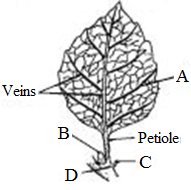
-
0%
a) A - Lamina, B - Axillary bud, C - Stipule, D - Leaf base
-
0%
b) A - Lamina, B - Stipule, C - Axillary bud, D - Leaf base
-
0%
c) A - Lamina, B - Axillary bud, C - Stipule, D - Pedicel
-
100%
d) A - Leaflet, B - Axillary bud, C - Stipule, D - Leaf base
Q.25.
Which of the following statements is correct?
-
0%
a) Imbricate aestivation is found in papilionaceous family.
-
100%
b) Generally sepals are green, leaf like and protect the flowers in the bud stage.
-
0%
c) In cymose type of inflorescence, the main axis terminates in a flower, hence is limitless in growth.
-
0%
d) In axile placentation ovary is one chambered but it becomes two cambered due to formation of the false septum.
Q.26.
Match the following stem modifications given in column I with their examples given in column II and select the correct combination from the options given below.
| (Stem Modifications) | (Found in) |
| A. Underground stem | I. Euphorbia |
| B. Stem tendril | II. Opuntia |
| C. Stem thorns | III. Potato |
| D. Flattened stem | IV. Citrus |
| E. Fleshy cylindrical stem | V. Cucumber |
-
0%
a) A I, B II, C III, D V, E IV
-
100%
b) A II, B III, C IV, D V, E I
-
0%
c) A III, B IV, C V, D I, E II
-
0%
d) A III, B V, C IV, D II, E I
Q.27.
Which one of the following characteristics does not belong to parietal placentation?
-
0%
a) Ovules are borne on central axis.
-
0%
b) Ovary is one-chambered but it becomes two-chambered due to the formation of false septum.
-
100%
c) Examples are mustard and Argemone.
-
0%
d) Both (b) and (c)
Q.28.
Epigynous flowers are present in:
-
0%
a) Mustard.
-
0%
b) Brinjal.
-
100%
c) China rose.
-
0%
d) Cucumber.
Q.29.
The region of the root-tip which is involved in the formation of root hairs by epidermal cells is called the
-
0%
a) region of maturation.
-
0%
b) region of meristematic activity.
-
100%
c) region of elongation.
-
0%
d) none of the above.
Q.30.
Floral features are chiefly used in angiosperms identification because
-
0%
a) flowers are of various colours.
-
50%
b) flowers can be safely pressed.
-
6%
c) reproductive parts are more stable and conservative than vegetative parts.
-
44%
d) flowers are good materials for identification.
Q.31.
Stem modified into flattened photosynthetic structure is:
-
33%
a) Phyllode
-
0%
b) Bulbil
-
67%
c) Phylloclade
-
0%
d) Tendril
Q.32.
Opposite decussate phyllotaxy is found in:
-
0%
a) Calotropis
-
0%
b) Mango
-
100%
c) Hibiscus
-
0%
d) Nerium
Q.33.
Placentation in legumes is: (N.C.E.R.T.1988,C.P.M.T. 19977)
-
0%
a) Basal
-
0%
b) Marginal
-
0%
c) Axile
-
0%
d) Free central
Q.34.
Match the column-I containing types of aestivation with their examples given in column-II and choose the correct option.
| Column - I (Type of aestivation) | Column-II (Examples) |
| A. Valvate | I. Cotton |
| B. Twisted | II. Calotropis |
| C. Imbricate | III. Bean |
| D. Vexillary | IV. Gulmohar |
-
0%
a) A I; B II; C IV; D III
-
0%
b) A II; B I; C IV; D III
-
0%
c) A II; B IV; C I; D III
-
0%
d) A II; B I; C III; D IV
Q.35.
ead the following statements and answer the questions.Gynoecium is situated in the centre and other parts of the flower are located on the rim of the thalamus almost at the same level.Ovary is half-inferior.Examples are plum, rose and peach. Which condition of flowers is being described by the above statements?
-
0%
a) hypogyny
-
0%
b) perigyny
-
0%
c) epigyny
-
0%
d) none of these
Q.36.
Which one of the following statement is correct?
-
0%
a) Bulb of Allium cepa is a modified stem.
-
0%
b) Cloves of Allium sativum are fleshy scale leaves.
-
0%
c) Corm of Colacasia is a modified root.
-
0%
d) Tendril in Vitis vinifera is a modified axillary bud.
Q.37.
Stilt roots occur in __________ .
-
0%
a) groundnut
-
0%
b) rice
-
0%
c) sugarcane
-
0%
d) wheat
Q.38.
Fibrous root system is found in
-
0%
a) monocotyledonous plants.
-
0%
b) dicotyledonous plants.
-
0%
c) bryophytes.
-
0%
d) gymnosperm
Q.39.
Fibrous roots develop in maize from
-
0%
a) upper nodes
-
0%
b) lower nodes
-
0%
c) upper internodes
-
0%
d) none of these
Q.40.
A fruit developed from a condensed inflorescence is
-
0%
a) simple fruit
-
0%
b) aggregate fruit
-
0%
c) composite fruit
-
0%
d) etaerio
Q.41.
How many plants in the list given below have the composite fruits that develop from an inflorescence? Walnut, poppy, radish, fig, pineapple, apple, tomato, mulberry.
-
0%
a) 4.
-
0%
b) 2.
-
0%
c) 5.
-
0%
d) 3.
Q.42.
logy of flowering plants (I) gneetStudy Companion For more NEET and AIIMS mcq on Morphology of flowering plants (I) Q120) Cyathium and Hypanthodium inflorescence are similar in:
-
0%
a) Nectar glands.
-
0%
b) Apical pore.
-
0%
c) Petaloid bracts.
-
0%
d) Unisexual flowers.
Q.43.
Nodulated roots occur in: (R.P.M.T 1995)
-
0%
a) Leguminoceae
-
0%
b) Solanaceae
-
0%
c) Malvaceae
-
0%
d) Papilionaceae
Q.44.
A catkin of unisexual flower is found in:
-
0%
a) Mulberry
-
0%
b) Wheat
-
0%
c) Onion
-
0%
d) Grass
Q.45.
The leaves are modified into tendrils, hooks, pitcher ,and bladder in the following plants respectively:
-
0%
a) sweet pea, bignonia, Nepenthes, Utricularia
-
0%
b) sweet pea, bignonia, Utricularia, Nepenthes,
-
0%
c) Nepenthes , bignonia, sweet pea, Utricularia
-
0%
d) Utricularia, Nepenthes, bignonia, sweet pea
Q.46.
Phylloclades are: (JKCMEE 2004)
-
0%
a) leaf modification
-
0%
b) one internode and long stem
-
0%
c) modified petioles
-
0%
d) green succulent stem of indefinite growth
Q.47.
Flowers are zygomorphic in : (A.I.P.M.T. 2011)
-
0%
a) Mustard
-
0%
b) Gulmohar
-
0%
c) Tomato
-
0%
d) Datura
Q.48.
Which is the correct pair for edible part? (C.B.S.E.2001)
-
0%
a) Tomato - Thalamus
-
0%
b) Maize – Cotyledons
-
0%
c) Guava - Mesocarp
-
0%
d) Date palm- Pericarp
Q.49.
Leaf morphology helps in :
-
0%
a) Plant identification
-
0%
b) Plant classification
-
0%
c) None of these
-
0%
d) (a) & (b) both
Q.50.
Flowers are always present in :
-
0%
a) Cryptogamous
-
0%
b) Pteridophytes
-
0%
c) Angiosperms
-
0%
d) Bryophytes