Q.1.
Perianth is found in a flower in which :
-
50%
a) Calyx and Corolla are not distinguishable
-
0%
b) Stamens are leaf like
-
50%
c) Corolla leaf- like but calyx is colored
-
0%
d) None of the above
Q.2.
Stipular tendril modification is found in : (Pb. PMT2001)
-
0%
a) Smilex
-
50%
b) Pea
-
50%
c) Guava
-
0%
d) Mimosa pudica
Q.3.
In a compound umbel each umbellate is subtended by:
-
0%
a) Involucre
-
100%
b) Bracket
-
0%
c) Involucel
-
0%
d) Bracteole
Q.4.
Water inside a coconut is : (Manipal PMT 1995)
-
0%
a) Liquid endosperm
-
100%
b) Liquid endocarp
-
0%
c) Liquid Mesocarp
-
0%
d) Liquid Nucleus
Q.5.
Which one of the following is not a characteristic of root:
-
0%
a) Presence of root tap
-
0%
b) Presence of unicellular hair
-
100%
c) Presence of chlorophyll
-
0%
d) Absence of buds
Q.6.
Root that grow from any part of the plant body other than the radical are called? (AFMC 2010)
-
0%
a) Tap root
-
100%
b) Adventitious root
-
0%
c) Modified roots
-
0%
d) Aerial roots
Q.7.
Which of these characters do not belong to Compositae?( CPMT,1991)
-
0%
a) Ligulate ray flowers
-
0%
b) Basal ovules
-
100%
c) Syngenesious stamens
-
0%
d) Five lobed stigma
Q.8.
The correct match for Branching
| Colum I | Colum II |
| (P) Mirabilis | I sympodial |
| (Q) Polyalthea | II dichotomous |
| (R) Vitis | III monopodial axis |
| (S) Hyphaene | IV Cymose |
-
0%
a) (P)-III, (Q) – IV, (R)-I, (S)-II
-
0%
b) (P)-I, (Q)- IV, (R)- III, (S)- II
-
100%
c) (P) - IV ,(Q) - III (R)-I, (S)-II
-
0%
d) (P)-IV (Q)- III, (R)- II , (S)- I
Q.9.
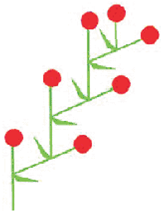
Choose the correct option by given diagram :
-
0%
a) Scorpioid - Heliotropium
-
0%
b) Scorpioid - Hamelia
-
100%
c) Spike - Achyranthus
-
0%
d) Spike – musa
Q.10.
nflorescence with single central achlamydeous female flower surrounded by a number of achlamydeous male flowers is:
-
100%
a) Cyathium.
-
0%
b) Vesticillaster.
-
0%
c) Spadix.
-
0%
d) Hypanthodium.
Q.11.
Opposite simple leaves with reticulate venation is present in:
-
0%
a) Nerium.
-
100%
b) China rose.
-
0%
c) Calotropis.
-
0%
d) Neem.
Q.12.
The region of the root-tip whose cells undergo rapid elongation and enlargement and are responsible for the growth of the root in length is called the
-
50%
a) region of maturation.
-
50%
b) region of elongation.
-
0%
c) region of meristematic activity.
-
0%
d) root-hairs.
Q.13.
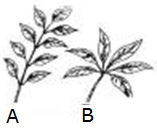
The given figures (A & B) show two types of compound leaves. Choose the option which identity the correct compound leaf and their example (C).
-
100%
a) A - Pinnately compound leaf, C - Neem
-
0%
b) A - Palmately compound leaf, C - Neem
-
0%
c) B- Pinnately compound leaf, C - Silk cotton
-
0%
d) none of these
Q.14.
Which part of plant is generally green when young and later often become woody and dark brown?
-
100%
a) stem
-
0%
b) seed
-
0%
c) leaves
-
0%
d) flower
Q.15.
Which of the following is the green expanded part of leaf with vein and veinlets?
-
0%
a) Petiole
-
0%
b) Node
-
0%
c) Stipule
-
100%
d) Lamina
Q.16.
Pappus helps in dispersal of pollen in
-
0%
a) Asteraceae
-
100%
b) Brassicaceae
-
0%
c) Malvaceae
-
0%
d) Solanaceae
Q.17.
How many of the given plants bear Trimerous condition in flower: Glory lily, Groundnut, Indigofera, Tobacco, Aswagandha, Tulip, Moong, Smilax, Red chilli, Sunhemp, Aloe, Pea.
-
0%
a) 6
-
100%
b) 4
-
0%
c) 5
-
0%
d) 3
Q.18.
Common feature of the stems of Potato, ginger, turmeric and zaminkand:
-
0%
a) Weak.
-
0%
b) Woody.
-
50%
c) Photosynthetic.
-
50%
d) Underground stems, which store food in them.
Q.19.
Which among the following root is of adventitious origin? (i) Storage root of tapioca. (ii) Conical root of carrot. (iii) Pneumatophores of Rhizophora. (iv) Prop roots of banyan tree.
-
0%
a) (i) and (ii).
-
0%
b) (ii) and (iii).
-
100%
c) (i) and (iv).
-
0%
d) (i), (iii) and (iv).
Q.20.
The placentation type in which ovules are arranged in a Multicarpellary, syncarpous, unilocular ovary is:
-
0%
a) Parietal.
-
100%
b) Marginal.
-
0%
c) Axile.
-
0%
d) Both (A) and (C).
Q.21.
Identify the plant with multilocular ovary:
-
0%
a) Cucumber.
-
0%
b) Cashew.
-
0%
c) China rose.
-
100%
d) Chilli.
Q.22.
In one plant, underground stems are modified to store food and in another plant, the stem tendrils develop from Axillary buds to help plant climb, they are:
-
50%
a) Ginger and cucumber.
-
0%
b) Carrot, jasmine.
-
50%
c) Sweet potato, bougainvillaea.
-
0%
d) Opuntia, Eichhornia.
Q.23.
In marginal placentation, the placenta forms a ridge along the:
-
0%
a) Ventral suture of the ovary
-
0%
b) Dorsal suture of the ovary
-
100%
c) Anterior suture of the ovary
-
0%
d) Posterior suture of the ovary.
Q.24.
Find out the correct matched pairs as to aestivation of petals: (i) Valvate – Calotropis. (ii) Twisted – Bean. (iii) Imbricate – Cassia. (iv) Vexillary – China rose.
-
0%
a) (ii) and (iv).
-
0%
b) (i) and (iii).
-
0%
c) (ii) and (iii).
-
100%
d) (i) and (iv).
Q.25.
Select the true statements regarding stem: (i) Stem is the ascending part of the axis bearing branches, leaves, flowers and fruits. (ii) The region of the stem where leaves are borne are called internodes. (iii) It develops from the radicle of the embryo of a germinating seed. (iv) Stems also perform the function of storage of food, support, protection and of vegetative propagation. (v) Stems also act as organs which help plants to climb.
-
0%
a) (ii), (iii) and (v) only.
-
0%
b) (i) and (iv) only.
-
100%
c) (i), (iv) and (v) only.
-
0%
d) (ii) and (v) only.
Q.26.
In a Pinnately compound leaf, a number of leaves are present on a common axis called as:
-
0%
a) Rachis.
-
0%
b) Stipule.
-
100%
c) Bract.
-
0%
d) Nodes.
Q.27.
Name the family with contorted petals:
-
0%
a) Solanaceae.
-
0%
b) Fabaceae.
-
0%
c) Malvaceae.
-
100%
d) Lilliaceae.
Q.28.
Which of the following is/are wrong regarding drupe?
-
0%
a) Always develops from inferior ovary.
-
100%
b) Always develops from superior ovary.
-
0%
c) Endocarp and seed together is called pyrene.
-
0%
d) Both (A) and (B).
Q.29.
The seed can be defined as:
-
0%
a) An immature embryo protected by coats
-
100%
b) A mature ovule with a dormant embryo with enough reserve food and protective coating.
-
0%
c) A mature spore with enough reserve food and protective coatings
-
0%
d) A mature ovary with reserve food and protective coverings
Q.30.
The capacity for vegetative reproduction is found in:
-
0%
a) Leaves
-
0%
b) Roots
-
0%
c) Stem
-
100%
d) All of above
Q.31.
In a cereal grain, the single cotyledon of embryo is represented by:
-
0%
a) Coleoptile.
-
0%
b) Coleorhizae.
-
100%
c) Scutellum.
-
0%
d) Prophyll.
Q.32.
Potato and sweet potato:
-
100%
a) Have edible parts which are homologous organs.
-
0%
b) Have edible parts which are analogous organs.
-
0%
c) Have been introduced in India from the same place.
-
0%
d) Are two species of the same genus.
Q.33.
Which of the following is not the characteristic feature of Fabaceae?
-
100%
a) Tap root system, compound leaves and raceme inflorescence.
-
0%
b) Flowers actinomorphic, twisted aestivation and gamopetalous.
-
0%
c) Stamens , introrse, basifixed, dithecous.
-
0%
d) Monocarpellary, ovary superior and bent stigma.
Q.34.
Match the following placentation types given in column I with their examples given in column II and choose the correct combination from the options given below.
| Placentation Types | Examples |
| A. Basal | I. Dianthus |
| B. Free central | II. Pea |
| C. Parietal | III. Lemon |
| D. Axile | IV. Marigold |
| E. Marginal | V. Argemone |
-
0%
a) A → I, B → II, C → III, D → IV, E → V
-
0%
b) A → II, B → III, C → IV, D → V, E → I
-
0%
c) A → IV, B → I, C → V, D → III, E → II
-
100%
d) A → IV, B → III, C → V, D → I, E → II
Q.35.
A sterile stamen is known as
-
0%
a) staminode
-
100%
b) anther
-
0%
c) pollen grain
-
0%
d) filament
Q.36.
Which of the following groups of plants have underground stems?
-
0%
a) Potato, ginger, turmeric, Euphorbia, zaminkand
-
100%
b) Potato, ginger, turmeric, zaminkand, Colacasia
-
0%
c) Potato, Citrus, Opuntia, zaminkand, Colacasia
-
0%
d) Potato, cucumber, watermelon, zaminkand, Colacasia
Q.37.
Which of the following is not a modification of stem?
-
0%
a) Tendrils in cucumber.
-
0%
b) Thorn in legumes.
-
100%
c) Flattened green structure in cactus.
-
0%
d) Pitcher in Nepenthes.
Q.38.
In pea, the flowers are:
-
0%
a) Zygomorphic, Perigynous and Valvate aestivation.
-
0%
b) Zygomorphic, hypogynous and twisted aestivation.
-
0%
c) Zygomorphic, Perigynous and descending imbricate aestivation.
-
100%
d) Zygomorphic, Perigynous and ascending imbricate aestivation.
Q.39.
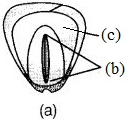
Identify the diagram ‘a’ along with the labelling b and c.
-
100%
a) (a) – Dicot seed, (b) – two cotyledons, (c) – Hypocotyls.
-
0%
b) (a) – Monocot seed, (b) – embryo, (c) – Scutellum.
-
0%
c) (a) – Monocot seed, (b) – embryo, (c) – Hypocotyls.
-
0%
d) (a) – Monocot seed, (b) – embryo, (c) – endosperm.
Q.40.
How many of the following plants have endospermous seeds? Gram, Maize, Brinjal, Castor, Groundnut, Tomato, Orchid, Cashew nut, Coconut, Moong.
-
0%
a) 3
-
100%
b) 4
-
0%
c) 5
-
0%
d) 6
Q.41.
Select the correct statements: (i) From the region of elongation, some epidermal cells form root hairs. (ii) Pneumatophores are seen in Rhizophora. (iii) Adventitious roots are seen in the banyan trees. (iv) Maize and sugarcane have prop roots.
-
0%
a) (i) and (iv).
-
0%
b) (i), (iii) and (iv).
-
0%
c) (iii) and (iv).
-
100%
d) (ii) and (iii).
Q.42.
In unilocular ovary with a single ovule, the placentation is:
-
0%
a) Marginal.
-
100%
b) Basal.
-
0%
c) Free central.
-
0%
d) Axile.
Q.43.
Prickles of rose are:
-
0%
a) Modified leaves.
-
0%
b) Modified stipules.
-
100%
c) Exogenous in origin.
-
0%
d) Endogenous in origin.
Q.44.
The character of flower which is represented by floral formula but not by floral diagram is
-
0%
a) aestivation
-
0%
b) placentation
-
100%
c) position of gynoecium
-
0%
d) adhesion of stamen
Q.45.
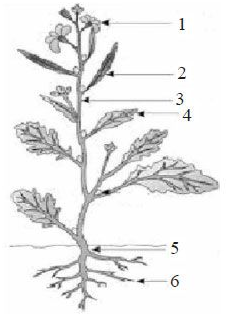
The given figure shows the parts of flowering plant. Which parts of the given figure were involved in the following functions?Storing reserve food materialSynthesis of plant growth regulators.Absorption of water and minerals from the soil.Providing a proper anchorage to the plant parts
-
100%
a) 5 and 6
-
0%
b) 1, 2 and 6
-
0%
c) 1, 2, 3 and 4
-
0%
d) 2, 4, 5 and 6
Q.46.
Matching column I with column II and choose the correct option.
| Column I | Column II |
| A. Coleorhiza | I. Grapes |
| B. Food storing tissue | II. Mango |
| C. Parthenocarpic fruit | III. Maize |
| D. Single seeded fruit developing from monocarpellary superior ovary | IV. Radicle |
| E. Membranous seed coat | V. Endosperm |
-
0%
a) A → III, B → I, C → IV, D → II, E → V
-
100%
b) A → IV, B → II, C → V, D → I, E → III
-
0%
c) A → V, B → I, C → III, D → IV, E → II
-
0%
d) A → IV, B → V, C → I, D → II, E → III
Q.47.
S: leaf to prepare food by carrying out photosynthesis R: Leaf to arrange gaseous exchange for respiration
-
0%
a) S and R both are true, where R is definition of S
-
100%
b) S and R both are true, where R is not reason of S
-
0%
c) S is true, R is false
-
0%
d) S is false , R is true
Q.48.
Root pockets present in root apex are seen in:
-
100%
a) Eichhornia.
-
0%
b) Maize.
-
0%
c) Wheat.
-
0%
d) Bean.
Q.49.
Pentamerous, actinomorphic flowers, Bicarpellary ovary with oblique septum and fruit of capsule or berry belongs to family:
-
0%
a) Lilliaceae.
-
0%
b) Brassicaceae.
-
100%
c) Solanaceae.
-
0%
d) Fabaceae.
Q.50.
In tetradynamous stamens:
-
0%
a) Two outer stamens are shorter and four inner stamens are longer.
-
100%
b) Four outer stamens are shorter and two inner stamens are longer.
-
0%
c) All stamens are equally long.
-
0%
d) None of the above.