Q.1.
Name the inflorescence lacking involucres of bracts:
-
67%
a) Cyathium.
-
33%
b) Capitulum.
-
0%
c) Umbel.
-
0%
d) Synconium.
Q.2.
Assertion: Cashew apple is a spurious fruit. Reason: Peduncle is fleshy and edible.
-
100%
a) Both Assertion and Reason are true and Reason is the correct explanation of Assertion.
-
0%
b) Both Assertion and Reason are true but Reason is NOT the correct explanation of Assertion.
-
0%
c) Assertion is true but Reason is false.
-
0%
d) Both Assertion and Reason are false.
Q.3.
In which of following, the plants have all roots?
-
50%
a) Podostemon
-
0%
b) Lemna
-
0%
c) Wolffia
-
50%
d) Utricularia
Q.4.
Roots are differentiated into adventitious roots by their:
-
0%
a) Function
-
0%
b) appearance
-
100%
c) place of origin
-
0%
d) position
Q.5.
Plants with jointed stem and hollow internodes are known as :
-
50%
a) Clums
-
50%
b) Scape
-
0%
c) Ephemerals
-
0%
d) Lianas
Q.6.
Tiny sacs or bladders are found in:
-
0%
a) Utriculariya
-
0%
b) salvinia
-
0%
c) nepenthes
-
100%
d) Hydrilla
Q.7.
Insectivorous plants catch insects for obtaining:
-
0%
a) Na - K
-
100%
b) Taste
-
0%
c) Phosphorus
-
0%
d) Nitrogen
Q.8.
Which of the following is not a term connected with seed?
-
100%
a) Unitegmic.
-
0%
b) Testa.
-
0%
c) Tegmen.
-
0%
d) Pappus.
Q.9.
Which of the following family exhibit scape?
-
0%
a) Solanaceae
-
100%
b) Lilliaceae.
-
0%
c) Fabaceae.
-
0%
d) Malvaceae
Q.10.
What is the common character for Solanaceae, Fabaceae and Lilliaceae?
-
0%
a) Alternate leaves.
-
0%
b) Compound leaves.
-
0%
c) Perfect flowers.
-
100%
d) Both (A) and (C).
Q.11.
In a Staminal tube, the fusing region is:
-
0%
a) Filaments.
-
0%
b) Anthers.
-
0%
c) Connective
-
100%
d) Both (B) and (C).
Q.12.
Assertion: Racemose inflorescence is monopodial. Reason: The main axis terminates in a flower and subsequent growth is by lateral buds.
-
100%
a) Both Assertion and Reason are true and Reason is the correct explanation of Assertion.
-
0%
b) Both Assertion and Reason are true but Reason is NOT the correct explanation of Assertion.
-
0%
c) Assertion is true but Reason is false.
-
0%
d) Both Assertion and Reason are false.
Q.13.
Petiole is modified into tendril in
-
0%
a) Passiflora
-
100%
b) Gloriosa
-
0%
c) Pisum
-
0%
d) clematis
Q.14.
What is the eye of potato ?
-
100%
a) Axillary bud
-
0%
b) Accessory bud
-
0%
c) Adventitious bud
-
0%
d) Apical bud
Q.15.
Zig-zag development of inflorescence axis is an example of:
-
0%
a) Helicoid cyme
-
0%
b) Scorpioid
-
0%
c)Umbel
-
100%
d) Compound umbel
Q.16.
Root pocket does not occur in : (Orrisa 2004)
-
100%
a) Ipomoea
-
0%
b) Mangrove plants
-
0%
c) trapa
-
0%
d) trapa
Q.17.
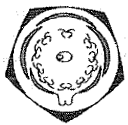
Which of the following is the correct floral formula for the floral diagram given below?
-
0%

-
0%

-
0%

-
100%

Q.18.
Match column - I, II and III and choose the correct option.
| Column - I | Column - II | Column - III |
| A. Marginal |  | p. Sunflower, Marigold |
| B. Axile |  | q. Dianthus, Primrose |
| C. Parietal |  | r. Mustard, Argemone |
| D. Free central |  | s. China rose. tomato |
| E Basal | | r. Pea |
-
0%
a) A - V, t; B - II, s; C -I, r; D -III, q; E -IV, p
-
100%
b) A - I, t; B - II, s; C - III, r; D - IV, p; E - V, q
-
0%
c) A - V, p; B - II, s; C - I, q; D - III, r; E - IV, t
-
0%
d) A - V, p; B - III, q; C - II, s; D - I, t; E - IV, r
Q.19.
The fleshy receptacle encloses a number of: (C.B.S.E. 2008)
-
100%
a) Berries
-
0%
b) achene
-
0%
c) Unisexual flower
-
0%
d) Samaras
Q.20.
What is the edible part of Mango?
-
0%
a) Epicarp
-
100%
b) Mesocarp
-
0%
c) Endocarp
-
0%
d) Thalamus
Q.21.
How many plants in the list given below have composite fruits that develop from an inflorescence? Walnut, poppy, radish, pineapple, apple, tomato, mulberry.
-
0%
a) Five
-
0%
b) Two
-
100%
c) Three
-
0%
d) Four
Q.22.
Parallel venation is a characteristic of :
-
0%
a) Legumes
-
0%
b) Grasses
-
100%
c) Parasitic plants
-
0%
d) Xerophytic plants
Q.23.
Beauty of Bougainvillea flower are: (AFMC, 1997)
-
0%
a) Corolla
-
100%
b) Calyx
-
0%
c) Bracts
-
0%
d) Androecium
Q.24.
Brinjal show ______ calyx.
-
0%
a) Pappus
-
0%
b) Deciduous
-
0%
c) Caduceus
-
100%
d) Persistent
Q.25.
An inflorescence always forms a : (Punjab PMT 1997 )
-
0%
a) Multiple or composite fruit
-
0%
b) Simple fruit
-
0%
c) Dry dehiscent fruit
-
100%
d) Aggregate fruit
Q.26.
Match the following with correct combination.
| Colum I | Colum II |
| (P) Marginal Placentation | I Petuna |
| (Q) Axial Placentation | II Dianthus |
| (R) Free central Placentation | III Mustard |
| (S) Parietal Placentation | IV Pea |
-
0%
a) (P)- II, (Q)- I, (R)-IV ,(S)-III
-
100%
b) (P)-III, (Q)-IV, (R)–II,(S)- I
-
0%
c) (P)- IV ,(Q) – I,(R)-II ,(S)-III
-
0%
d) (P)-IV ,(Q)– I, (R)-III,(S)- II
Q.27.
The storage roots formed in clusters from the base of the stem are called:
-
0%
a) Moniliform.
-
0%
b) Annulated.
-
100%
c) Nodulose.
-
0%
d) Fasciculated.
Q.28.
Which of the following represents the floral characters of lilliaceae?
-
100%
a) Six tepals, zygomorphic, six stamens, bilocular ovary, axile placentation.
-
0%
b) Actinomorphic, polyphyllous, unilocular ovary, axile placentation.
-
0%
c) Tricarpellary, actinomorphic, polyandrous, superior ovary, axile placentation.
-
0%
d) D Bisexual, zygomorphic, gamophyllous, inferior ovary, marginal placentation.
Q.29.
Replum is present in the ovary of the flower of:
-
100%
a) Sunflower.
-
0%
b) Mustard.
-
0%
c) Pea.
-
0%
d) Lemon.
Q.30.
Which of the following statements are correct about the leaf?Leaf is a lateral, generally flattened structure borne on the stem.It develops at the node and bears a bud in its axil.Leaves originate from root apical meristem and arranged in an acropetal order.They are the most important vegetative organs for reproduction.
-
0%
a) (i) and (ii)
-
0%
b) (ii) and (iii)
-
0%
c) (i), (ii) and (iv)
-
100%
d) all of these
Q.31.
The condition in which stamens are united throughout their whole length is:
-
100%
a) Synandrous.
-
0%
b) Syngenesious.
-
0%
c) Polyandrous.
-
0%
d) Adelphous.
Q.32.
Which of the following statement(s) is/are correct about calyx?
-
0%
a) Calyx is the outermost whorl of the flower and are called sepals.
-
0%
b) Sepals are green, leaf like and protect the flower in the bud stage.
-
0%
c) The calyx may be gamosepalous (sepals free) or polysepalous (sepals united).
-
100%
d) Both (a) and (b)
Q.33.
Alternate type of phyllotaxy is found in
-
0%
a) china rose
-
0%
b) mustard
-
0%
c) sunflower
-
100%
d) all of these
Q.34.
Prop roots of banyan tree are meant for
-
0%
a) respiration.
-
0%
b) absorption of water from soil.
-
0%
c) providing support to big tree.
-
100%
d) all of the above.
Q.35.
Inflorescence of Lilliaceae is
-
100%
a) actinomorphic
-
0%
b) Trimerous
-
0%
c) Pentamerous
-
0%
d) imperfect
Q.36.
Petals of a flower are arranged in such a way that each overlaps a petal on one side and is overlapped by other petal on the other side. This aestivation is:
-
100%
a) Valvate.
-
0%
b) Quincuncial.
-
0%
c) Imbricate.
-
0%
d) Twisted.
Q.37.
Common feature found in China rose, tomato and lemon:
-
0%
a) Monadelphous stamens.
-
0%
b) Epipetalous stamens.
-
0%
c) Polyadelphous stamens.
-
100%
d) Axile placentation.
Q.38.
Match the following correctly:
| a. Spike | Centella |
| b. Spadix | Colacasia |
| c. Capitulum | Adhatoda |
| d. Umbel | Salix |
| e. Catkin | Sunflower |
| f. Verticillaster | Ociumum |
-
0%
a) a= 2 ;b=4 c =5; d=6 ;e=1 ; f=3
-
100%
b) a= 3 ;b=2 c =5; d=1 ;e=4 ; f=3
-
0%
c) a= 5 ;b=2 c =3; d=1 ;e=6 ; f=4
-
0%
d) a= 4 ;b=3 c =6; d=1 ;e=2 ; f=5
Q.39.
Choose the mismatched one:
-
0%
a) Belladonna – Solanaceae.
-
0%
b) Gloriosa – Solanaceae.
-
100%
c) Asparagus – Lilliaceae.
-
0%
d) Tulip – Lilliaceae.
Q.40.
Find the incorrect match:
-
100%
a) Stilt roots – Sugarcane.
-
0%
b) Adventitious roots – Potato.
-
0%
c) Rhizome – Ginger.
-
0%
d) Sucker – pineapple.
Q.41.
With regard to the character given below, identify the family: Actinomorphic, bisexual flowers, Persistent calyx, United five petals, Valvate aestivation, epipetalous stamens, oblique orientation of ovary.
-
0%
a) Fabaceae.
-
0%
b) Brassicaceae.
-
0%
c) Solanaceae.
-
100%
d) Lilliaceae.
Q.42.
Main function of leaf is
-
100%
a) exchange of gases
-
0%
b) increase the beauty of a tree
-
0%
c) manufacturing of food
-
0%
d) nerve impulse induction
Q.43.
Which one of the following statement is not correct?
-
100%
a) Each stamen which represents the male reproductive organ consists of a stalk or a filament and an anther.
-
0%
b) An actinomorphic flower can be dissected into two equal halves from any plane.
-
0%
c) Superior ovary is found in hypogynous flowers.
-
0%
d) When stamens are attached to the petals, they are epiphyllous as in brinjal.
Q.44.
Pollen grains are produced within _________of stamen.
-
0%
a) ovary
-
0%
b) anther
-
100%
c) filament
-
0%
d) connective
Q.45.
Which of the following is a modified stem for the protection of plants from browsing animals?
-
100%
a) Tendrils
-
0%
b) Thorns
-
0%
c) Rhizome
-
0%
d) Tuber
Q.46.
Root hairs develop from
-
0%
a) region of maturation
-
0%
b) region of elongation
-
0%
c) region of meristematic activity
-
100%
d) root cap
Q.47.
Diadelphous condition occurs in:
-
0%
a) Potato.
-
0%
b) Sunflower.
-
100%
c) Pea.
-
0%
d) Mustard.
Q.48.
The picture showing is a:

-
0%
a) Simple opposite leaves.
-
0%
b) Simple alternate leaves.
-
100%
c) Pinnately compound leaves.
-
0%
d) Palmately compound leaves.
Q.49.
Which of the following sentences is wrong?
-
0%
a) Respiratory roots are present in mangrove plants.
-
0%
b) Modified leaf root are characteristics of aquatic pteridophytes Salvinia.
-
100%
c) Phylloclade is a modified aerial stem in Opuntia.
-
0%
d) Arrangement of accessory floral organs in relation to one another in floral bud is known as placentation.
Q.50.
The most interesting example of anemochory shown by coastal plant where ripe fruits and seeds are rolled like a ball miles away by incurved branches is
-
0%
a) Cocos.
-
0%
b) Salsola kali.
-
0%
c) Areca catechu.
-
100%
d) Nipa fruiticans