Q.1.
In which of the following, petals show valvate aestivation:
-
0%
a) China rose.
-
0%
b) Cassia.
-
0%
c) Mustard.
-
100%
d) Pea.
Q.2.
Pappus is the modification of:
-
0%
a) Bract.
-
0%
b) Corolla.
-
0%
c) Stamen.
-
0%
d) Calyx.
Q.3.
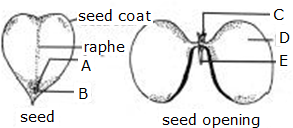
A - Which one of the option shows the correct labelling of the parts marked as A, B, C and D in a typical structure of dicotyledonous seeds?
-
0%
a) A - Hilum, B - Micropyle, C - Radicle, D - Cotyledon, E - Plumule
-
0%
b) A - Hilum, B - Micropyle, C - Plumule, D - Cotyledon, E - Radicle
-
0%
c) A - Micropyle, B - Hilum, C - Plumule, D - Cotyledon, E - Radicle
-
0%
d) A - Hilum, B - Micropyle, C - Plumule, D - Radicle, E – Cotyledon
Q.4.
The flower is the reproductive unit in the ___________ meant for ___________ reproduction.
-
0%
a) angiosperms and sexual
-
0%
b) gymnosperms and sexual
-
0%
c) algae and asexual
-
0%
d) pteridophytes and asexual
Q.5.
Roots develop from parts of the plant other than radicle are called
-
0%
a) tap roots
-
0%
b) fibrous roots
-
0%
c) adventitious roots
-
0%
d) nodular roots
Q.6.
Unifoliate leaf is found in: (BHU2002)
-
0%
a) Pea
-
0%
b) Citrus
-
0%
c) Royal palm
-
0%
d) Oil palm
Q.7.
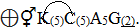
Select the floral formula of an actinomorphic, bisexual, hypogynous flower with five united sepals, five free petals, five free stamens and two united carpels with superior ovary:
-
0%
a) ⊕ ⚥ K(5) C5A5G(2).
-
0%
b) ⊕ ⚥ K(5) C5A5G(2)¯
-
0%
c) ⊕ ⚥ K2+2C4A2+4G(2).
-
0%
d)
Q.8.
Which among the following sentence is wrong about a hypogynous flower?
-
0%
a) The thalamus is dome/convex shaped, so ovary at the top of the thalamus, other whorls are starting below the gynoecium.
-
0%
b) The ovary is superior in position.
-
0%
c) Hypogynous condition more primitive than epigynous condition.
-
0%
d) Hypogynous flowers are found in the families: Fabaceae, Asteraceae and Rubiaceae.
Q.9.
Ginger, turmeric, Canna, water lily, some ferns and any aroids possess a prostate thickened stem with distinct nodes, internodes, buds and scale leaves, which creeps horizontally under the ground called:
-
0%
a) Stem tuber.
-
0%
b) Corm.
-
0%
c) Bulb.
-
0%
d) Rhizome.
Q.10.
The fruits and seeds which are sticky, have different types of outgrowths and are capable of undergoing
-
0%
a) Forced zoochory.
-
0%
b) Compensated zoochory
-
0%
c) Hydrochory
-
0%
d) Anemochory
Q.11.
Sessile and hermaphrodite flowers arranged in acropetal succession are found in:
-
0%
a) Spadix.
-
0%
b) Corymb.
-
0%
c) Spike.
-
0%
d) Raceme.
Q.12.
The fruit is chambered, developed from the inferior ovary and seed is within succulent testa in:
-
0%
a) Pomegranate.
-
0%
b) pineapple.
-
0%
c) Guava.
-
0%
d) Cucumber.
Q.13.
Find out the correctly matched pair regarding the placentation type and the example in which it is represented in:
-
0%
a) Marginal – Tomato.
-
0%
b) Axile – Pea.
-
0%
c) Parietal – Primrose.
-
0%
d) Basal – Marigold.
Q.14.
Which of the following statements are true regarding tendrils?
-
0%
a) They develop from axillary buds.
-
0%
b) Helps the plant to climb.
-
0%
c) They are slender and spirally coiled.
-
0%
d) All of these.
Q.15.
Verticillate leaves are seen in:
-
0%
a) Nerium.
-
0%
b) Calotropis.
-
0%
c) Ixora.
-
0%
d) Both (B) and (C).
Q.16.
Identify the type of phyllotaxy present in sunflower, guava and Alstonia:
-
0%
a) Opposite, alternate, whorled.
-
0%
b) Whorled, alternate, opposite.
-
0%
c) Alternate, whorled, opposite.
-
0%
d) Alternate, opposite, whorled.
Q.17.
Potatoes are borne on :
-
0%
a) Primary roots
-
0%
b) axil of scaly leaves
-
0%
c) Lateral roots
-
0%
d) Adventitious roots
Q.18.
Stem is very much reduced in:
-
0%
a) Tuber
-
0%
b) Bulb
-
0%
c) Corm
-
0%
d) Rhizome
Q.19.
Red root is name of:
-
0%
a) Carrot
-
0%
b) Sweet potato
-
0%
c) Potato
-
0%
d) Beet root
Q.20.
Smallest dicotyledonous parasitic plant of the world is: (JIPMER 1997)
-
0%
a) Coryadalis nana
-
0%
b) Primulaminutissina
-
0%
c) Arcethobiumminustissimum
-
0%
d) Marsilea minuta
Q.21.
Inflorescence is :
-
0%
a) Number of flower present on an axis
-
0%
b) Arrangement of flowers on an axis
-
0%
c) Method of the opening of flower
-
0%
d) Type of flower borne on peduncle
Q.22.
From the life cycle point of view the most important part of a plants is:
-
0%
a) Flower
-
0%
b) Leaf
-
0%
c) Stem
-
0%
d) Stem
Q.23.
Pappus is a modification of :
-
0%
a) Calyx
-
0%
b) Corolla
-
0%
c) Stamens
-
0%
d) Gynoecium
Q.24.
A phyllode is a modified: (Kerala CET 2004)
-
0%
a) leaf
-
0%
b) stem
-
0%
c) root
-
0%
d) branch
Q.25.
Tallest gymnosperm : (AFMC 2006)
-
0%
a) sequoia
-
0%
b) Eucalyptus
-
0%
c) Pinus
-
0%
d) Rannuncoulus
Q.26.
Which one of the following statements is correct? (A.I.P.M.T. 2011)
-
0%
a) In tomato ,fruit is capsule
-
0%
b) Seeds of orchids have oil –rich endosperm
-
0%
c) Placentation in primrose is basal
-
0%
d) Flower of tulip is a modified shoot.
Q.27.
Which one of the following is not fruit?
-
0%
a) Cabbage
-
0%
b) Apple
-
0%
c) Watermelon
-
0%
d) Tomato
Q.28.
What is the edible part in coconut?
-
0%
a) Entire seed
-
0%
b) Fruit wall
-
0%
c) Endosperm
-
0%
d) None of the above
Q.29.
Sessile flowers of only one sex are found in the inflorescence are called:
-
0%
a) Spadix.
-
0%
b) Catkin.
-
0%
c) Achene.
-
0%
d) Panicle.
Q.30.
Which one of the following structure is not associated with gynoecium?
-
0%
a) Ovary
-
0%
b) Style
-
0%
c) Stigma
-
0%
d) Filament
Q.31.
Which of the following plants is growing in swampy areas, where many roots come out of the ground and grow vertically upwards?
-
0%
a) Potato
-
0%
b) Opuntia
-
0%
c) Rhizophora
-
0%
d) Grass
Q.32.
Which of the following fruit is not matched with its edible part?
-
0%
a) Coconut – Endosperm.
-
0%
b) Pomegranate – Seeds.
-
0%
c) Apple – Ovary wall.
-
0%
d) Mulberry – inflorescence.
Q.33.
When stamens are fused by their anthers and the filaments are free, the condition is called:
-
0%
a) Monadelphous.
-
0%
b) Synandrous.
-
0%
c) Syngenesious.
-
0%
d) Epipetalous.
Q.34.
Imbricate aestivation is found in:
-
0%
a) Calotropis
-
0%
b) Cassia.
-
0%
c) Cotton.
-
0%
d) Lady’s finger.
Q.35.
Palmately compound leaves are found in:
-
0%
a) Neem.
-
0%
b) Acacia.
-
0%
c) Cassia.
-
0%
d) Silk cotton.
Q.36.
A scar on the seed coat through which the developing seeds attached to the fruit is called as ________.
-
0%
a) testa
-
0%
b) Tegmen
-
0%
c) Hilum
-
0%
d) Micropyle
Q.37.
Cladode' is a characteristic morphological feature of
-
0%
a) Asparagus and Ruscus
-
0%
b) Casuarina and Opuntia
-
0%
c) Cladophora and Cactus
-
0%
d) Citrus and Euphorbia
Q.38.
The distinct features of Fabaceae are:
-
0%
a) Diadelphous, zygomorphic and monocarpellary.
-
0%
b) Actinomorphic, monocarpellary and monadelphous.
-
0%
c) Zygomorphic, monocarpellary and monadelphous.
-
0%
d) Actinomorphic, monocarpellary and diadelphous.
Q.39.
A green leaf like modified aerial stems/branches with a single internode is called:
-
0%
a) Phyllode.
-
0%
b) Phylloclade.
-
0%
c) Cladode.
-
0%
d) Bulbils.
Q.40.
Identify the correct combination:
-
0%
a) Datura – Solanaceae – Epipetalous stamens.
-
0%
b) Allium – Solanaceae – tricarpellary gynoecium.
-
0%
c) Petunia – Solanaceae – Didynamous condition.
-
0%
d) Crotalaria – Fabaceae – Diadelphous stamen.
Q.41.
S: In caryopsis the pericarp and seed coat are fused and form a ‘hull’ R: Tridex and vernonia are example of caryopsis
-
0%
a) S and R both are true, where R is definition of S
-
0%
b) S and R both are true, where R is not reason of S
-
0%
c) S is true, R is false
-
0%
d) S is false , R is true
Q.42.
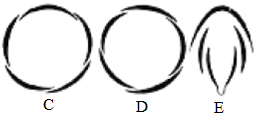
Choose correct option by giving diagram:
-
0%
a) C- vexillary, D- Quincuncial , E- Imbricate
-
0%
b) C- vexillary , D- Imbricate , E- Quincuncial,
-
0%
c) C-Imbricate , D-Quincuncial, E-vexillary
-
0%
d) C- Imbricate , D- vexillary , E-Quincuncial
Q.43.
Labeling ‘p’ in root section
-
0%
a) Velamen tissue
-
0%
b) Meristemaictissus
-
0%
c) Growth tissue
-
0%
d) Fleshy tissue
Q.44.
Match list I with II types of leaves
| List I | List II |
| (p) leaf included with in seed | I scaly leaf |
| (q) small or papery leaf | II bract |
| (r) stamen and Carpel | III seed leaf |
| (s) which a flower develops is | IV soprophylls |
-
0%
a) P= III; Q= I ; R= IV ; S= II
-
0%
b) P= I; Q= III ; R= II; S= IV
-
0%
c) P= III; Q= IV; R= I; S= II
-
0%
d) P= III; Q= II R= I S= IV
Q.45.
Which of the following pairs is not correct? (J & k, 2004)
-
0%
a) Corymb - Candytuft
-
0%
b) Capitulum - sunflower
-
0%
c) Catkin – Mulberry
-
0%
d) Raceme – Wheat
Q.46.
Geocarpic fruit is : (AIPMT 2002)
-
0%
a) Potato
-
0%
b) Pea nut
-
0%
c) Onion
-
0%
d) Garlic
Q.47.
The hairs present in maize corn cob are: (AIPMT,2000,2006)
-
0%
a) Styles
-
0%
b) Stigma
-
0%
c) Seed hairs
-
0%
d)Modified hairs of bracts
Q.48.
Flower in which only set of one essential organ develops are call: (Kerala,PMT,04)
-
0%
a) Unisexual
-
0%
b) Monoecious
-
0%
c) Dioecious
-
0%
d) Polygamous
Q.49.
When the stem or its branch ends into floral bus:
-
0%
a) Vegetative growth starts
-
0%
b) Reproductive growth starts
-
0%
c) Lateral branch is given out
-
0%
d) Apical growth is stimulated
Q.50.
_____ are the vegetative organs of the flowering plants:
-
0%
a) Root ,stem, flower
-
0%
b) Leaves ,stem, fruits
-
0%
c) Roots, leaves, flowers
-
0%
d) Roots, stem, leaves